





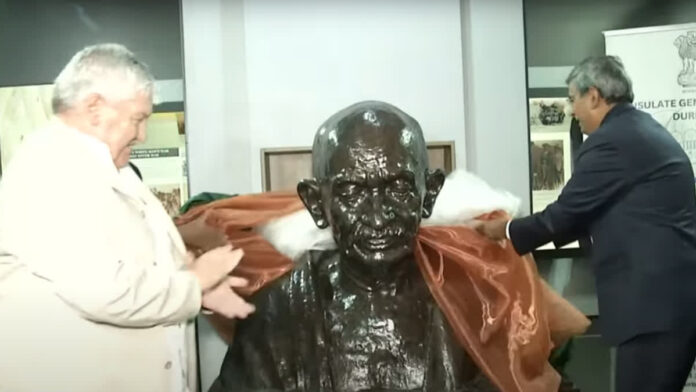

Historic Recognition of Indian Role in Anglo-Boer War Finally Comes to Light
Johannesburg |
In a powerful symbol of reconciliation and historical justice, a larger-than-life bronze bust of Mahatma Gandhi was unveiled at the Anglo-Boer War Museum in Bloemfontein, capital of South Africa’s Free State province — a region that, until 1994, had legally barred Indians under apartheid-era laws.
The sculpture, crafted by renowned Indian artist and Padma Bhushan awardee Ram V. Sutar, was donated by the Indian Council for Cultural Relations (ICCR). The unveiling ceremony on April 11 was led by Indian High Commissioner Prabhat Kumar, accompanied by the launch of a documentary and a book that illuminate the long-overlooked role of Indians in the Anglo-Boer War of 1899–1902.
Forgotten Histories: The Indian Footprint in South Africa’s War
The Free State — formerly known as the Orange Free State- had, for over a century, legally excluded Indians from residing or even travelling through the region. Indian migrants had to obtain special permits simply to pass through the province en route to Durban, where their ancestors first arrived as indentured sugarcane workers.
Now, with this statue and supporting literature, the province formally acknowledges Indian contributions and struggles during the war between the British colonial forces and the Boer republics.
“The painful story of Indian involvement in the war was never told — until now,” said Tokkie Pretorius, Director of the War Museum. “This project represents overdue recognition and will help foster reconciliation by acknowledging the full truth of South Africa’s history.”
The Book: Caught in the Crossfire
The newly released book — Caught in the Crossfire: Indian Involvement in the South African War — is a reprint of a monograph by the late Dr. T.G. Ramamurthi, highlighting:
-
The role of the British Indian Army in South Africa.
-
Contributions of South African Indians and Indian migrants.
-
Gandhi’s leadership in mobilizing Indian volunteers as stretcher-bearers.
-
The untold bias, segregation, and hardships Indians faced during the conflict.
“This narrative will change the way the world views India’s contribution to South Africa’s complex history,” said High Commissioner Prabhat Kumar, urging more research into the prisoner-of-war camps set up in India during the conflict.
This symbolic act is more than a statue, it’s a long-overdue recognition of India’s global historical presence, the pain of marginalization, and the resilience of a community whose story was left out for generations. In bringing these truths to light, South Africa and India reaffirm their commitment to truth, justice, and shared historical healing.