





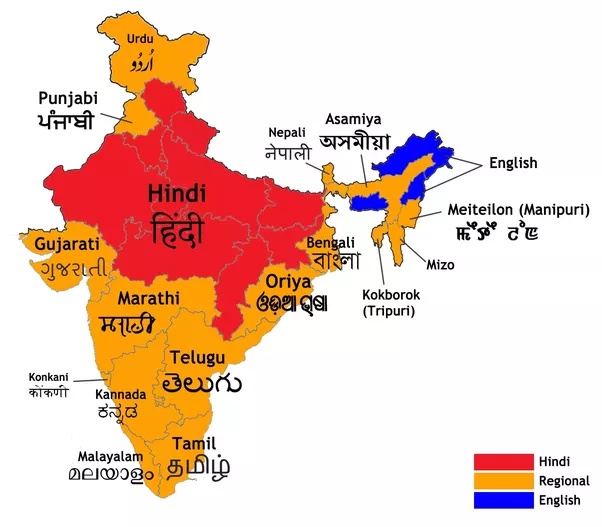

In a nation where every few miles the dialect changes, can one language ever define us all?
India speaks in many voices — 19,500 dialects, 121 major languages, and 22 officially recognised ones under the Constitution. Yet, despite this rich symphony, recent events in Maharashtra have reignited a long-standing debate: Does India have a language hierarchy? And if so, who decides which one sits on top?
📚 Maharashtra’s Language U-turn
The spark came in April 2025, when the Maharashtra government issued an order making Hindi mandatory as the third language in English and Marathi medium state board schools — aligning with the National Education Policy (NEP) 2020.
But the move triggered a sharp backlash.
Language activists, regional leaders, and concerned citizens accused the government of imposing Hindi and undermining Marathi identity. Bowing to the protests, the government withdrew the order and formed a review committee.
On July 4, a new resolution was passed:
-
Hindi would no longer be compulsory beyond Class 5.
-
Students can now choose any Indian language as the third language, provided at least 20 students opt for it.
-
If fewer than 20 students enroll, the subject will be taught online.
School Education Minister Deepak Kesarkar clarified the government’s stance:
“Hindi was already compulsory for Classes 5, 6, and 7. Now that compulsion is being removed from class 6 onwards. Hindi will be taught only at the primary level — to give students a basic grasp of the language, which is widely spoken across the country.”
Kesarkar also emphasized efforts to promote Marathi, citing achievements like granting classical language status, building Marathi Bhawan, launching a Marathi International Council, and a Marathi encyclopedia.
While the government tried to strike a balance, parents like Ashish Shah said,
“I want my child to know Marathi as we are living in the state. But if they eliminate Hindi, then it’s a tough spot for parents. I’ve met many students and teachers who can’t read Hindi. I don’t want my son to become the same.”
His concern highlights a larger issue — the fear that removing Hindi from the curriculum may disconnect students from national integration. While supporting the promotion of regional language and culture, many parents also worry about their children losing access to broader communication and opportunities across India.
A History of Resistance
The debate isn’t new. Tamil Nadu has been at the forefront of resisting Hindi imposition for decades — with anti-Hindi agitations dating back to the 1930s and flaring up again in the 1960s.

“I refer to this question of language imperialism. There are various forms of imperialism and language imperialism is one of the most powerful methods of propagating the imperialistic idea… This kind of intolerance makes us fear that the strong Centre which we need, a strong Centre which is necessary, will also mean the enslavement of people who do not speak the language of the legislature, the language of the Centre… My honourable friends in UP do not help us in any way by flogging their idea ‘Hindi Imperialism’ to the maximum extent possible. Sir, it is up to my friends in UP to have a whole-India; it is up to them to have a Hindi-India. The choice is theirs.” – TT Krishnamachari, Constituent Assembly Debate, November 5, 1948 ( source- The News minutes)
In April 2025, Tamil music legend A.R. Rahman stirred emotions on Tamil New Year by posting:
“Tamil is the most powerful language that evolves and grows in the world’s class languages.Especially, Tamil Sangas have played an important role in strengthening the language through studies and enriching it by making amendments. The stretch of our Tamil, which is not innovative, shows us the responsibility that we should carry to the next generation through meaningful communications. (sic)”
While celebrated in Tamil circles, his post triggered backlash from some Hindi-speaking netizens. Rahman later clarified:
“I was celebrating Tamil, not rejecting any other language. Every language has beauty, but Tamil is intrinsic to my identity.”
The exchange exposed a deeper anxiety — is celebrating one language automatically viewed as opposing another?
Celebrating a language shouldn’t be seen as a threat. But in Hindi vs. others debates, everything — including cultural pride — becomes political.
Language and Opportunity: A National Dilemma
The language row isn’t just about school curriculum. Earlier this year, the Railway Recruitment Board faced backlash when it announced exams would be conducted only in Hindi and English. States like Odisha and West Bengal protested, demanding options in Odia and Bengali.
Professor Ishwar Chandra from Gujarat framed the issue bluntly:
“It’s about access to education and opportunities. When exams are only in Hindi or English, it excludes a large segment of the country. That’s discrimination.”
In a multilingual nation, your language shouldn’t be a barrier to your livelihood.
The English Dilemma
Amid this tug-of-war, English remains the politically safe, elite language — a colonial legacy that now dominates metros, boardrooms, and top universities.
But not everyone is comfortable with it.
Krishna Mahawar, a language professor from Rajasthan, warns:
“English is politically safe but it divides society. It doesn’t bring uniformity but separates urban from rural, elite from common. People don’t protest English because it comes with opportunities.”
However, others argue that in today’s globalised world, English is no longer just a colonial tool — it’s a gateway.
Swati Shekhani, an English professor from Pune, offers a more nuanced view:
“Yes, English was introduced to maintain office records and administration, but its overuse today reflects global reality. Whether we like it or not, to stay in competition — be it in education, jobs, or research — our students must learn English. It’s not about replacing Indian languages, but about coexisting with them smartly.”
Together, their voices reflect the core dilemma: How do we embrace English for opportunity without letting it erode the dignity and utility of our native tongues?
Federalism of Tongues
India’s Constitution provides space for its diversity, with states allowed to choose their official languages and 22 languages recognized under the Eighth Schedule. Yet, tension arises when one language is subtly privileged over others.
As Dr. Ranjeet Kumar, Head of the Hindi Department at Delhi University, rightly puts it:
“India is a multilingual nation by design, not by accident. Linguistic federalism is key to our unity. Language cannot be imposed, it has to be embraced.”
Many Tongues, One Country
India’s strength lies not in one voice, but in its chorus.
The solution isn’t to pick a winner, but to honour every language’s space — in education, governance, and culture. A multilingual policy doesn’t create chaos; it creates cohesion. We must protect each language and not flatten them.
So the question remains: Whose language is India’s language?
The answer may never be one.
And perhaps, that’s exactly what makes India… India.