





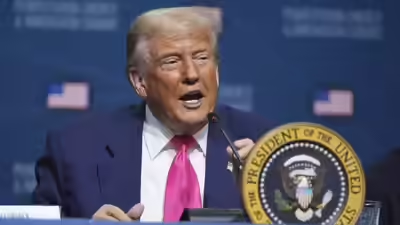

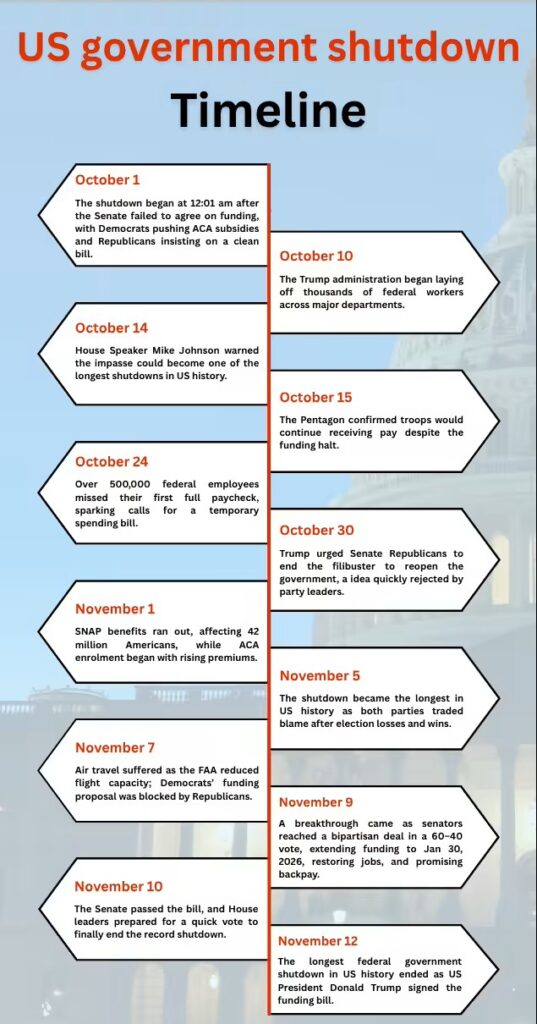
US President Donald Trump on Wednesday (local time) signed a government funding bill to officially end the record 43-day shutdown, which had created widespread financial stress for federal workers and caused major disruptions across the country.
The prolonged shutdown led to airport delays, flight cancellations due to staffing shortages, and long queues at food banks as federal assistance programs stalled.
Speaking after signing the bill, Trump said the country had “never been in better shape” and described the standoff with Democrats as a “short-term disaster,” while emphasizing it was “an honour” to sign the agreement and restore government operations.
Shutdown Ends, But Frustrations Remain
The historic shutdown ended with neither party fully satisfied Democrats failed to secure key healthcare demands, while Republicans and the White House faced public backlash despite holding a majority.
The funding bill, shaped by the Senate Appropriations Committee, ensures temporary support for crucial areas such as:
-
Food aid
-
Veterans’ programs
-
Legislative operations
However, the deal only extends most federal funding until January 30, giving Congress a narrow two-month period to agree on additional spending legislation.
Trump’s signature came just hours after the House passed the bill, following a Senate vote earlier in the week.
Widespread Fallout During Shutdown
The prolonged shutdown had severe consequences:
-
Thousands of federal workers went without paychecks.
-
Air travel services were strained due to staff shortages.
-
Food aid programs stalled, leading to long lines at community assistance centres.
-
Federal data reporting was disrupted, raising concerns that some economic indicators including employment and inflation figures for October may be permanently lost.
Republican Congressman David Schweikert compared the political gridlock to a “Seinfeld episode,” adding: “We just spent 40 days and I still don’t know what the plotline was.”
What Happens Next
Federal workers are expected to return to work as early as Thursday, but experts warn that the return to normalcy will be slow.
-
Air travel is likely to stabilise gradually ahead of the Thanksgiving travel rush.
-
Government data agencies will restart operations, though some information gaps may remain.
-
Nutrition assistance and social programs will resume once funds flow again.
Economists also point out deeper fiscal challenges: government debt continues to rise by roughly $1.8 trillion annually, while partisan disagreements over long-term spending persist as the next funding deadline approaches.