





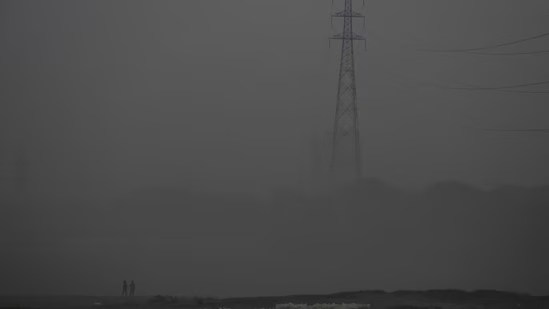

Delhi’s air has once again turned deadly. As smog thickens and air quality plunges to life-threatening levels, health experts and environmental agencies are sounding the alarm, calling the situation a “public health emergency.” Surveys show nearly 80% of Delhi-NCR households report at least one family member falling ill due to pollution over the past month a grim reflection of how toxic air has gripped the national capital.
1. No Respite for Delhiites
At 9 a.m. Friday, Delhi recorded an average Air Quality Index (AQI) of 370, marking the eighth consecutive day in the ‘very poor’ category, according to the Sameer App. The Central Pollution Control Board (CPCB) reported AQIs of 392 on Wednesday, 374 on Tuesday, and 351 on Monday, showing a sharp weekly deterioration.
2. 18 Stations Cross ‘Severe’ Mark
Over 18 air monitoring stations logged AQI readings above 400, categorised as ‘severe’. These included Chandni Chowk, Anand Vihar, Mundka, Bawana, Narela, DTU, and Wazirpur areas that consistently breach dangerous thresholds of 400–450.
3. Forecast: Worse Days Ahead
The Air Quality Early Warning System under the Ministry of Earth Sciences predicted that Delhi’s air will remain between ‘very poor’ and ‘severe’ for the next six days due to stagnant wind patterns and winter inversion, which trap pollutants near the surface.
4. Sources of Pollution
According to the IITM Decision Support System, vehicular emissions were the leading cause, contributing 17.3% of PM2.5 on Thursday, while stubble burning added 2.8%. Friday’s forecast showed slight dips to 16.2% and 1.8%, respectively. Experts said poor dispersion conditions amplify even minor emissions.
5. Farm Fires Add to the Problem
Satellite imagery revealed 16 farm fires in Punjab, 11 in Haryana, and 115 in Uttar Pradesh on Wednesday. Though relatively low in number, these fires continue to worsen background pollution under Delhi’s stagnant winter conditions.
6. Doctors Sound Alarm
Medical experts at AIIMS warned that Delhi has entered “medical emergency” territory, with a 10–15% spike in hospital admissions for respiratory and pollution-linked illnesses.
Dr. Anant Mohan, Head of Pulmonary Medicine at AIIMS, said:
“This is absolutely life-threatening. Pollution is damaging the heart, brain, lungs even mental health. We’re seeing more patients on ventilators, more children wheezing. This must be treated as a national health emergency.”
Dr. Saurabh Mittal, another senior pulmonologist, added:
“Delhi repeats the same mistake every year reacting in November instead of acting year-round. Sprinklers and street sprays are cosmetic fixes, not solutions.”
7. Masks Offer Only Partial Protection
Experts reiterated that masks and air purifiers provide “limited personal safety” and cannot substitute for structural reforms such as reducing emissions and implementing long-term clean energy transitions.
8. 80% Households Affected
A LocalCircles survey revealed that 8 in 10 households in Delhi-NCR have had at least one member sick due to pollution this month.
-
36% households reported four or more members facing respiratory or pollution-linked issues.
-
Common symptoms include persistent cough, burning eyes, asthma aggravation, and headaches.
9. Supreme Court Steps In
The Supreme Court has intervened, urging authorities to defer outdoor school sports and monitor air quality measures monthly. The bench said making children train outdoors now was “like forcing them to exercise in gas chambers.” It also instructed states to strictly enforce stubble burning controls and compliance with the CAQM’s guidelines.
10. Public Anger Grows
Frustrated residents including children and parents have taken to India Gate and Jantar Mantar, demanding urgent government action. Protesters say that despite Graded Response Action Plan (GRAP) restrictions, enforcement remains lax, while political blame games continue.
“We’ve worn masks, stayed indoors, missed work yet every winter we breathe poison,” said one protester at India Gate.
A Crisis That Returns Every Winter
While Delhi has long battled its winter smog, this year’s air quality has fallen faster than expected. Experts warn that without year-round interventions in transport, industry, waste, and agriculture, such emergencies will only grow deadlier.
“Clean air is not a seasonal privilege it’s a constitutional right,” said one environmental activist at the protest.