





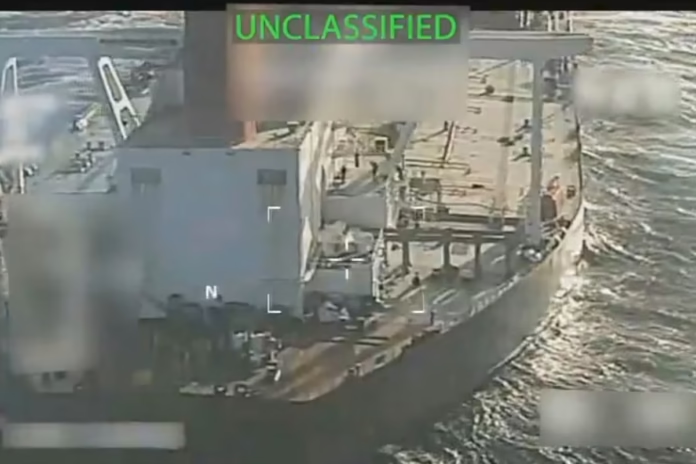

The Trump administration’s seizure of an oil tanker off the Venezuelan coast marks one of the most dramatic escalations yet in Washington’s pressure campaign against President Nicolás Maduro.
US Coast Guard personnel, backed by the Navy and federal law-enforcement agencies, boarded and seized the vessel Skipper in international waters. The tanker was allegedly transporting Venezuelan crude oil and had a US federal warrant against it due to suspected ties with Iran-backed terror networks.
A video released by Attorney General Pam Bondi showed US forces rappelling onto the tanker from a helicopter a highly choreographed moment that President Trump publicly celebrated, calling it “the largest tanker ever seized.”
A New Front in Trump’s Pressure Campaign
While not directly tied to the current standoff with Maduro, the seizure is seen as part of a broader US strategy that includes:
-
A large US naval deployment in the Caribbean
-
Strikes on more than 20 boats Washington claims were used by drug traffickers
-
Repeated warnings from Trump that military strikes on Venezuelan soil could follow
US officials argue these actions are aimed at squeezing Maduro’s financial and political networks. Critics, however, see an unpredictable escalation with unclear legal boundaries.
Legal and Human Rights Concerns Intensify
A major point of contention is a series of US strikes on alleged drug-trafficking boats in the Caribbean and Pacific. These attacks have killed at least 87 people, and one strike on September 2 sparked outrage for allegedly killing survivors in a second attack a move Democrats and rights groups say could amount to a war crime.
Lawmakers are pushing Defense Secretary Pete Hegseth to release video of the strike. Trump initially appeared open to the idea but later denied making that comment.
US Power and the Stakes in Venezuela
The US naval buildup, which includes the aircraft carrier USS Gerald R. Ford, raises the symbolic and geopolitical stakes. Any outcome that leaves Maduro in power could be viewed as a failure for Trump.
Millions of Venezuelans continue to face economic collapse, political repression, and mass migration making Maduro’s departure widely desired among the diaspora and opposition groups.
Yet questions persist about Trump’s strategy:
-
Is regime change the real aim?
-
Would the US intervene militarily?
-
Is Trump acting within constitutional limits?
Even Trump’s own statements have been contradictory, ranging from threats of military action to vague assurances that he wants Venezuelans to be “treated well.”
Opposition Momentum and New Pressure Points
Adding to the drama, opposition leader María Corina Machado, long targeted by the Maduro regime, surfaced in Oslo to attend the Nobel Peace Prize ceremony. Her appearance undermined Maduro’s attempts to isolate her and gives the US another opportunity to amplify her cause.
Why the Tanker Seizure Matters
According to US officials, the operation was lawful, based on a court-issued warrant. Analysts say it sends a clear warning to:
-
Tanker operators moving sanctioned Venezuelan or Iranian oil
-
The “shadow fleet” that helps Maduro evade sanctions
Venezuela’s government condemned the seizure, arguing the US is seeking control of its natural resources. “This has always been about our oil,” a government statement said.
Experts note that such interdictions are not unusual the difference now is the scale of US military presence enabling them.
Concerns on Capitol Hill: Are the US and Venezuela Closer to War?
Members of Congress are alarmed by the escalation.
Rep. Chrissy Houlahan warned that rappelling troops onto a foreign-flagged civilian vessel is “undeniably escalatory.” She added that if Trump seeks regime change, he must obtain authorization from Congress.
Senate Minority Leader Chuck Schumer criticized Trump’s erratic messaging:
“You don’t know what he is talking about from one moment to the next.”
An Unpredictable Path Forward
Trump’s second-term foreign policy remains opaque and deeply personal. There has been no clear explanation of why large numbers of US troops are deployed off Venezuela’s coast or what the administration expects to achieve.
If Maduro falls and a democratic transition takes hold, Trump could claim a major geopolitical victory and a restored American influence in the Western Hemisphere. If not, the US risks appearing overextended and unclear in purpose.
For now, the seizure of the Skipper tightens the pressure on Maduro and pushes Trump further down a path that increasingly resembles a march toward confrontation one in which he has invested significant personal and political capital.