





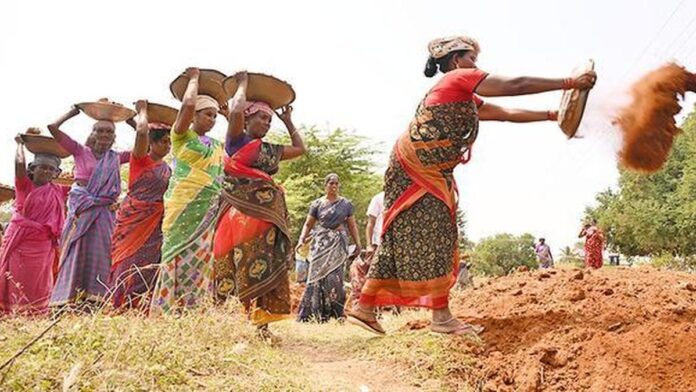

The proposed ‘Viksit Bharat Guarantee for Rozgar and Ajeevika Mission (Gramin)’ seeks to expand guaranteed workdays but significantly alters funding responsibilities and the demand-driven nature of rural employment support.
The Union government is preparing to introduce a new rural employment legislation the Viksit Bharat Guarantee for Rozgar and Ajeevika Mission (Gramin) during the ongoing Winter Session of Parliament, marking a major policy shift away from the Mahatma Gandhi National Rural Employment Guarantee Act (MGNREGA), 2005.
The proposed law, circulated among Members of Parliament on Monday, aims to replace MGNREGA with a framework aligned to the government’s long-term vision of “Viksit Bharat @2047.” While the Bill increases the guaranteed number of workdays for rural households from 100 to 125, it also introduces substantial changes to funding structures, implementation mechanisms, and the legal character of rural employment guarantees.
The legislation is officially shortened to VB-G-RAM-G, according to documents shared with parliamentarians.
Key Shift in Funding Responsibility
One of the most consequential changes proposed in the new Bill relates to cost-sharing between the Centre and states.
Under the existing MGNREGA framework, the Central government bears the full cost of wages, while states are responsible for a portion of material costs and administrative expenses. This structure has been central to ensuring timely wage payments and uniform implementation across states.
However, Section 22 of the new Bill alters this arrangement by requiring states excluding those in the Northeast, Himalayan regions, and three Union Territories to bear 40% of the total expenditure under the scheme.
This shift is expected to significantly increase the financial burden on states, particularly those with high rural employment demand and limited fiscal capacity.
From Demand-Driven to Allocation-Based
Another major departure from MGNREGA lies in how employment demand will be handled.
MGNREGA is a rights-based, demand-driven programme, under which rural households can legally demand work, obligating the government to provide employment or pay unemployment allowance. Budget allocations under MGNREGA have historically been adjusted based on demand.
The new Bill, however, replaces this system with fixed allocations determined by the Centre.
According to Section 4(5), the Central government will determine state-wise normative allocations for each financial year, based on parameters it prescribes. This effectively caps spending and removes the flexibility to respond to fluctuating rural employment needs.
Greater Central Control Over Implementation
In addition to setting budgets, the Centre will also have expanded authority over where and how the scheme operates.
Section 5(1) empowers the Union government to notify specific rural areas within states where the programme will be implemented. This represents a shift away from the universal, village-level access that characterised MGNREGA.
Critics argue that such provisions centralise decision-making and reduce the role of local governments and community institutions that were integral to MGNREGA’s design.
Pause During Agricultural Seasons
The Bill also introduces a provision allowing the programme to be paused during peak agricultural seasons to “facilitate availability of labour.”
While the government frames this as a measure to support agriculture, labour groups warn it could undermine income security for landless workers who depend on public employment during lean periods.
Technology Measures Made Statutory
Several technological practices introduced administratively under MGNREGA including mobile app-based attendance, Aadhaar-linked payments, and geotagging of worksites have now been formally codified into law under the new Bill.
While the government argues these measures improve transparency and efficiency, activists have repeatedly flagged issues related to exclusion, delayed payments, and technological failures affecting vulnerable workers.
Government’s Rationale for Change
In its Statement of Objects and Reasons, the government contends that MGNREGA no longer reflects the realities of rural India.
It cites improvements in rural connectivity, housing, electrification, digital access, financial inclusion, and diversification of livelihoods as evidence of “significant socio-economic transformation.” The Bill emphasises goals such as better incomes, growth-oriented infrastructure, sustainable livelihoods, and climate resilience.
According to the government, the new framework is intended to support evolving rural aspirations while aligning with national development priorities.
Criticism From Rights Activists
The proposal has drawn sharp criticism from activists and policy experts associated with MGNREGA’s original design.
Nikhil Dey, founder member of the Mazdoor Kisan Shakti Sangathan (MKSS) and one of the architects of MGNREGA, described the move as a retreat from a hard-won rights-based framework.
“This marks the end of the right to work in India,” Mr. Dey said, arguing that the Bill dismantles MGNREGA’s core architecture and replaces it with an allocation-based scheme dominated by central control. He also warned that shifting financial responsibility to states would be impractical and inequitable.
As the Bill awaits parliamentary debate, it is expected to trigger intense discussion over the future of rural employment, federal fiscal responsibility, and the role of rights-based welfare legislation in India’s development trajectory.