





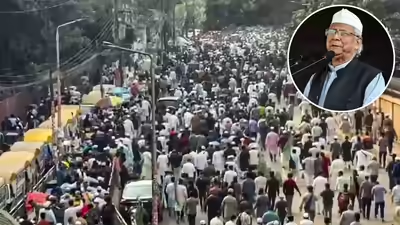

Relations between India and Bangladesh have entered a period of acute strain following weeks of political unrest, targeted violence, and diplomatic friction that have unsettled the region. The crisis intensified after the killing of prominent youth leader Sharif Osman Hadi in Dhaka and the lynching of a Hindu worker in northern Bangladesh, events that triggered nationwide protests and raised alarm in New Delhi over minority safety and the security of diplomatic missions.
The unrest has unfolded under Bangladesh’s interim government, led by Chief Adviser Muhammad Yunus, which took charge after the fall of former Prime Minister Sheikh Hasina’s administration earlier this year. As tensions rise on the streets, they have also spilled into bilateral diplomacy, with both India and Bangladesh summoning envoys, suspending visa services, and trading sharp public statements.
Violence Sparks Nationwide Protests
The immediate trigger for the latest wave of unrest was the shooting of Sharif Osman Hadi on December 12 in Dhaka’s Bijoynagar area. Hadi, a spokesperson for the Inqilab Moncho platform and a key figure in last year’s July uprising, was shot at close range by unidentified assailants. His condition deteriorated rapidly, and he was airlifted to Singapore on December 15. He died three days later, on December 18.
Hadi’s death sparked widespread protests across Bangladesh. Demonstrators accused authorities of failing to act against growing lawlessness and demanded swift justice. The anger soon took a political turn, with protests reviving strong anti-India sentiment in several cities.
Tensions deepened further after Dipu Chandra Das, a Hindu factory worker in Mymensingh, was lynched by a mob following allegations of religious defamation. Minority rights groups described the killing as part of a broader pattern of attacks against religious minorities and official inaction. Protests by civil society groups followed, including demonstrations outside the National Press Club in Dhaka.
Attacks on Media and Growing Fear
As protests spread, violence extended to Bangladesh’s media houses. Mobs attacked the offices of leading outlets such as Prothom Alo and The Daily Star. Prothom Alo was forced to suspend its print edition for the first time in its 27-year history.
The interim government condemned the attacks, calling them assaults on press freedom. Authorities said they had identified 31 suspects through video footage and made several arrests. Despite these assurances, critics argue that the damage to Bangladesh’s democratic image has already been done.
Concerns escalated further when another youth leader, Motaleb Shikder, was shot in the head in Khulna days after Hadi’s death. Police launched a manhunt but said they remained unsure about the motive or perpetrators. The incident reinforced fears that a coordinated campaign was targeting figures linked to last year’s protests.
Diplomatic Fallout With India
India has reacted with increasing concern. New Delhi has repeatedly raised issues related to minority safety and the security of Indian diplomatic missions in Bangladesh. Following protests outside Indian missions and reports of extremist threats, India summoned Bangladesh’s envoy to convey its concerns.
The Ministry of External Affairs urged Dhaka to bring those responsible for Dipu Chandra Das’s lynching to justice and emphasised that India remains vigilant about the protection of minorities. New Delhi also rejected what it called “misleading narratives” emerging from Bangladesh regarding security breaches at Bangladeshi diplomatic premises in India, saying protests there were brief and controlled.
Bangladesh, for its part, suspended visa services at its High Commission in New Delhi and missions in Tripura and Siliguri, citing unavoidable circumstances. India had earlier suspended visa services at its Chittagong mission after protesters attempted to storm the compound.
Bangladesh’s interim government has indicated it may review the scale of its diplomatic presence in India if the situation worsens. Foreign Affairs Adviser M Touhid Hossain dismissed Indian statements as oversimplified and rejected India’s press note, saying the situation was far more complex than portrayed.
US Engagement and Election Promises
Amid the turmoil, the United States has stepped in diplomatically. Muhammad Yunus held a half-hour phone call with US Special Envoy for South and Central Asia Sergio Gor, during which they discussed recent developments in Bangladesh. Yunus reiterated his commitment to holding general elections on February 12, describing them as essential to restoring democratic legitimacy.
The US said the discussion focused on stability and shared interests, including prosperity through trade. However, Yunus also warned that supporters of the ousted Awami League regime were allegedly attempting to sabotage the electoral process using money and external influence.
Sheikh Hasina Blames Interim Government
From exile in India, Sheikh Hasina has launched a fierce critique of the interim government. She accused Yunus of empowering extremists, failing to protect minorities, and undermining relations with India. Hasina argued that lawlessness has worsened since her removal and that Bangladesh’s international credibility now stands at risk.
She claimed radical groups were exploiting the interim leadership to reshape foreign policy without a mandate. According to her, ties with India would normalise only after legitimate governance returns.
A Region on Edge
The unfolding crisis has placed Bangladesh at a critical crossroads. With elections approaching, rising political violence, and strained relations with India, the coming weeks will test the interim government’s ability to restore order and credibility.
For India, the situation poses a delicate challenge: safeguarding diplomatic interests and minority rights while supporting stability in a neighbouring country that plays a key role in regional security and connectivity.
As protests continue and diplomacy remains tense, the future of India–Bangladesh relations now hinges on whether Bangladesh can contain violence, ensure fair elections, and restore confidence both at home and abroad.