





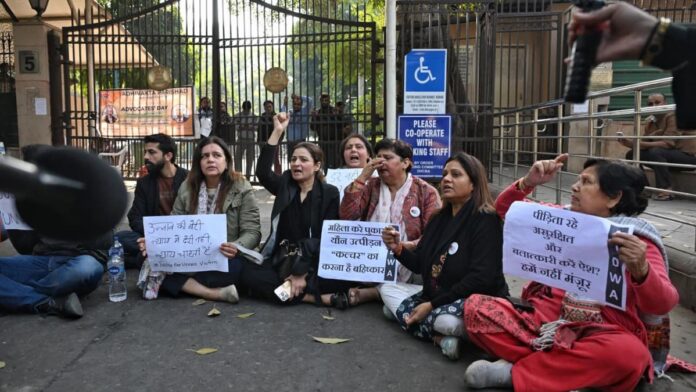

Protests erupted outside the Delhi High Court on Friday following its decision to grant conditional bail to expelled Bharatiya Janata Party (BJP) leader Kuldeep Singh Sengar in the Unnao rape case. Demonstrators gathered near the court premises, raising slogans and expressing strong opposition to the suspension of Sengar’s jail sentence, which has triggered widespread outrage among women’s rights groups and the survivor’s family.
The protest came amid deep concern expressed by the Unnao rape survivor and her relatives, who said the bail order had left them feeling unsafe and betrayed by the justice system. Speaking to Hindustan Times, the survivor said she felt “extremely upset” after learning about the court’s decision and feared for her safety due to Sengar’s release, even though the bail was granted with conditions.
Security personnel were deployed outside the court to manage the situation as protesters demanded the immediate revocation of the bail order. Visuals shared by news agencies showed police officials warning demonstrators to disperse within five minutes, stating that legal action would follow if the protest continued.
The survivor’s mother voiced her anguish and anger while speaking to ANI. She strongly criticised the High Court’s decision and demanded harsher punishment for those convicted in the case. “His bail should be rejected. We will approach the Supreme Court. We have lost faith in the High Court,” she said. She further added that if justice was not delivered by the apex court, the family would explore all possible legal options. Calling for the strictest punishment, she said, “The person guilty of my husband’s murder should be hanged.”
The Unnao rape case, which shook the country, involves multiple allegations against Sengar, including rape and the murder of the survivor’s father. The case has remained a symbol of the struggle faced by survivors seeking justice against politically powerful individuals. Although Sengar was convicted and sentenced to life imprisonment, the High Court’s recent decision to grant conditional bail has reopened wounds for the victim’s family.
Women’s rights activist Yogita Bhayana, who participated in the protest, said the court’s order had deeply hurt women across the country. “A rapist’s sentence has been overturned by the same court that once delivered justice. We have come here to demand accountability from the institution where this injustice occurred,” she said, according to ANI.
Several protesters questioned the legal basis on which bail was granted. One demonstrator told ANI, “On what grounds was Kuldeep Sengar given bail when he was convicted of rape and murder? If a life sentence was awarded, why is he out now? Women will never feel safe if such people walk free.”
The bail order has also sparked a larger debate on judicial accountability and the protection of survivors after convictions. Activists argue that conditional bail in cases involving severe crimes sends a dangerous signal and may discourage survivors from pursuing legal action.
Legal experts have noted that while courts have the authority to grant bail under specific circumstances, such decisions must carefully weigh public safety, victim protection, and the severity of the crime. In high-profile cases like Unnao, even procedural decisions can carry far-reaching social consequences.
The survivor’s family has indicated that they will challenge the bail order in the Supreme Court. They have also sought enhanced security, citing fears of intimidation and retaliation. Police officials have not yet commented on whether additional protection will be provided.
As the protest concluded under police supervision, demonstrators vowed to continue their fight through legal and democratic means. Women’s groups announced plans for nationwide campaigns to oppose what they describe as leniency towards convicted offenders.
The Unnao rape case remains a defining moment in India’s discourse on sexual violence, political influence, and justice delivery. For the survivor and her family, the bail order has reignited trauma and uncertainty. For many others, it has raised uncomfortable questions about whether justice truly ends with a conviction or if the struggle continues long after a verdict is delivered.