





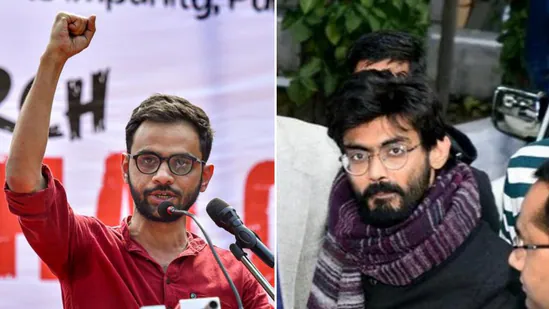

The Supreme Court of India is expected to pronounce its verdict on Monday, January 5, on bail pleas filed by student activists Umar Khalid and Sharjeel Imam, along with five other accused, in the alleged “larger conspiracy” case linked to the 2020 Delhi riots. The ruling is being closely watched as it may significantly shape bail jurisprudence under the stringent Unlawful Activities (Prevention) Act (UAPA).
A bench comprising Justices Aravind Kumar and N. V. Anjaria had reserved its judgment on December 10 after hearing extensive arguments from the defence and the Delhi Police. Lawyers present during the hearing said the court repeatedly questioned the prosecution on whether the material placed on record met the legal threshold for a “terrorist act” under the UAPA.
Years of Incarceration Without Trial Conclusion
Umar Khalid has been in judicial custody since September 13, 2020, while Sharjeel Imam was arrested on January 28, 2020, weeks before communal violence broke out in northeast Delhi. Both have spent more than five years in prison, with the trial yet to conclude.
The prolonged pretrial detention emerged as a central issue during the hearings. Counsel for the accused argued that the right to personal liberty under Article 21 of the Constitution had been severely compromised due to repeated delays. They submitted that the prosecution’s approach of arresting accused persons in phases had the effect of indefinitely prolonging the alleged conspiracy and postponing trial timelines.
Senior lawyers appearing for the accused contended that bail jurisprudence cannot be suspended merely because charges are framed under a special statute, particularly when the evidence does not directly link the accused to acts of violence.
Background of the 2020 Delhi Riots Case
The Delhi riots erupted in February 2020 following weeks of protests against the Citizenship (Amendment) Act (CAA). Violence spread across parts of northeast Delhi over several days, leaving at least 53 people dead and hundreds injured. Homes, shops, religious structures, and public property suffered extensive damage.
Following the violence, the Delhi Police described the riots as the outcome of a premeditated conspiracy and arrested several activists, students, and intellectuals under the UAPA. The law imposes stringent conditions on bail, requiring courts to deny release if the accusations appear “prima facie true.”
Khalid and Imam were among the most prominent individuals named in the alleged conspiracy case.
Allegations Against Sharjeel Imam
The prosecution has relied heavily on speeches delivered by Sharjeel Imam during anti-CAA protests. One video clip cited by investigators allegedly shows Imam speaking about blocking the “chicken neck” corridor to disrupt connectivity between the northeast and the rest of India. Another speech refers to a proposed “chakka jam” to disrupt supplies to Delhi.
The defence strongly disputed these claims. Lawyers for Imam told the court that the speeches constituted political dissent and protest, not incitement to violence or terrorism. They argued that the police selectively extracted short clips from longer speeches, stripping them of context to create an impression of criminal intent.
During the hearing, the bench sought clarity on whether such speeches, in the absence of any direct call to violence or operational planning, could fall within the ambit of a terrorist act.
Prosecution’s Stand on Umar Khalid
Opposing bail for Khalid, Additional Solicitor General S. V. Raju referred to Khalid’s past activities, including his alleged involvement in a controversial 2016 Jawaharlal Nehru University (JNU) protest. The prosecution argued that these earlier events formed part of the supplementary chargesheet filed in November 2020 and reflected a pattern of conduct.
The defence countered that reliance on past allegations and unrelated FIRs amounted to prejudicial profiling. Khalid’s lawyers argued that the case against him rested largely on WhatsApp messages and public speeches that did not advocate violence. They submitted that criminalising dissent would have chilling consequences for democratic expression.
Court Examines UAPA’s Terror Clause
A significant portion of the December 10 hearing focused on the interpretation of Section 15 of the UAPA, which defines a terrorist act. According to lawyers present in court, the bench repeatedly asked whether protest mobilisation, without a clear nexus to violence, could meet the statutory threshold.
The judges also questioned whether the prosecution had produced evidence demonstrating coordination, financing, or execution of violent acts, as opposed to ideological opposition to government policy.
Other Accused and High Court Findings
The Supreme Court’s verdict will also cover bail pleas filed by Gulfisha Fatima, Meeran Haider, Shifa ur Rehman, Mohd Saleem Khan, and Shadab Ahmed. In September 2025, the Delhi High Court denied bail to all nine accused, describing Khalid and Imam as “intellectual architects” of the violence.
The accused challenged that finding before the apex court, arguing that the High Court relied on conjecture rather than concrete evidence establishing their role in riots.
International Attention and Wider Implications
The case has attracted international attention, with public figures abroad raising concerns over prolonged detention without trial. Supporters argue that the outcome could redefine safeguards for undertrials booked under anti-terror laws.
As the Supreme Court prepares to pronounce its verdict, legal experts say the ruling could have far-reaching consequences for how courts balance national security concerns with civil liberties, particularly in cases involving speech, protest, and prolonged incarceration.
The court has not indicated the precise timing or contents of the judgment. However, the decision is expected to resonate far beyond this case, shaping the future contours of bail law under the UAPA.