





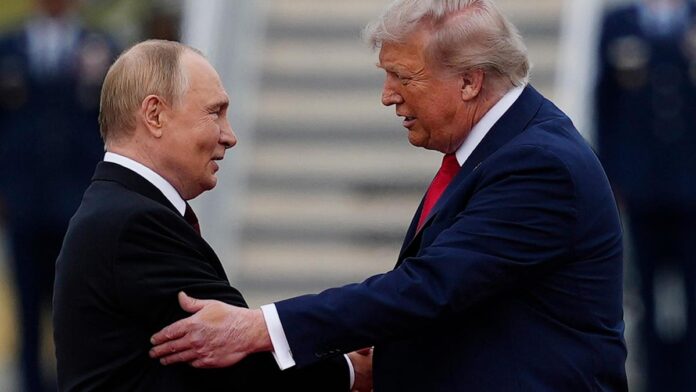

U.S. President Donald Trump on Thursday called for a “new, improved and modernised” nuclear arms control treaty following the expiration of New START, the last remaining agreement limiting the nuclear arsenals of the United States and Russia. The treaty’s lapse has raised alarm among arms control experts and world leaders, who warn of a dangerous slide toward unconstrained nuclear competition.
New START, signed in 2010 under President Barack Obama and later extended by President Joe Biden, formally expired on February 4, 2026, removing caps on deployed strategic nuclear warheads held by the world’s two largest nuclear powers.
Within hours of the treaty’s expiration, Trump criticised the agreement, calling it “badly negotiated” and claiming it had been “grossly violated.”
“We should have our Nuclear Experts work on a new, improved, and modernized Treaty that can last long into the future,” Trump wrote on his Truth Social platform.
No Interim Restraints in Place
Asked whether Washington and Moscow had agreed informally to continue observing New START’s limits while negotiations for a new treaty proceed, White House spokesperson Karoline Leavitt said no such understanding exists.
“Not to my knowledge,” she said.
Russia has already indicated it no longer considers itself bound by the treaty’s restrictions. On Wednesday, Moscow formally stated that with New START expired, it is no longer obligated to limit the number of nuclear warheads in its arsenal.
Russia had earlier suspended participation in inspections under the treaty as relations with Washington deteriorated during the Biden administration.
Trump Pushes Broader Treaty Including China
The Trump administration has repeatedly argued that any future arms control framework must include China, whose nuclear arsenal is expanding rapidly, though it remains far smaller than those of the U.S. and Russia.
Secretary of State Marco Rubio said on Wednesday that meaningful arms control was “impossible” without Beijing’s participation.
China, however, rejected the pressure. On Thursday, the Chinese Foreign Ministry expressed regret over the demise of New START but ruled out joining disarmament talks at this stage.
“China’s nuclear capabilities are of a totally different scale compared to those of the United States and Russia,” Foreign Ministry spokesperson Lin Jian said.
According to the Stockholm International Peace Research Institute (SIPRI), China possesses at least 600 nuclear warheads, compared to roughly 800 each held by the U.S. and Russia under New START limits. China’s arsenal has been growing by around 100 warheads per year since 2023.
Together, the U.S. and Russia still control more than 80 per cent of the world’s nuclear weapons.
Renewed U.S.–Russia Engagement Amid Arms Control Vacuum
Despite the collapse of New START, Trump has moved swiftly to reopen diplomatic channels with Moscow. He invited Russian President Vladimir Putin to Alaska last August, signalling a reset in bilateral engagement.
On Thursday, the U.S. announced it had resumed military-to-military dialogue with Russia following three-way talks in Abu Dhabi focused on the Ukraine war.
However, critics say renewed diplomacy without binding arms control measures risks normalising nuclear expansion rather than containing it.
Global Warnings of an Arms Race
Arms control advocates have warned that the end of New START could usher in a destabilising era with no transparency, inspections, or numerical limits on nuclear weapons.
A group of former senior arms control officials from multiple countries issued a joint statement urging Washington and Moscow to voluntarily continue observing New START’s limits as an interim confidence-building step.
“The end of New START will reduce nuclear stability and predictability, threaten global security, and increase the risk of a new era of unconstrained nuclear competition,” the statement said.
United Nations Secretary-General Antonio Guterres described the moment as a “grave turning point.”
“This dissolution of decades of achievement could not come at a worse time,” Guterres said, warning that the risk of nuclear weapons use is now “the highest in decades,” particularly following Russia’s earlier suggestions of using tactical nuclear weapons during the Ukraine conflict.
A NATO official, speaking on condition of anonymity, called for “restraint and responsibility,” while condemning what the alliance described as “Russia’s irresponsible nuclear rhetoric.”
Experts Question China Strategy
While many analysts agree that China should eventually be part of arms control discussions, some question whether the Trump administration has laid the groundwork for such engagement.
“There is no indication that President Trump or his team have proposed meaningful risk-reduction or arms control talks with China since returning to office in 2025,” said Daryl Kimball, executive director of the Arms Control Association.
An Uncertain Nuclear Future
With no treaty in force, no inspections underway, and no interim limits agreed upon, the global nuclear order now faces one of its most precarious moments since the Cold War.
Whether Trump’s call for a new treaty leads to renewed restraint or accelerates a global arms race will depend on whether diplomacy can keep pace with rapidly shifting geopolitical realities and whether the world’s nuclear powers are willing to trade mistrust for mutual survival.