





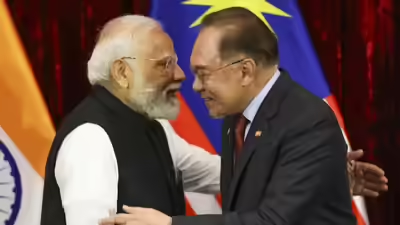

India and Malaysia have delivered a clear and coordinated message against cross-border terrorism, reaffirming a shared position of “no double standards and no compromise” as Prime Minister Narendra Modi concluded a high-level bilateral engagement with Malaysian Prime Minister Anwar Ibrahim in Kuala Lumpur.
The strong stance on terrorism marked a key outcome of Modi’s visit, which also produced a wide-ranging set of agreements and announcements covering defence, security cooperation, semiconductors, trade, social security for Indian workers, disaster management and multilateral coordination. Officials described the visit as a significant step forward in elevating India–Malaysia relations amid growing global uncertainty and shifting geopolitical alignments.
Speaking after bilateral talks, Prime Minister Modi said the two countries were fully aligned on the need to confront terrorism in all its forms, particularly cross-border terrorism. He underlined that the joint message from New Delhi and Kuala Lumpur was unequivocal and carried no ambiguity.
“Our message is clear no double standards, no compromise,” Modi said, thanking his Malaysian counterpart for unequivocally condemning recent terror attacks, including the Pahalgam attack and the Red Fort blast. The joint statement issued after the meeting explicitly referred to cross-border terrorism, a phrasing that Indian officials see as important in highlighting state-sponsored terror networks.
Beyond symbolism, both sides committed to strengthening practical cooperation in counter-terrorism, intelligence sharing and maritime security. Modi said defence cooperation would also be expanded through deeper institutional engagement and regular exchanges between armed forces and security agencies.
Defence, Maritime Security and Strategic Trust
The joint statement expressed satisfaction over the growing defence relationship between the two countries, noting regular staff talks, training exchanges, joint exercises and collaboration between defence industries. While no specific defence deals were announced, officials indicated that India is considering the sale of Dornier aircraft to Malaysia and the possible supply of naval platforms built by Indian shipyards.
Maritime security emerged as a key area of convergence, particularly as tensions persist in the South China Sea. Modi and Ibrahim reaffirmed their commitment to freedom of navigation and overflight, as well as unimpeded lawful commerce in accordance with international law, including the United Nations Convention on the Law of the Sea (UNCLOS), 1982.
The leaders urged all parties to resolve disputes peacefully and avoid actions that could escalate regional tensions, reinforcing India’s consistent position on maintaining stability in the Indo-Pacific.
Expanding Cooperation Beyond Security
While security dominated headlines, the visit also focused on economic and technological collaboration. Modi said both countries would work together to unlock new trade and investment opportunities, particularly in emerging sectors such as semiconductors, digital technologies, health and food security.
At a CEO Forum attended by business leaders from both sides, Modi described India–Malaysia ties as guided by “strategic trust” and said the partnership could play a role in broader economic transformation. He also welcomed Malaysia’s support for an early completion of the review of the ASEAN–India Trade in Goods Agreement, which New Delhi views as essential for correcting trade imbalances and enhancing market access.
The two leaders also discussed cooperation in disaster management, UN peacekeeping operations, countering corruption and social security arrangements for Indian workers in Malaysia — an issue of importance given the sizeable Indian diaspora in the country.
Multilateral Coordination and Global Governance
At the multilateral level, Modi and Ibrahim agreed to deepen coordination in international forums, including the United Nations. Both leaders supported reforms of global institutions to better reflect contemporary realities and enhance their credibility and effectiveness.
The joint statement noted Malaysia’s support for India’s permanent membership in a reformed UN Security Council, a long-standing Indian objective. Modi also welcomed Malaysia’s backing for India’s BRICS chairmanship in 2026, while acknowledging Kuala Lumpur’s aspiration to join BRICS as a full member in the future.
These positions reflect growing political alignment between the two countries on global governance issues, particularly as emerging economies seek greater representation in international decision-making.
Cultural Links and Diaspora Outreach
Ahead of elections in Tamil Nadu, Modi also reached out to the Tamil community in Malaysia, highlighting the deep cultural and linguistic ties that bind the two countries. He noted that Tamil culture remains a vibrant part of Malaysia’s educational, media and cultural landscape.
Among the cultural initiatives announced during the visit was the establishment of a dedicated Thiruvalluvar Centre at Universiti Malaya in Kuala Lumpur, along with the launch of Thiruvalluvar Scholarships for Malaysian nationals. Modi also said an audio-visual cooperation agreement signed during the visit would strengthen people-to-people links through cinema and music, particularly Tamil films.
A Signal Beyond Bilateral Ties
Diplomats say the visit sends a broader message at a time when global security challenges, regional conflicts and institutional fragmentation are testing international cooperation. By explicitly naming cross-border terrorism and committing to practical security collaboration, India and Malaysia have signalled a willingness to move beyond generic declarations toward clearer alignment.
For New Delhi, Malaysia’s strong language on terrorism is also seen as diplomatically significant, reinforcing India’s narrative at multilateral forums. For Kuala Lumpur, the engagement underscores its intent to balance regional interests while deepening ties with key partners in the Indo-Pacific.
As both sides look to translate commitments into action, the visit has laid a foundation for a more strategic, multifaceted partnership one anchored in security cooperation, economic engagement and shared positions on global challenges.