





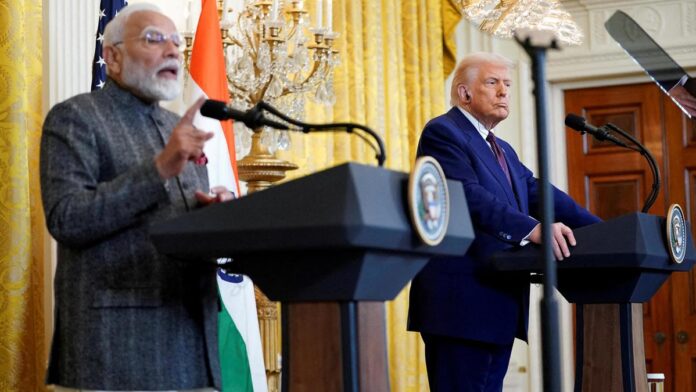

The White House has quietly revised its official fact sheet on the recently announced interim trade agreement with India, removing a reference to “certain pulses” from the list of American agricultural products expected to receive tariff relief. The update, issued on February 10, also subtly altered language describing India’s commitments under the deal replacing the word “committed” with “intends” in relation to major purchases of U.S. goods.
The changes, while technical in appearance, are politically significant in India, where agricultural trade remains one of the most sensitive elements of any bilateral agreement.
What Changed in the Fact Sheet
On February 9, the White House released a document titled “The United States and India Announce Historic Trade Deal (Interim Agreement)”, outlining key provisions of the framework agreed upon by Washington and New Delhi.
In its initial version, the fact sheet stated that India would “eliminate or reduce tariffs on all U.S. industrial goods and a wide range of U.S. food and agricultural products,” explicitly listing dried distillers’ grains (DDGs), red sorghum, tree nuts, fresh and processed fruit, “certain pulses,” soybean oil, wine and spirits, among others.
However, the revised fact sheet issued a day later omitted the phrase “certain pulses” from the list.
The updated version now reads that India will reduce or eliminate tariffs on industrial goods and selected agricultural products including DDGs, red sorghum, tree nuts, fruits, soybean oil, wine and spirits but makes no mention of pulses.
The revised document also changed the wording around India’s proposed purchases of U.S. products. Where the earlier version suggested India was “committed” to buying more American goods, the new version states that “India intends to buy more American products and purchase over $500 billion of U.S. energy, information and communication technology, coal, and other products.”
Why Pulses Matter
The removal of pulses from the list is not a minor editorial correction. Pulses — including lentils, chickpeas and other protein-rich staples are politically sensitive in India, forming a crucial part of food security policy and smallholder farm incomes.
India is both one of the world’s largest producers and consumers of pulses. Even modest tariff changes in this sector can have a ripple effect on domestic prices and rural livelihoods. Any perception that the government has opened the pulses market to foreign competition could trigger strong pushback from farmer organisations and opposition parties.
Notably, the original India–U.S. joint statement announcing the interim trade framework did not mention pulses among items eligible for tariff reductions. It referred more generally to selected agricultural and industrial products.
The revised White House fact sheet therefore brings the U.S. description more closely in line with the language of the bilateral joint statement.
Language Shift: ‘Committed’ vs ‘Intends’
The shift from “committed” to “intends” is also significant in diplomatic and legal terms. Trade agreements often rely heavily on precise wording, particularly during interim phases before finalisation of a comprehensive deal.
The revised phrasing suggests that some elements of the agreement may still be subject to negotiation or formalisation. It also reduces the impression of binding purchase obligations, which could otherwise have political ramifications in India.
Under the updated text, India “intends” to purchase over $500 billion worth of U.S. energy, coal, technology products and related goods over time a formulation that provides greater flexibility.
The joint statement issued by both governments last week similarly used future-oriented language, stating that India “intends to purchase $500 billion of U.S. energy products, aircraft and aircraft parts, precious metals, technology products, and coking coal over the next five years.”
Political and Economic Context
The interim trade framework has already generated debate within India, particularly around agricultural protections and tariff concessions.
The government has maintained that sensitive sectors especially staple food grains and dairy remain “ring-fenced.” Officials have repeatedly emphasised that no compromise has been made on core food security interests.
The revised White House document appears to avoid language that could be interpreted as contradicting those assurances.
From the U.S. perspective, the interim agreement is being framed as a major market access win, opening opportunities across agriculture, industrial goods, energy and digital trade. The White House has described the arrangement as “historic,” positioning it as a step toward a broader Bilateral Trade Agreement (BTA).
A Sign of Ongoing Negotiations
Trade experts note that interim frameworks are often fluid documents, with technical clarifications and adjustments occurring before final ratification.
The deletion of pulses and adjustment of language may reflect consultations between negotiating teams after the initial release. It may also indicate sensitivity to domestic political reactions in India.
Importantly, neither government has described the changes as a renegotiation of terms. Instead, the revised fact sheet appears to refine the description of previously agreed parameters.
Looking Ahead
Negotiations toward a comprehensive Bilateral Trade Agreement between India and the United States are expected to continue in the coming months, covering additional tariff barriers, digital trade rules, intellectual property, services and investment provisions.
The episode underscores how closely trade language is scrutinised not only for economic impact, but for political signalling.
As both governments move from interim understanding to detailed implementation, clarity and consistency in official communication will be critical in maintaining domestic confidence and strategic alignment.