





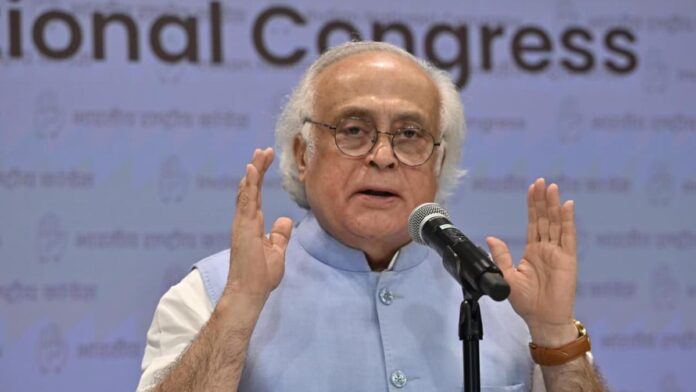

The Congress on Wednesday intensified its attack on the Centre over the recently announced interim trade agreement between India and the United States, describing the framework as lopsided and accusing the government of conceding more than it secured.
Congress general secretary (communications) Jairam Ramesh said the agreement reflects what he termed a failure of both “political huglomacy” and economic diplomacy, arguing that Washington extracted significant concessions while offering limited returns.
The remarks come days after India and the United States unveiled the contours of an interim reciprocal trade framework under which Washington agreed to reduce its reciprocal tariffs on Indian goods from 25 per cent to 18 per cent. The United States had also earlier removed an additional 25 per cent punitive tariff imposed last year over India’s purchases of Russian crude oil.
‘Asymmetrical Commitments’, Says Congress
Ramesh said that despite the government’s portrayal of the agreement as mutually beneficial, several independent analysts have questioned the balance of commitments.
“It is significant that a number of independent commentators who cannot be described as unfriendly to the government have characterised the deal as asymmetrical,” he said, suggesting that the terms disproportionately favour the United States.
According to the Congress leader, the U.S. has gained deeper access to Indian markets and broader policy commitments, while India’s concessions outweigh tangible gains secured in return.
“No matter what spin is attempted, the reality is that the U.S. has extracted more than it has conceded,” Ramesh asserted.
Personal Diplomacy Under Scrutiny
The Congress also sought to link the outcome of the agreement to Prime Minister Narendra Modi’s personal engagement with U.S. President Donald Trump.
Ramesh recalled that Modi had publicly campaigned for Trump during a visit to the United States in 2019 and was among the first global leaders to congratulate him following his re-election in 2025.
“The Prime Minister has repeatedly showcased a personal friendship with President Trump,” Ramesh said. “Yet that friendship does not appear to have translated into strategic advantage for India.”
He added that while Trump has publicly praised Modi, his administration has simultaneously pursued hard trade terms.
The Congress described this contrast as evidence that personal rapport cannot substitute for institutional negotiation leverage.
Government’s Position
The Centre has maintained that the interim trade agreement is a calibrated and strategic step designed to unlock market access while safeguarding sensitive domestic sectors, particularly agriculture and dairy.
Under the announced framework, the U.S. has reduced reciprocal tariffs to 18 per cent, a move the government says enhances India’s export competitiveness in sectors such as engineering goods, textiles, pharmaceuticals and auto components.
Officials have also pointed to commitments on digital trade discussions, supply-chain resilience and expanded cooperation in energy and technology.
The government has rejected claims of a “sell-out”, arguing that the agreement positions India more favourably in global trade networks while correcting tariff imbalances that previously disadvantaged Indian exporters.
Congress: ‘Coerced Opening’, Not Calibrated Reform
The Congress, however, insists the agreement is not a carefully structured reform but rather a pressured compromise.
On Tuesday, the party described the framework as a “coerced opening,” alleging that India was compelled to make concessions under diplomatic and economic pressure.
Party leaders have argued that India’s negotiating position was weakened by the U.S. decision last year to impose additional tariffs linked to energy purchases from Russia. Although those punitive duties have since been withdrawn, Congress claims that India’s eventual concessions reflect asymmetrical leverage during talks.
The opposition has also raised broader concerns about the long-term impact of the deal on domestic industry and strategic autonomy, particularly in sectors where market access commitments could constrain future policy flexibility.
Political Undercurrent
The trade agreement has quickly become a focal point in Parliament, with opposition parties demanding greater transparency on the full scope of commitments under the interim framework.
While the joint statement described the agreement as “reciprocal and mutually beneficial,” critics say the absence of detailed disclosures fuels scepticism about its balance.
Ramesh characterised the deal as “not a deal but a steal,” suggesting that the narrative of economic gain masks structural disadvantages embedded in the framework.
The BJP has dismissed the criticism as politically motivated, arguing that the agreement strengthens India’s global standing and advances long-term economic interests.
A Debate Beyond Tariffs
The dispute reflects a broader ideological divide over trade strategy. The government has increasingly positioned India as a competitive global manufacturing and technology partner, willing to negotiate reciprocal market access to deepen integration with advanced economies.
The Congress, by contrast, has emphasised caution, arguing that strategic sectors require insulation from external pressure and that diplomatic engagement must translate into equitable economic outcomes.
As negotiations continue toward a comprehensive Bilateral Trade Agreement between the two countries, the interim pact is likely to remain under political scrutiny.
Whether the framework ultimately delivers measurable economic gains or validates the opposition’s concerns will depend on implementation, sectoral impact, and the evolution of broader geopolitical dynamics.
For now, the trade deal has moved from diplomatic announcement to domestic political battleground.