





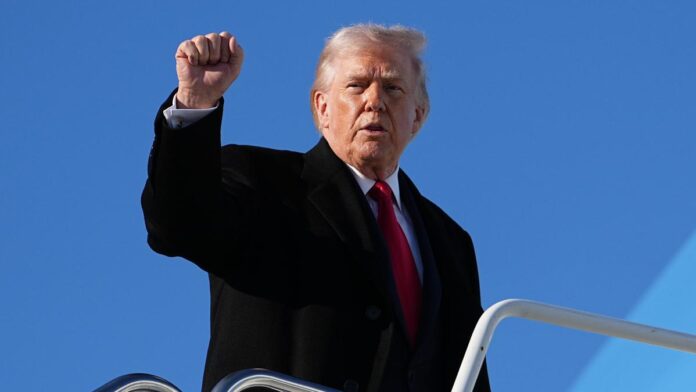

U.S. President Donald Trump has said that a change in Iran’s ruling system “would be the best thing that could happen,” as his administration weighs potential military action against Tehran and ramps up American naval deployments in West Asia.
Speaking to reporters after visiting troops at Fort Bragg, North Carolina, Mr. Trump confirmed that a second U.S. aircraft carrier strike group is being dispatched to the region. The move comes amid rising tensions over Iran’s nuclear programme, stalled diplomatic efforts, and ongoing unrest inside the Islamic Republic.
“It seems like that would be the best thing that could happen,” Mr. Trump said when asked whether Washington should push for the removal of Iran’s clerical leadership. “For 47 years, they’ve been talking and talking and talking.”
The remarks underscore a hardening tone from the White House, even as officials publicly maintain that diplomacy remains an option.
Second Carrier Deployment Signals Escalation
Earlier in the day, Mr. Trump confirmed that the USS Gerald R. Ford, the world’s largest aircraft carrier, would leave the Caribbean Sea and head toward West Asia. It will join the USS Abraham Lincoln carrier strike group, which has already been operating in the region for over two weeks alongside guided-missile destroyers and other assets.
“In case we don’t make a deal, we’ll need it,” Mr. Trump said of the additional deployment. “It’ll be leaving very soon.”
The presence of two carrier strike groups would significantly increase the U.S. military footprint near Iran, doubling the number of aircraft, munitions, and personnel available to commanders. The Ford strike group alone brings more than 5,000 service members, along with advanced air and missile capabilities.
However, analysts note that while the added carrier increases firepower and flexibility, it does not introduce entirely new capabilities beyond what is already present with the Lincoln group. Instead, it enhances redundancy and sustained operational capacity.
Given the Ford’s current position in the Caribbean, it may take weeks before it reaches operational range off Iran’s coast.
Diplomacy in Limbo
The deployment comes against a backdrop of uncertain diplomatic engagement. Indirect talks between U.S. and Iranian officials were held in Oman last week. Mr. Trump had previously suggested that another round of negotiations might follow, but no formal breakthrough materialised.
Tehran’s top security officials reportedly travelled to Oman and Qatar to exchange messages via intermediaries, yet the dialogue appears stalled.
Asked about the prospects of renewed negotiations, Mr. Trump expressed guarded optimism but coupled it with a warning. “I think they’ll be successful,” he said. “And if they’re not, it’s going to be a bad day for Iran, very bad.”
Iran maintains that its nuclear programme is for peaceful purposes. Before last year’s regional conflict, Tehran had enriched uranium to 60 percent purity a level technically short of weapons-grade but viewed by Western powers as a serious escalation.
Tensions also remain high following a brief but intense 12-day conflict last year involving Israeli strikes on Iranian targets and U.S. bombing of nuclear facilities. Those events effectively derailed earlier negotiation attempts.
Regional Concerns Mount
Gulf Arab states have warned that any military action against Iran could trigger a broader regional conflict. West Asia remains fragile following the prolonged Israel-Hamas war and clashes involving Iran-backed groups across multiple fronts.
In recent days, U.S. forces reportedly shot down an Iranian drone that approached the USS Abraham Lincoln. Separately, Iran attempted to interfere with a U.S.-flagged vessel transiting the Strait of Hormuz a vital global energy corridor.
Meanwhile, domestic tensions inside Iran are intensifying. Citizens are holding 40-day mourning ceremonies for thousands reportedly killed in a recent government crackdown on nationwide protests. The internal unrest adds pressure to an already sanctions-strained economy.
Mr. Trump has repeatedly suggested that Tehran’s leadership is vulnerable, arguing that sustained economic pressure and strategic military positioning could compel change.
Strategic Trade-offs
The redeployment of the Ford has also drawn attention within U.S. defence circles. The Trump administration’s national security strategy has emphasised strengthening focus on the Western Hemisphere and countering influence in Latin America.
Last October, the Ford was repositioned to the Caribbean as part of broader regional operations. Its rapid redeployment to West Asia may signal a shift in immediate priorities.
U.S. Southern Command has sought to reassure that operational readiness in Latin America remains intact. “While force posture evolves, our operational capability does not,” a spokesperson said, emphasising continued readiness to defend U.S. interests.
Naval leadership has expressed caution about extended deployments. Admiral Daryl Caudle, the Navy’s top officer, recently warned that prolonging carrier missions beyond six or seven months can strain crews, disrupt maintenance cycles, and complicate readiness schedules.
“When it goes past that, that disrupts lives,” he said in a previous interview, noting the personal and operational toll of prolonged sea duty.
A Calculated Gamble
With two carriers potentially positioned near Iran, Washington appears to be increasing leverage while leaving room for diplomacy. The dual approach military readiness combined with conditional negotiation — reflects a familiar strategy of pressure and persuasion.
Whether that posture leads to renewed talks or escalates into confrontation remains uncertain.
For now, the message from the White House is clear: the U.S. is prepared for multiple scenarios. As tensions simmer and diplomacy teeters, the deployment of the Ford marks a tangible escalation in one of the world’s most sensitive geopolitical flashpoints.