





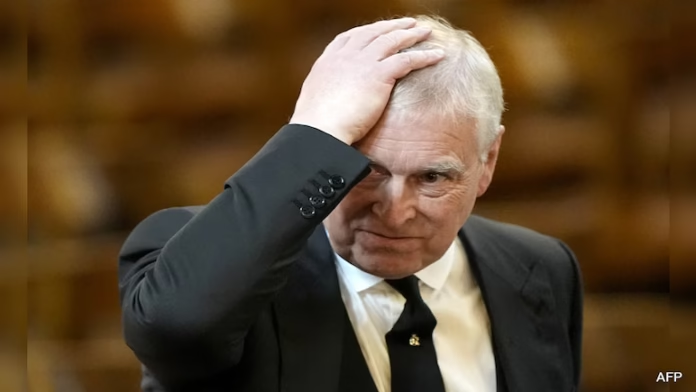

A fresh tranche of documents released by the US Justice Department has renewed scrutiny of Prince Andrew’s past association with convicted sex offender Jeffrey Epstein, revealing detailed correspondence that appears to show the former British royal sharing official material and exploring potential business ventures during his tenure as a UK trade envoy.
Prince Andrew, 66, who formally stepped back from royal duties and was stripped of his military titles and royal patronages in recent years, was briefly arrested on Thursday on suspicion of misconduct in public office. Authorities later released him without charge. The arrest is not directly linked to previous civil allegations involving Epstein’s victims, but instead relates to newly surfaced documents that investigators are examining.
The Duke of York has consistently denied wrongdoing and has previously expressed regret over his friendship with Epstein. His representatives did not issue a public comment following the latest developments.
Confidential Material and Official Briefings
Among the documents disclosed are emails dated 2010, during the period when Prince Andrew served as the United Kingdom’s Special Representative for International Trade and Investment. The correspondence suggests that he forwarded government visit reports and briefing documents to Epstein shortly after receiving them from palace advisers.
One email from November 2010 shows Andrew sharing reports covering official visits to Vietnam, Singapore, Hong Kong and Shenzhen. These documents were reportedly transmitted minutes after they were provided to him by aides following a trade mission to Southeast Asia and southern China.
On the same day, additional files labelled “Overseas Bids 301110” were forwarded to Epstein from Andrew’s private office. The contents included assessments of overseas commercial opportunities and expenditure summaries connected to trade and charitable activities.
Another message, dated December 24, 2010, referenced what Andrew described as a “confidential brief” prepared by the Provincial Reconstruction Team in Afghanistan. The document related to potential international investment opportunities. In the email, Andrew sought Epstein’s comments and suggestions.
While the documents do not establish that classified information was disclosed, legal analysts note that trade envoys are generally bound by confidentiality protocols that restrict distribution of sensitive material beyond authorised channels.
A separate email chain from May 2010 referenced discussions about financial “responsibility,” with Andrew stating there would be “no problems” provided investment decisions were delegated to banks, trusts or trusted intermediaries. The context of the discussion remains unclear.
Business Ventures and Oil Discussions
The disclosures also reveal conversations about possible private ventures between Andrew and Epstein. In mid-2010, Andrew appeared to explore participation in an entity referred to as the Green Park Group while still serving in his official capacity as trade envoy.
Other communications mention Witan Holdings, an investment vehicle discussed with mutual contacts. Additionally, a July 2010 exchange refers to a proposed $8 billion “cash-for-oil” transaction involving parties in Abu Dhabi, Dubai and Libya.
The emails describe potential introductions to senior officials, including associates of the late Libyan leader Muammar Gaddafi. Another set of correspondence outlines preparations for commercial engagements in China, referencing a possible “private placement for oil” exchange structure.
Experts reviewing the material caution that discussions of prospective deals do not necessarily indicate that transactions were completed. However, the overlap between official diplomatic responsibilities and private commercial conversations has drawn renewed attention to governance and conflict-of-interest standards.
Social Ties and Personal Interactions
The files also revisit aspects of Andrew’s personal relationship with Epstein. Deposition testimony from Epstein’s former estate manager, Juan Alessi, given in 2009, stated that Andrew had stayed at Epstein’s property for extended periods and received daily massages. Alessi’s statements were part of civil litigation records and have not been independently verified in the latest release.
Emails from 2010 show Epstein introducing Andrew to a Russian woman he described as “beautiful” and “trustworthy.” Andrew responded positively to the suggestion of meeting her for dinner.
Photographs included in the document trove depict Andrew in social settings with women whose identities have been redacted.
Andrew has previously stated that he never witnessed illegal activity and has denied allegations of sexual misconduct. In 2022, he reached an out-of-court settlement with a woman who accused him of abuse as a minor. The settlement did not include an admission of liability.
Institutional and Public Reaction
The release of millions of Epstein-related documents has triggered broader reassessment of the financier’s network, which included politicians, business leaders and public figures across multiple countries.
For Prince Andrew, who had already retreated from public life following earlier controversies, the new revelations may further complicate efforts to restore his reputation. Buckingham Palace has maintained distance from the matter, emphasising that Andrew no longer undertakes official duties on behalf of the monarchy.
Legal analysts note that an arrest without charges does not imply guilt. The investigation into whether any laws were breached remains ongoing.
As authorities continue reviewing the material, the case underscores the enduring consequences of high-profile associations and the complex interplay between diplomacy, private enterprise and personal relationships.