





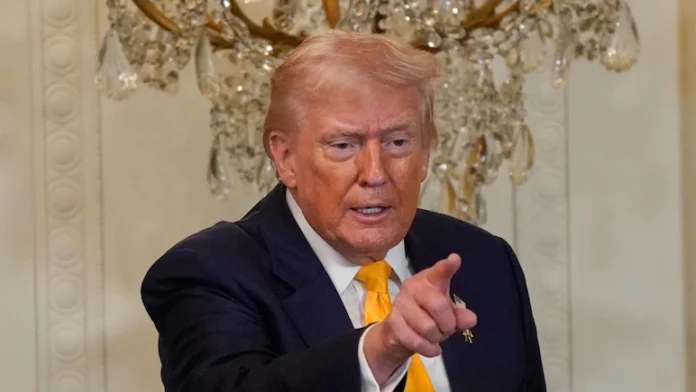

US President Donald Trump has escalated his rhetoric on trade, warning countries against reconsidering recently negotiated agreements with Washington after the US Supreme Court struck down his emergency tariff framework. In a series of posts on his social media platform, Trump signaled that nations attempting to “play games” with the ruling could face significantly higher duties under alternative legal authorities.
The warning comes days after the Supreme Court invalidated tariffs imposed under the International Emergency Economic Powers Act (IEEPA), delivering a sharp setback to one of the signature economic tools of Trump’s second term. The court ruled that the 1977 statute did not authorize the president to impose sweeping country-specific tariffs without explicit congressional approval.
However, Trump moved swiftly to reassure supporters that the ruling does not limit his broader authority to regulate trade. Instead, he argued that the decision allows his administration to deploy other statutory mechanisms in what he described as a “more powerful and legally certain” manner.
“Any Country that wants to ‘play games’ with the ridiculous Supreme Court decision… will be met with a much higher Tariff, and worse, than that which they just recently agreed to,” Trump wrote. He also floated the possibility of imposing license fees on trading partners, though no details were provided on how such measures would function.
New Tariff Mechanism Activated
In response to the court’s ruling, Trump invoked Section 122 of the Trade Act of 1974, announcing a temporary 10% duty on imports from all countries. Within 24 hours, the administration increased the rate to 15%, the maximum permitted under that statute.
The revised duty is scheduled to take effect at 12:01 a.m. EST on Tuesday. Simultaneously, US Customs and Border Protection confirmed it would cease collecting the now-invalid IEEPA tariffs.
The administration maintains that revenue levels from the new duties are expected to remain broadly consistent with projections under the previous regime. Treasury Secretary Scott Bessent suggested over the weekend that alternative trade authorities would help stabilize tariff revenue in 2026.
Global Trade Deals in Flux
The abrupt legal shift has introduced uncertainty into several high-profile trade negotiations. In Brussels, the European Parliament postponed a planned vote on an EU-US trade arrangement after Washington imposed the 15% across-the-board import duty.
Under the proposed deal, European goods would face the 15% tariff while receiving exemptions for hundreds of categories, including food products, aircraft components, critical minerals, and pharmaceutical ingredients. In return, the European Union would remove duties on selected US industrial exports.
China, meanwhile, called on Washington to withdraw tariff measures altogether, reiterating its longstanding criticism of unilateral trade actions. India has reportedly delayed scheduled trade discussions, citing the need for clarity on the US administration’s next steps.
US Trade Representative Jamieson Greer indicated that the administration is preparing to launch new investigations under Section 301 of the Trade Act of 1974. Such investigations into alleged unfair trade practices could serve as the basis for additional targeted tariffs.
Markets React to Policy Volatility
Financial markets responded negatively to the renewed uncertainty. The Dow Jones Industrial Average fell 1.34% in early trading, while the S&P 500 and Nasdaq Composite both declined by 0.65%. The US dollar index slipped modestly against major currencies.
Investors appear unsettled not only by the court’s rebuke but also by the lack of clarity surrounding future trade enforcement mechanisms. Analysts note that businesses planning cross-border supply chains require predictable tariff regimes to manage pricing and investment decisions.
Business groups have expressed cautious optimism that the Supreme Court ruling restores clearer legal boundaries around executive trade powers. However, the administration’s rapid pivot to alternative statutes has kept markets on edge.
Constitutional Tensions Surface
Trump also used his remarks to criticize members of the Supreme Court majority, including two justices he appointed during his first term. The ruling, authored by Chief Justice John Roberts, emphasized Congress’s constitutional authority over tariff policy.
The decision marked one of the most consequential checks on executive trade power in decades. While the court reaffirmed presidential authority under other statutes, it rejected the use of emergency economic powers as a blanket justification for sweeping import duties.
The president further suggested concern that the court could rule against his administration in a separate case involving birthright citizenship another issue that may test executive authority.
What Comes Next?
Trade experts suggest that while Section 122 allows temporary tariffs for balance-of-payments concerns, longer-term duties would require more extensive investigations under statutes such as Section 301 or Section 232, which address unfair trade practices and national security concerns respectively.
The coming weeks are likely to determine whether the administration formalizes broader investigations or relies primarily on temporary measures. For US trading partners, the uncertainty complicates diplomatic and commercial planning.
Despite the Supreme Court’s decision, Trump has made clear that tariffs will remain central to his economic strategy. Whether the new framework provides stability or prolongs volatility remains to be seen.