





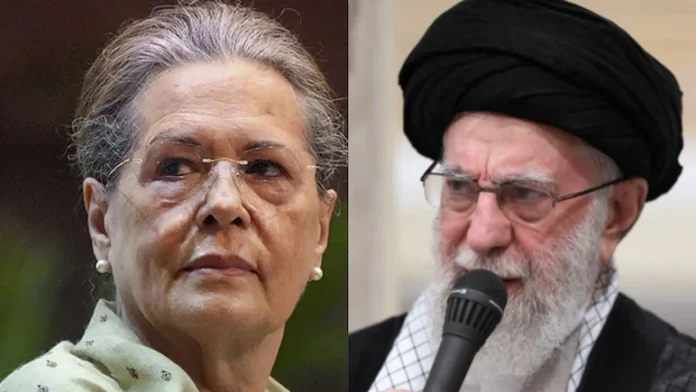

Senior Congress leader Sonia Gandhi has sharply criticised the Narendra Modi government for what she described as a troubling silence following the reported assassination of Iran’s Supreme Leader, Ayatollah Ali Khamenei. In a strongly worded opinion piece, Gandhi argued that India’s muted response risks undermining its credibility as a principled global actor and ignores the depth of New Delhi’s historical ties with Tehran.
Iran confirmed earlier this month that Khamenei had been killed in targeted strikes allegedly carried out by the United States and Israel. The development marked an extraordinary moment in international politics the targeted killing of a sitting head of state amid ongoing diplomatic negotiations. While the Indian government has called for restraint and de-escalation in West Asia, it has stopped short of directly condemning the assassination.
Gandhi contended that this approach amounts to more than diplomatic caution. “Silence in such circumstances is not neutrality,” she wrote, calling it an “abdication” of India’s long-standing commitment to sovereignty and international law.
A Question of Principles
The Congress Parliamentary Party chairperson noted that the assassination occurred without a formal declaration of war and during an active diplomatic process. For India which has historically championed the principles of non-alignment and territorial integrity failing to articulate a clear position raises uncomfortable questions, she argued.
“When the targeted killing of a foreign leader draws no clear defence of sovereignty or international law from our country, it casts doubt on the direction and credibility of our foreign policy,” she wrote.
Government sources, however, have defended the measured tone adopted by New Delhi. Officials indicate that India’s stance mirrors that of several major global powers that have avoided direct condemnation while urging restraint. According to these sources, foreign policy decisions must be calibrated to protect national interests, especially amid volatile regional conditions.
Prime Minister Narendra Modi initially expressed “deep concern” about escalating tensions in the Middle East and emphasized the importance of dialogue and diplomacy. Gandhi criticised this formulation, arguing that diplomacy was already underway before what she described as “unprovoked attacks.”
The Israel Factor
The timing of the incident has added another layer of political sensitivity. Barely days before the assassination, Prime Minister Modi concluded a visit to Israel, where he reiterated strong support for the government of Prime Minister Benjamin Netanyahu. India’s ties with Israel have expanded significantly over the past decade, particularly in defence procurement, agriculture, and high-technology cooperation.
Gandhi acknowledged the importance of India-Israel relations but suggested that maintaining strategic partnerships should not preclude principled positions.
“It is precisely because India maintains relations with both Tehran and Tel Aviv that it possesses diplomatic space to urge restraint,” she wrote, adding that such space depends on perceived impartiality.
Analysts note that India has sought to balance its growing alignment with Israel while preserving longstanding economic and strategic ties with Iran, particularly in areas such as energy security and connectivity projects.
A Kashmir Reminder
In her column, Gandhi invoked a significant episode from the 1990s to underscore Iran’s past diplomatic support for India. She recalled that in 1994, when certain members within the Organisation of Islamic Cooperation sought to advance a resolution critical of India over Kashmir at the United Nations Commission on Human Rights, Iran played a key role in preventing the issue’s internationalisation.
“That intervention helped prevent the internationalisation of the Kashmir issue at a delicate moment in India’s economic trajectory,” she wrote.
Beyond historical diplomacy, Gandhi highlighted the strategic relevance of Iran in India’s regional calculations. Tehran has facilitated India’s presence in the southeastern city of Zahedan, near the Pakistan border — a location seen as a counterbalance to the China-backed development of Gwadar port under the China-Pakistan Economic Corridor.
She also referenced former Prime Minister Atal Bihari Vajpayee’s 2001 visit to Tehran, during which he emphasized India’s civilisational and contemporary ties with Iran.
Strategic Interests and the Gulf Diaspora
Gandhi framed her argument not only in moral but also in pragmatic terms. Nearly 10 million Indians live and work across the Gulf region. In previous crises from the Gulf War to evacuations from Yemen, Iraq, and Syria India’s ability to protect its citizens depended, she argued, on being viewed as an independent actor rather than aligned with any single bloc.
“For India, which seeks to represent the Global South, the optics of acquiescence carry real costs,” she wrote, suggesting that other developing nations may question India’s commitment to defending territorial integrity if it appears hesitant in this instance.
India has repeatedly projected the philosophy of Vasudhaiva Kutumbakam “the world is one family” in global forums. Gandhi argued that such civilisational ideals must translate into consistent positions on international norms.
A Broader Debate
The controversy underscores the increasingly complex terrain of Indian foreign policy. As geopolitical rivalries intensify, balancing strategic partnerships with normative commitments has become more challenging.
While the government emphasizes pragmatic engagement and safeguarding national interests, the opposition is urging clearer articulation of India’s stance on issues of sovereignty and international law.
As tensions in West Asia continue to evolve, the debate over India’s diplomatic posture reflects broader questions about the country’s global identity whether as a strategic balancer, a moral voice, or a synthesis of both.