





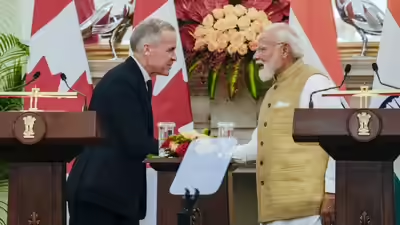

In a significant diplomatic turnaround, India and Canada have announced a $2.6 billion uranium supply agreement alongside a broader framework aimed at restoring and expanding bilateral ties. The breakthrough came during Canadian Prime Minister Mark Carney’s visit to New Delhi, where he held extensive talks with Prime Minister Narendra Modi amid efforts to rebuild trust after months of strained relations.
At the heart of the renewed engagement is a long-term contract under which Canada’s Cameco Corporation will supply 22 million pounds of uranium to India between 2027 and 2035. The deal is expected to bolster India’s civil nuclear energy capacity as the country pushes to diversify its energy mix and reduce dependence on fossil fuels.
The uranium agreement was accompanied by a set of government-level memoranda of understanding (MoUs) and sectoral partnerships spanning critical minerals, renewable energy, defence cooperation, innovation, and education. The leaders also committed to concluding negotiations on a Comprehensive Economic Partnership Agreement (CEPA) by the end of the year, a move seen as central to stabilizing trade ties.
From Diplomatic Chill to Strategic Dialogue
Relations between New Delhi and Ottawa had faced turbulence in recent months, particularly following allegations aired in Canadian media linking Indian officials to transnational incidents in Canada. India has consistently rejected these claims as “baseless” and politically motivated, insisting that concerns should be addressed through formal law enforcement and judicial channels rather than public narratives.
While both leaders avoided direct reference to contentious issues in their public remarks, officials confirmed that security concerns were discussed privately. The Canadian readout emphasized cooperation on law enforcement and addressing transnational challenges, while India reiterated its commitment to credible investigative processes.
Despite the sensitivities, the tone of the meeting signaled a desire on both sides to reset the relationship. Modi credited Carney for restoring momentum across multiple sectors, describing the renewed engagement as grounded in shared democratic values and economic resilience. Carney, in turn, characterized the discussions not as a mere renewal but as an expansion of bilateral partnership, emphasizing the need for diversified and independent economies.
Energy and Critical Minerals at the Core
The uranium supply deal marks a strategic pillar of the reset. India’s expanding nuclear energy program requires steady fuel supplies to meet long-term power generation targets. Canada, one of the world’s largest uranium producers, has emerged as a reliable supplier since civil nuclear cooperation resumed following earlier diplomatic breakthroughs.
In addition to uranium, both countries signed agreements to strengthen collaboration in critical minerals — an area of growing geopolitical importance given global supply chain vulnerabilities. These partnerships are expected to support manufacturing in electric vehicles, renewable energy infrastructure, and advanced technologies.
A new strategic energy partnership was also launched, covering renewable energy research and sustainable development initiatives.
Defence, Innovation and Education Links
Beyond energy, the talks produced progress in defence and technology cooperation. A formal India-Canada defence dialogue mechanism was established, with an emphasis on enhancing interoperability and expanding engagement in bilateral and multilateral naval activities.
Innovation featured prominently as well. The two leaders announced the launch of a Canada-India Talent and Innovation Strategy aimed at strengthening academic collaboration and knowledge exchange. Universities and research institutions signed over two dozen additional partnerships in areas including artificial intelligence, healthcare, agriculture, and emerging technologies.
An MoU under the Australia-Canada-India Technology and Innovation Partnership was also formalized to support AI research and deployment, reflecting trilateral cooperation in cutting-edge sectors.
Trade Ambitions and Economic Goals
Trade remains a central driver of the reset. Modi expressed confidence that annual bilateral trade could reach $50 billion by 2030, while Canadian officials projected that a finalized CEPA could raise trade volumes to $70 billion within five years.
The agreement aims to reduce tariff barriers, promote investment flows, and facilitate services trade. Industry groups in both countries have welcomed the renewed momentum, particularly in sectors such as clean energy, agritech, pharmaceuticals, and advanced manufacturing.
Carney emphasized that the economic partnership is intended to make both economies more resilient in an era of geopolitical fragmentation and supply chain disruptions.
Addressing Security Concerns
While Carney did not publicly address terrorism concerns, Modi noted that both sides recognized terrorism, extremism, and radicalization as serious global challenges. The statement reflected India’s longstanding emphasis on security cooperation in bilateral discussions.
Observers say the meeting reflects pragmatic diplomacy. Despite unresolved tensions, both governments appear to have prioritized economic and strategic interests over prolonged confrontation.
A Cautious Optimism
The visit concluded with a symbolic gesture of goodwill, as both leaders underscored the importance of unbreakable democratic values and mutual respect. While the reset is still in early stages, the uranium deal and CEPA roadmap suggest a tangible effort to rebuild trust.
Analysts caution that sustaining the momentum will depend on managing political sensitivities and ensuring transparent communication. Yet the breadth of agreements announced indicates that New Delhi and Ottawa are seeking a forward-looking partnership anchored in energy security, innovation, and diversified trade.