





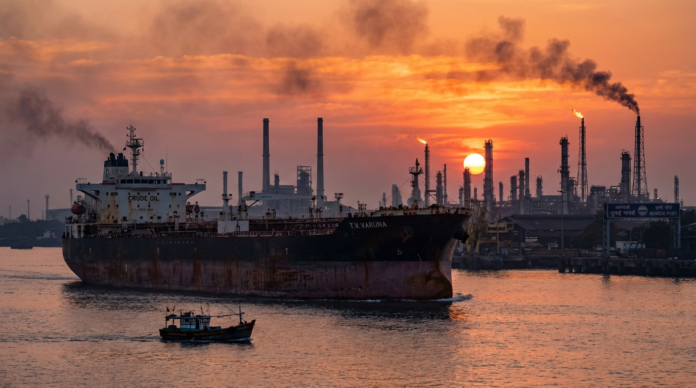

India has secured nearly 30 million barrels of Russian crude oil after receiving temporary approval from the United States, as escalating tensions in the Middle East disrupt one of the world’s most crucial energy supply routes. The move highlights the growing pressure on India’s energy security as the conflict involving the United States, Israel, and Iran threatens global oil flows.
The purchases were made after Washington allowed Indian companies to import Russian crude that had already been loaded onto tankers before March 5. Analysts estimate that roughly 138 million barrels of Russian oil are currently in transit globally, and countries such as China are also expected to compete for these shipments.
The decision comes at a time when the Strait of Hormuz a strategic maritime chokepoint connecting the Persian Gulf to global markets has effectively become inaccessible due to the ongoing conflict. Around 20 percent of the world’s oil and gas normally passes through this narrow passage, making it a critical supply route for energy-hungry economies like India.
Indian Refiners Secure Emergency Supplies
Major Indian refiners have moved quickly to secure alternative crude supplies to maintain operations. State-owned Indian Oil Corporation and private energy giant Reliance Industries have purchased large quantities of Russian crude from the spot market.
Market intelligence firm Kpler reports that Indian Oil alone acquired roughly 10 million barrels, while Reliance secured a similar volume. Several oil tankers initially headed toward Singapore reportedly changed course toward Indian ports after the US waiver allowed these transactions to proceed.
However, unlike earlier purchases following the Ukraine conflict, Russian crude is no longer available at steep discounts. Instead, buyers are now paying premiums ranging between $2 and $8 per barrel above the Brent crude benchmark, reflecting tighter global supply conditions.
The rush for Russian oil also signals a shift in India’s import strategy. After Russia’s invasion of Ukraine in 2022, India dramatically increased its crude purchases from Moscow to take advantage of discounted prices. By mid-2024, imports from Russia had climbed to more than 2 million barrels per day.
Under diplomatic pressure from Washington, India gradually reduced those volumes. Data from Kpler shows that imports had fallen to about 1.06 million barrels per day last month before the latest surge in purchases.
Global Oil Markets React to Conflict
Energy markets have remained volatile amid uncertainty about the duration of the Middle East conflict. International crude prices initially surged, with Brent crude touching around $119 per barrel earlier this week.
Prices later retreated to roughly $88 after US President Donald Trump suggested the conflict could soon de-escalate, though he later moderated those remarks, leaving markets uncertain about the situation’s trajectory.
Despite the temporary price correction, supply disruptions remain a serious concern for countries dependent on Middle Eastern crude exports.
India Activates Emergency Gas Allocation Plan
The scramble to secure crude oil supplies is only one aspect of a broader energy challenge unfolding in India. The government has invoked emergency powers under the Essential Commodities Act of 1955 to manage natural gas distribution across the country.
Under a newly introduced framework known as the Natural Gas (Supply Regulation) Order, 2026, authorities have established a priority system to determine which sectors receive fuel during shortages.
Households and essential services have been placed at the top of the priority list. Piped natural gas for homes, compressed natural gas used in transportation, LPG production, and fuel required for pipeline operations will continue to receive full supplies based on recent consumption levels.
Fertiliser plants, considered critical for agriculture and food production, will receive approximately 70 percent of their usual gas allocation. Officials say maintaining fertiliser production is vital as farmers prepare for the upcoming kharif sowing season.
Industrial consumers connected to the national gas grid including manufacturing companies and tea processing facilities will receive about 80 percent of their normal supply. Commercial users such as restaurants, hotels, and small businesses supplied through city gas networks will also receive similar allocations.
To compensate for reduced availability, oil refineries are expected to cut gas usage to around 65 percent of their recent consumption. Supplies will first be curtailed to petrochemical plants, heavy industries, and certain power stations.
LPG and LNG Supplies Also Under Pressure
India’s liquefied petroleum gas supply chain is also feeling the strain. Authorities have instructed refineries to increase LPG production and create emergency reserves to ensure household availability.
Reliance Industries announced that it would maximise LPG output at its Jamnagar refining complex in Gujarat the world’s largest integrated refinery to maintain domestic supply stability.
The challenge is compounded by India’s heavy reliance on imports from the Middle East, which account for more than 90 percent of the country’s LPG supply. Much of this fuel typically travels through the Strait of Hormuz, now affected by the ongoing conflict.
Natural gas imports are also facing disruptions after Qatar, a major supplier, halted production temporarily following an Iranian drone strike.
To help manage shortages, Reliance has said it will divert natural gas produced from its KG-D6 offshore basin to support priority sectors such as households and transportation.
Power Demand Could Surge in Summer
Energy analysts warn that the coming months could be particularly challenging. India is expected to experience an unusually hot summer, which could significantly increase electricity demand.
Gas-fired power plants currently contribute only a small share of the country’s electricity generation but play an important role in meeting peak evening demand when solar power generation declines.
If liquefied natural gas supplies remain constrained, experts warn that only a fraction of the gas-based power generation capacity may be available during peak hours.
With electricity consumption expected to exceed 270 gigawatts during the summer months, India’s energy infrastructure could face one of its most demanding periods in recent years.