





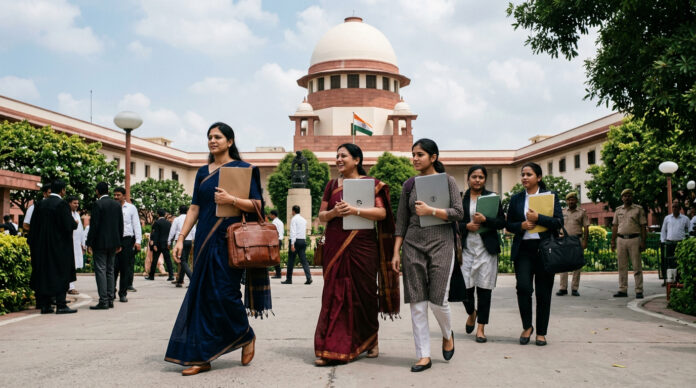

The Supreme Court of India on Friday declined to issue directions mandating menstrual leave for women across workplaces and educational institutions, expressing concerns that such a law could unintentionally harm women’s employment prospects. During the hearing, the bench led by Chief Justice Surya Kant suggested that compulsory menstrual leave policies might discourage employers from hiring women, potentially reinforcing workplace discrimination rather than addressing gender inequality.
The court was hearing a petition filed by advocate Shailendra Mani Tripathi, who sought directions from the Supreme Court to the central and state governments to frame rules providing paid menstrual leave for women, including students and working professionals.
Court Highlights Employment Concerns
While acknowledging the importance of improving awareness around menstrual health, the court cautioned that introducing a legally mandated leave policy could have unintended consequences in the job market.
Chief Justice Surya Kant remarked that employers might become reluctant to hire women if they are legally required to provide menstrual leave.
“Creating awareness and sensitisation is different, but the moment you bring a law mandating menstrual leave, nobody will hire them,” the Chief Justice said during the hearing.
He warned that the mindset of employers could lead to women being perceived as a less attractive workforce if additional statutory leave requirements are imposed exclusively for them.
According to the Chief Justice, while affirmative action for women is recognised under the Constitution, the practical realities of the labour market must also be considered before introducing new legal mandates.
Debate on Gender Equality
Justice Joymalya Bagchi, who was part of the bench, echoed similar concerns and emphasised the need to evaluate the issue from an economic and business perspective.
He noted that employers often make hiring decisions based on operational efficiency and competitiveness. If legal obligations create additional perceived burdens for businesses, companies may hesitate to recruit candidates who are subject to those requirements.
“Look at it from a business model. The more unattractive the human resource, the less the possibility of absorption in the market,” Justice Bagchi observed during the proceedings.
The bench also warned that a compulsory menstrual leave policy might inadvertently reinforce harmful stereotypes about women in the workplace. According to the judges, such laws could lead to the perception that women are less capable than men, further complicating efforts to achieve gender equality.
Petitioner’s Argument
The petitioner argued that menstrual leave is a necessary workplace accommodation that recognises the physical challenges faced by many women during their menstrual cycles. He urged the court to ensure that women, both students and employees, are entitled to paid leave during menstruation.
Supporters of menstrual leave policies argue that such measures promote workplace inclusivity and help address health-related challenges faced by women.
Advocates also say that acknowledging menstrual health through supportive policies could reduce stigma and encourage more open discussions about women’s health in educational institutions and professional environments.
Voluntary Policies Already Exist
During the hearing, Senior Advocate M.R. Shamshad pointed out that some governments and private organisations have already introduced menstrual leave policies voluntarily.
He cited the example of Kerala, where the state government introduced menstrual leave for female students in state-run universities in 2013. At the time, Kerala Chief Minister Pinarayi Vijayan described the decision as part of the state’s broader commitment to building a gender-just society.
Several private companies across India have also implemented flexible policies that allow women to take leave during menstruation without penalty.
However, the Supreme Court distinguished between voluntary workplace policies and legally mandated rules.
Chief Justice Surya Kant emphasised that voluntary measures adopted by institutions allow employers to balance operational needs with employee welfare, whereas a nationwide legal mandate could impose rigid requirements on businesses.
“The moment you make it compulsory in law, employers may stop hiring women,” he said.
Previous Supreme Court Observations on Menstrual Health
Although the court declined to mandate menstrual leave, it has previously recognised menstrual health as a critical issue linked to women’s rights and dignity.
In January this year, the Supreme Court issued an important ruling affirming that menstrual hygiene is an essential component of a girl child’s right to life, dignity, health and education under Article 21 of the Constitution.
A bench comprising Justice J.B. Pardiwala and Justice R. Mahadevan directed governments across the country to ensure access to free sanitary napkins, functional gender-segregated toilets, and awareness programmes promoting menstrual health.
The judgment highlighted the responsibility of governments to address menstrual health challenges through infrastructure and public awareness rather than solely through workplace regulations.
A Continuing Policy Debate
The debate over menstrual leave policies has gained attention globally in recent years, with some countries and organisations adopting supportive measures while others remain cautious about formal legal mandates.
Supporters argue that menstrual leave promotes workplace equality by recognising biological differences and providing women with necessary support during periods of physical discomfort.
Critics, however, warn that such policies could unintentionally reinforce gender stereotypes or create hiring biases against women.
The Supreme Court’s observations reflect the complexity of balancing gender equity, workplace fairness, and economic realities.
For now, the court has signalled that menstrual leave policies may be better addressed through awareness initiatives, voluntary workplace practices, and broader public health policies, rather than through mandatory legislation.
As discussions around gender equality and workplace rights continue to evolve, policymakers and businesses may increasingly explore flexible solutions that support women’s health while ensuring equal employment opportunities.