





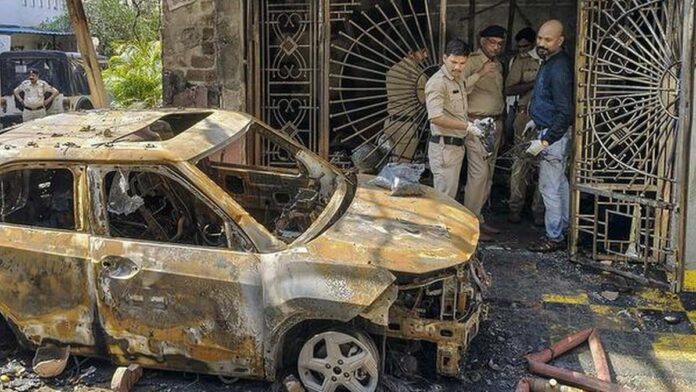

A devastating house fire in Indore that claimed eight lives has taken a new turn, as a survivor has questioned the initial narrative linking the blaze to an electric vehicle (EV) charging point. The incident, which occurred in the early hours of Wednesday, has left investigators examining multiple angles to determine the exact cause.
According to officials and family members, the fire broke out around 3:30 am in a three-storey residential building, trapping several members of an extended family inside. Early speculation suggested that the blaze may have originated from an EV charging point or a short circuit linked to it. However, this theory has now been strongly disputed by one of the survivors.
Saurabh Pugalia, son of polymer businessman Manoj Pugalia, stated that the family’s EV hatchback was not connected to the charging unit at the time of the fire. “Since the car charger wasn’t even connected to the power source, it is difficult to understand how a short circuit could have occurred at the charging point,” he told reporters. His statement directly challenges the earlier assumptions that gained traction shortly after the incident.
Adding to the complexity, Saurabh also dismissed another claim that electronic locks inside the building prevented rescue teams from entering. Some initial reports suggested that a power failure might have disabled the locking mechanism, delaying firefighting efforts. However, the survivor clarified that this explanation does not align with what actually happened on the ground.
Instead, he pointed to the possibility of an external electrical fault. Referring to videos circulating on social media, Saurabh indicated that there appeared to be an electricity pole outside the building emitting sparks or flames. “The source of the fire could be something external,” he suggested, urging authorities to broaden the scope of their investigation.
The tragedy has had a profound human cost. Among the deceased were Saurabh’s sister-in-law Simran and six other relatives, including individuals who had traveled from Kishanganj in Bihar. The victims included a cancer patient and two children, making the incident even more heartbreaking for the family and the wider community.
Authorities have acknowledged the conflicting narratives and emphasized that the investigation is still ongoing. Amrendra Singh, Deputy Commissioner of Police, confirmed that forensic teams are examining the charred remains of the vehicle as well as the building’s electrical systems.
“There have been instances of electric vehicles catching fire even when they are not being charged. We are exploring all possibilities, including the statements made by the family members, to determine the exact cause,” he said.
Experts note that while EV-related fires are relatively rare, they can occur under specific conditions such as battery damage or thermal runaway. However, in this case, the lack of an active charging connection raises important questions about whether the EV system played any role at all.
Meanwhile, the state government has assured a thorough and scientific probe into the incident. Mohan Yadav met with the survivors and extended his condolences to the bereaved family. He emphasized that the investigation would rely on technical evidence rather than speculation. “We will wait for the detailed forensic report and take all necessary steps to ensure that such tragedies do not occur again,” he said.
Fire safety experts have also weighed in, highlighting the need for improved electrical infrastructure and regular maintenance checks in residential areas. Faulty wiring, overloaded circuits, or external electrical failures can often trigger fires, especially in densely populated neighborhoods.
As investigators continue their work, the focus remains on uncovering the truth behind the blaze. The conflicting accounts underline the importance of a meticulous and unbiased inquiry. For the grieving family, however, the priority is justice and clarity.
The Indore fire serves as a stark reminder of how quickly such incidents can escalate and the need for robust safety measures. Whether the cause is ultimately traced to an external electrical source, internal wiring, or another factor entirely, the findings will likely have broader implications for urban safety protocols and EV-related regulations in India.