





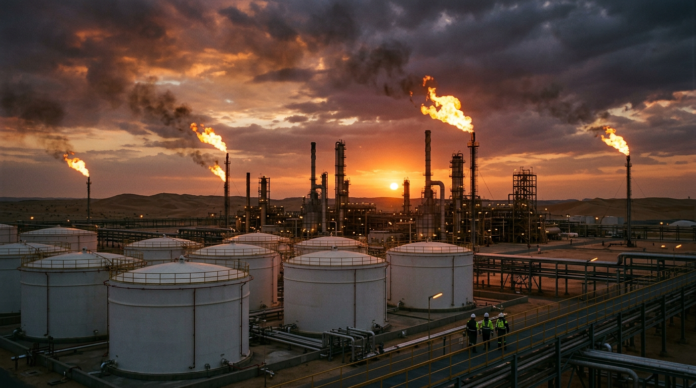

As tensions from the ongoing Iran conflict ripple across global energy markets, Saudi Arabia finds itself in a paradoxical position standing to gain enormously from soaring oil prices, yet increasingly uneasy about the consequences of such a surge.
According to recent projections cited in a Wall Street Journal report, Saudi officials are modeling worst-case scenarios where Brent crude prices could climb beyond $180 per barrel if the conflict continues to disrupt supply chains into late April. While such levels would significantly boost revenues for the world’s largest oil exporter, policymakers in Riyadh are far from celebrating.
The concern is rooted in long-term market stability. Rapid spikes in oil prices, while lucrative in the short term, often trigger demand destruction, accelerate global inflation, and increase the likelihood of an economic slowdown. Analysts warn that excessively high prices could ultimately hurt producers by pushing consumers toward alternative energy sources and reducing overall oil consumption.
“Saudi Arabia generally prefers gradual and stable price increases,” said Umer Karim of the King Faisal Center for Research and Islamic Studies. “Sharp spikes create volatility that can damage long-term demand and destabilize markets.”
The current surge in oil prices has been driven by escalating geopolitical tensions. Since the conflict intensified in late February, Brent crude has climbed sharply, recently touching around $119 per barrel. Key developments such as Iran’s reported strikes on Qatar’s Ras Laffan energy hub and continued disruptions in the Strait of Hormuz have heightened fears of supply shortages.
The Strait of Hormuz remains a critical chokepoint, handling nearly 20 percent of the world’s oil shipments. Any prolonged disruption here could send shockwaves through global markets. Gulf oil benchmarks, particularly those linked to Oman crude, have already seen extreme volatility, with prices surpassing $166 per barrel in recent trades.
For Saudi Aramco, the state-owned oil giant responsible for managing production and exports, the situation is complex. While the company has not officially commented on the projections, market indicators suggest that Saudi crude is already trading at elevated levels. Reports indicate that Saudi light crude sold to Asian markets via Red Sea ports is priced around $125 per barrel.
Industry insiders expect further increases. As existing inventories decline, projections suggest prices could approach $140 per barrel in the near term, potentially rising to $150 by mid-April. In more extreme scenarios, analysts foresee a climb toward $165 and even $180 if disruptions persist.
Some experts believe the upward trajectory could extend beyond the immediate crisis. Wood Mackenzie has indicated that oil prices could reach $200 per barrel by 2026 under sustained geopolitical pressure. Similarly, energy trader Rebecca Babin has suggested that such levels are plausible within months if the situation escalates further.
However, the ripple effects of rising oil prices are already being felt globally, particularly in major consuming economies. In the United States, gasoline prices have surged to approximately $3.88 per gallon, up significantly from the previous month. Diesel prices have also risen sharply, increasing costs across transportation and logistics sectors.
Economic experts warn that higher fuel costs function as an indirect tax on both consumers and businesses. Philip Blancato noted that rising energy expenses reduce disposable income and constrain business operations, ultimately slowing economic growth. Meanwhile, Jerome Powell has acknowledged that sustained oil price shocks could complicate efforts to manage inflation and employment.
For India, the implications are particularly serious. As one of the world’s largest oil importers, India relies on external sources for nearly 89 percent of its crude oil needs a figure expected to rise further in the coming years. This dependence makes the country highly vulnerable to global price fluctuations.
Economic models suggest that every $10 increase in oil prices could widen India’s current account deficit by 30 to 40 basis points. If prices were to remain in the $150–$180 range, the deficit could exceed 3 percent of GDP. Such a scenario would likely weaken the rupee, increase inflation, and put pressure on economic growth.
The inflationary impact alone could be substantial, potentially adding more than one percentage point to consumer prices. This would place the Reserve Bank of India in a difficult position balancing the need to control inflation with the risk of stifling economic recovery through higher interest rates.
India does have some buffers. In the past, the government has reduced fuel taxes to ease the burden on consumers, absorbing significant fiscal costs in the process. Additionally, the country has diversified its supply sources, notably increasing imports of discounted crude from Russia. However, in an environment of extremely high global prices, such discounts may shrink, limiting their effectiveness.
Ultimately, while rising oil prices may appear beneficial for producers like Saudi Arabia, the broader economic consequences paint a far more complex picture. For Riyadh, the challenge lies in navigating this delicate balance maximizing revenue without triggering a global economic backlash that could undermine future demand.