





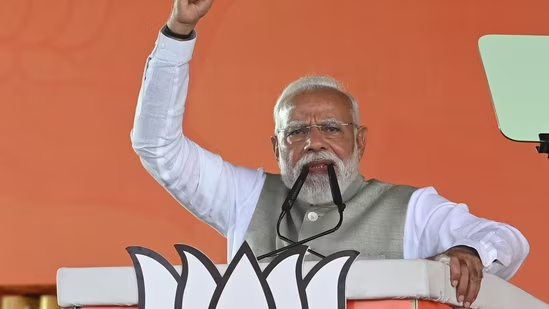

Narendra Modi on Sunday set a historic benchmark in Indian politics, becoming the longest-serving head of government in the country’s history. The milestone comes as Modi completed 8,931 days in office, surpassing the previous record held by Pawan Kumar Chamling, who served 8,930 days as chief minister of Sikkim.
The calculation includes Modi’s uninterrupted tenure as head of government beginning with his appointment as Chief Minister of Gujarat in October 2001, followed by his elevation to Prime Minister in 2014 and continuation in office through subsequent electoral victories. The achievement marks more than two decades of continuous leadership at the state and national levels.
Political observers note that the record reflects both longevity and electoral consistency. Modi remains the only Indian Prime Minister to have previously served such a long tenure as a chief minister before assuming office at the Centre. His administrative experience in Gujarat laid the foundation for his national political rise, shaping governance themes that later defined his campaigns.
Modi first took oath as Gujarat Chief Minister during a challenging period for the state. Gujarat was recovering from a devastating earthquake, dealing with drought conditions, and facing economic and political instability. Over the years, he repeatedly cited those early circumstances as formative, saying they strengthened his resolve to focus on infrastructure, governance reforms, and economic growth.
During his tenure in Gujarat, the state witnessed expansion in road networks, power generation, and industrial investment. The administration emphasized agricultural productivity and water management initiatives aimed at addressing recurring droughts. These policy directions later became part of Modi’s broader governance narrative at the national level.
In 2013, Modi was named his party’s prime ministerial candidate ahead of the 2014 general election. The campaign centered on development, governance reform, and economic revival. The subsequent victory in the 2014 Indian general election marked a major shift in Indian politics, giving him a strong mandate. He went on to secure further electoral wins in 2019 and 2024, becoming one of the few leaders to achieve three consecutive national mandates.
Modi is also notable for being the first Prime Minister born after India’s independence. His tenure has coincided with a period of significant economic and technological transformation, including expansion of digital infrastructure, welfare delivery reforms, and major policy initiatives focused on financial inclusion.
Reflecting on his journey during his 25th year in public office as head of government, Modi expressed gratitude to citizens for their continued trust. He recalled taking office in Gujarat amid adversity and emphasized that his approach has been shaped by the goal of improving living standards and expanding opportunities.
He also spoke about personal values that influenced his leadership style, including advice from his mother to work for the welfare of the poor and maintain integrity in public life. These principles, he said, guided his decisions throughout his political career.
The Prime Minister highlighted what he described as Gujarat’s transformation during his tenure, noting progress in agriculture, industry, and infrastructure. He characterized the state’s development as a model of governance focused on efficiency and economic expansion.
At the national level, Modi pointed to key achievements over the past decade, including poverty reduction, infrastructure expansion, and welfare programs targeting women, youth, and farmers. Government data has indicated that hundreds of millions have benefited from financial inclusion schemes, housing initiatives, and rural electrification.
Economists and policy analysts note that the period has also seen India emerge as one of the fastest-growing major economies. Investments in digital payments, manufacturing, and connectivity projects have been central to this narrative. However, observers also highlight that challenges remain, including employment generation, inflation management, and regional disparities.
Modi reiterated his commitment to building a “Viksit Bharat,” or developed India, guided by constitutional values and inclusive growth. He described serving the country as the highest honour and pledged continued efforts toward economic development and social empowerment.
The milestone of 8,931 days underscores not just longevity but continuity in leadership. In a democratic system where electoral cycles often produce change, maintaining uninterrupted tenure for over two decades is rare. The record therefore reflects sustained political support as well as organizational strength.
As Modi surpasses Chamling’s long-standing record, the achievement adds another chapter to India’s political history. Whether measured in years, policy initiatives, or electoral victories, his tenure has shaped the country’s governance landscape in significant ways.
With several years still remaining in his current mandate, Modi’s total tenure as head of government is likely to extend further, potentially setting a benchmark that may stand for decades.