





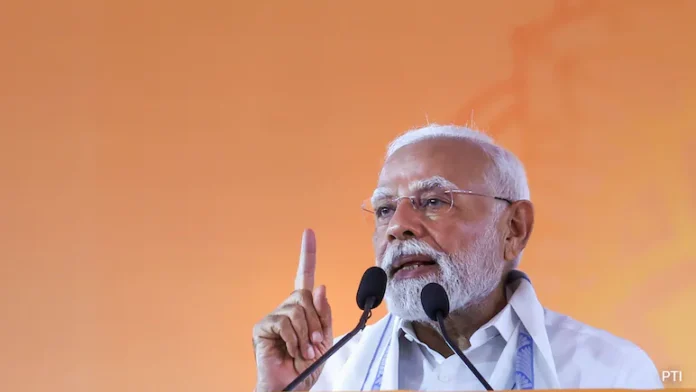

Palakkad Prime Minister Narendra Modi chose an unusual campaign stage on Sunday to deliver what was essentially a wartime address. Standing before a rally crowd in Kerala a state that sends more workers to the Gulf than almost any other in India he made two things clear: the government was working around the clock to protect Indians caught in the Middle East conflict, and Congress was actively making that job more difficult.
The setting was deliberate. Palakkad is not just an election venue. It is a community with deep, personal stakes in what is unfolding thousands of kilometres away. Families here have husbands, sons, and daughters working in Dubai, Kuwait, Riyadh, and Muscat. When Modi speaks about the nearly one crore Indians living across Gulf nations, this audience does not hear a statistic they hear the names of people they know.
The Middle East conflict has entered a dangerous new phase. US and Israeli military operations against Iran have expanded significantly, with the Strait of Hormuz severely disrupted and global oil markets in visible stress. Brent crude has crossed $116 per barrel. Shipping traffic through the world’s most critical energy corridor has collapsed by nearly 95 percent. And on the ground in Gulf countries, Indian workers many of them Keralites are navigating an environment of genuine uncertainty.
Modi’s decision to address the crisis directly at a campaign rally in Kerala was not incidental. With elections approaching and the Gulf diaspora community watching closely, the Prime Minister needed to demonstrate active engagement not just diplomatic activity happening quietly in South Block. He needed Kerala to see him leading.
“Our government is continuously working to ensure that the impact of this war on India is minimised as much as possible,” Modi told the crowd. He confirmed that Indian embassies across affected countries were operating round the clock, and that he had been in direct contact with the heads of state of nations where Indian workers are based.
“Many people from Kerala are working in the war-affected areas,” he said. “Ever since the war began, I have been in constant touch with the heads of state of all these countries. All those countries are prioritising the safety of Indians stuck in the war zones.”
In a room full of people with family in the Gulf, the answer to “who cares” is visceral and immediate. But Modi expanded the stakes further by making a pointed political charge: Congress, he alleged, was not just failing to help it was actively endangering lives through reckless statements for electoral gain.
“The Congress wants the lives of nearly one crore Indians living in Gulf countries to be put in danger so that it can then reap political benefits from it,” Modi said, his tone sharpening noticeably.
It was a serious allegation, and it landed with weight. During wartime, diplomatic messaging matters. Statements by opposition parties that contradict or undermine the government’s position on a sensitive international situation can complicate negotiations, create confusion among foreign governments, and in the worst case affect how host nations treat Indian nationals on their soil.
Modi did not specify which Congress statements he was referring to as “dangerous,” but the implication was clear: at a moment when India needs unified, careful diplomacy, political point-scoring was a luxury the country could not afford.
The broadside did not stop at the Gulf crisis. Modi extended his criticism to what he called a consistent pattern of governance failure by both Congress and the Left. He pointed to delayed dearness allowance payments and withheld leave encashments for Kerala government employees under the Left-led state administration. He then drew a parallel to Congress-governed Karnataka, where he claimed development projects had stalled, and Himachal Pradesh, which he described as facing an active economic crisis.
“The Congress and Left have a track record that wherever they come to power, they leave everything in ruins,” he said.
The immediate diplomatic priority remains the safety of Indian nationals. Modi’s government has been pursuing a dual track back-channel engagement with Iran to secure passage for Indian ships through the Strait of Hormuz, while simultaneously maintaining lines of communication with Gulf host governments to protect the worker community.
The April 6 deadline that US President Donald Trump has set for Iran to agree to ceasefire terms will be the next defining moment. If negotiations collapse and military operations intensify, the pressure on Indian embassies and on India’s diplomatic bandwidth will increase sharply. The possibility of an evacuation operation, similar to past missions in conflict zones, cannot be ruled out.
For Kerala, that prospect is not abstract. This is a state that has lived through the anxiety of Gulf crises before and knows exactly how quickly a distant war can arrive at the front door.
Modi’s message in Palakkad was ultimately simple: the government is on the job, the embassies are open, and the leaders of Gulf nations have been personally assured. But the unspoken message beneath it to Congress, to foreign governments, and to the diaspora was equally plain: do not mistake this moment for politics as usual.
The people waiting at home need more than statements. They need their government to hold the line.