





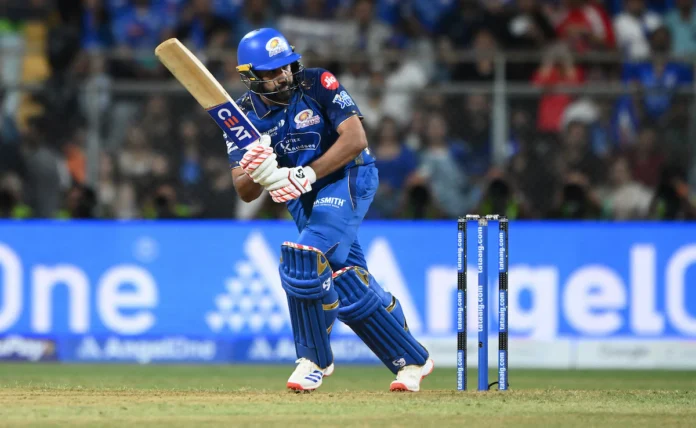

There are players who age gracefully in cricket. And then there is Rohit Sharma who seems to age in reverse the moment he walks out to bat at Wankhede.
Sunday’s IPL 2026 clash between Mumbai Indians and Kolkata Knight Riders was billed as a high-voltage encounter between two of the tournament’s most storied franchises. What nobody quite anticipated was that a 38-year-old, playing his first T20 match since the previous IPL season, would walk out and dismantle a 220-plus target as though the scoreboard were a personal inconvenience.
Rohit’s 78 off 38 balls studded with six sixes and six fours was not just an innings. It was a statement. And somewhere in the record books, Virat Kohli’s name quietly moved one place down.
The Knock That Rewrote History
Mumbai Indians needed 221 to win. It is the kind of target that forces teams to play percentage cricket, rotate strike, and hope the middle order fires. Rohit had other ideas.
From the first over, he was into his work picking gaps with the casual certainty of a man who has seen every bowling plan ever conceived against him. The sixes were not slogged. They were placed. There is a quality to Rohit’s best hitting that looks less like power and more like geometry the ball simply ends up where the fielders are not.
His opening partnership with South African Ryan Rickelton became the backbone of the chase. The two added 148 runs together, a stand that effectively decided the match before the middle overs arrived. Rickelton, for his part, was outstanding his 81 off 43 balls was the highest score of the innings and reflected a maturity that belied his relative inexperience at this level. But it was Rohit who set the tone, the tempo, and ultimately the record.
During his innings, Rohit surpassed Virat Kohli’s long-standing mark for the most runs scored by any player against a single team in IPL history. Rohit now has 1,161 runs across 36 IPL appearances against KKR — spread across his time with the now-defunct Deccan Chargers and his defining years with Mumbai Indians. Kohli’s previous benchmark of 1,159 runs against Punjab Kings, accumulated over a lengthy career, had stood as the gold standard of focused, consistent excellence against one opponent.
It no longer does.
The Numbers Behind the Legend
Records in cricket can sometimes feel like administrative footnotes numbers that accumulate over time without saying much about the player. This one is different.
To score 1,161 runs against a single team across two different franchises, over what is now a remarkably long T20 career, requires something beyond talent. It requires consistency at the highest level, sustained across seasons and decades. Rohit has played against KKR in different eras of the IPL when the pitches were different, the rules were different, the bowling attacks were different and he has kept scoring.
He is now only the fourth player in IPL history to register 50 or more half-centuries, joining Kohli (72), David Warner (66), and Shikhar Dhawan (53) in that exclusive company. He is also among only four batters in the tournament’s history to have crossed 6,000 career runs.
The broader statistical picture only deepens the appreciation. Rohit’s best IPL season remains 2013 the year he scored 538 runs and lifted MI to their maiden title as captain. That season began his most consequential chapter in the competition: eleven years of captaincy, five IPL trophies with Mumbai Indians, and one with Deccan Chargers before that. Six titles in total, making him the joint-most successful captain in IPL history.
What Sunday Meant
Mumbai Indians chased down KKR’s 220/4 with five balls to spare. The clinical nature of the victory achieved without panic, without a dramatic last-over finish spoke to the confidence that Rohit’s innings injected from the very first ball.
There had been genuine questions coming into this match about Rohit’s form and relevance in a format that increasingly rewards youth, pace, and innovation. He had not played a T20 game since the last IPL season. At 38, in a tournament where careers peak and fade within a few seasons, his place in the side was under quiet scrutiny.
He answered every question in 38 deliveries.
Cricket has a long history of great players who outstay their welcome who hang on a season too long and leave on a flat note. Rohit Sharma appears determined to write a different ending. Not a farewell tour. Not a lap of honour. Just another innings, another record, another win.
As he walked back to the pavilion on Sunday, the Wankhede roared. It sounded less like applause and more like recognition the crowd acknowledging something they had seen before and were grateful to see again.
Some players belong to an era. Rohit Sharma, apparently, belongs to every one of them.