





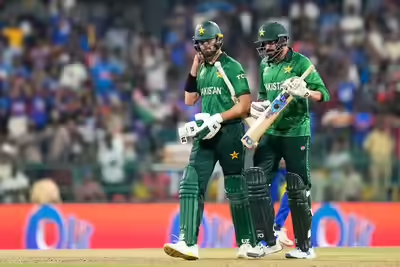

Pakistan’s crushing 61-run defeat to India in the ICC Men’s T20 World Cup has triggered sharp criticism from one of the country’s most outspoken cricketing voices. Former captain Shahid Afridi has urged team management to make “tough calls,” suggesting that several senior players be dropped ahead of the must-win clash against Namibia.
India, led by Suryakumar Yadav, dominated the Group A encounter at R. Premadasa Stadium, exposing gaps in Pakistan’s batting approach and bowling execution. The result leaves Pakistan in a precarious position, with qualification hopes hanging by a thread.
Speaking on Samaa TV shortly after the defeat, Afridi did not mince words. He called for the exclusion of senior players including Babar Azam, Shadab Khan and Shaheen Shah Afridi, arguing that extended opportunities over the years have not translated into consistent performances in high-pressure tournaments.
“Drop Shaheen, drop Shadab, and drop Babar. Try fresh faces against Namibia and give new players a chance to build confidence,” Afridi said. “They’ve been playing for a long time. Whenever we expect them to perform, they don’t. If the senior players are not delivering, why not try the juniors sitting on the bench?”
The remarks are particularly striking given that Shaheen Shah Afridi is married to Afridi’s daughter, Ansha. However, the former all-rounder appeared determined to separate personal ties from professional accountability, emphasising performance as the only metric that should matter at the international level.
A Defeat That Raised Questions
India’s performance was clinical. After setting a challenging target, their bowlers maintained pressure throughout, capitalising on early breakthroughs. Pakistan struggled to recover after losing wickets in the powerplay, and the middle order failed to stabilise the chase.
Pakistan captain Salman Ali Agha acknowledged that execution was lacking across departments. “We were believing in our spinners, and they had an off day today,” he said in the post-match presentation. “Execution was missing in some parts of the game.”
He admitted that losing early wickets in T20 cricket places teams under sustained pressure. “If you lose three or four wickets in the powerplay, you are always chasing the game,” Salman noted, adding that the team did not adapt effectively to conditions.
According to the captain, the surface was slightly tacky during the first innings, offering grip for spinners. However, he conceded that Pakistan’s bowlers did not adjust plans effectively and that the batting unit failed to apply itself in the chase.
Growing Scrutiny on Senior Players
Pakistan’s senior core including Babar Azam and Shaheen Shah Afridi has carried the team through several ICC tournaments in recent years. Yet inconsistency at key moments continues to draw criticism from former players and analysts.
Afridi’s comments reflect broader frustration within sections of Pakistan’s cricketing community. Critics argue that while talent is not in question, adaptability and mental resilience under tournament pressure remain concerns.
The suggestion to test bench strength ahead of a decisive group match is controversial. Dropping experienced players in a must-win scenario carries risk, but Afridi believes fresh energy could inject urgency into a struggling lineup.
Observers note that Pakistan’s talent pipeline remains strong, with domestic performers awaiting international opportunities. However, transitioning from established names to emerging prospects mid-tournament would represent a dramatic shift in strategy.
Tactical vs Structural Concerns
Beyond individual performances, analysts have highlighted structural issues. Pakistan’s T20 approach has often relied on anchoring innings rather than aggressive tempo in the powerplay. In contrast, India’s flexible batting order and aggressive strokeplay have set the benchmark in modern T20 cricket.
Similarly, Pakistan’s bowling attack, long considered its strength, appeared unable to contain India’s middle-order surge. Field placements, bowling changes and situational awareness have come under scrutiny.
The loss also intensifies pressure on team management to reassess selection philosophy. Loyalty to senior players has historically provided stability, but tournament cricket often demands swift recalibration.
A Crucial Test Ahead
Pakistan now faces a pivotal clash against Namibia. Victory alone may not guarantee progression, depending on net run rate calculations and other group results. The margin of defeat to India has further complicated qualification mathematics.
For Afridi, the path forward requires decisiveness rather than incremental tweaks. “What is the difference?” he questioned during the live broadcast, implying that persistence with underperforming seniors may yield the same outcome as bold experimentation.
Whether team management heeds that advice remains uncertain. Historically, Pakistan cricket has oscillated between patience and abrupt overhaul in response to major defeats.
The Broader Impact
High-profile criticism from former legends often shapes public discourse in Pakistan cricket. Afridi’s stature ensures that his remarks will resonate with fans and selectors alike.
At the same time, abrupt changes in tournament settings can destabilise team cohesion. Coaches must weigh immediate competitive needs against long-term squad development.
For now, Pakistan stands at a crossroads balancing faith in experience against the promise of youth. The coming match may not only determine their tournament fate but also influence the direction of their T20 strategy moving forward