





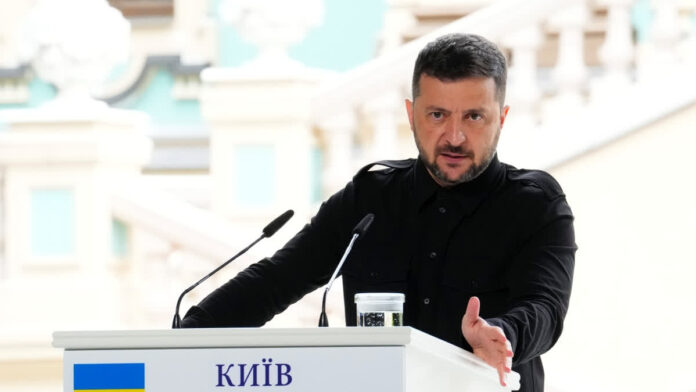

More than three years into one of Europe’s bloodiest modern wars, Ukraine’s President Volodymyr Zelensky has again called for direct talks with Russian President Vladimir Putin—describing it as the “most effective way forward” toward peace. His remarks, made on Ukraine’s Independence Day, came as signs of both battlefield escalation and diplomatic deadlock continue to define the conflict.
While prisoner exchanges between the two sides have quietly continued, breakthroughs remain elusive. Russia, for its part, has rejected the idea of an immediate summit between the two leaders. But Zelensky appears undeterred, betting that high-level dialogue might unlock what years of warfare have not: an end to a conflict that has displaced millions, redrawn borders, and disrupted global security.
A Push for Talks Amid Rising Tensions
Ukraine’s position remains clear—diplomacy must be pursued, even as fighting intensifies. Speaking at a formal ceremony in Kyiv attended by Western envoys, including US representative Keith Kellogg, President Zelensky reaffirmed his commitment to “push Russia to peace.” He reiterated that leader-to-leader dialogue remains the most practical path forward.
“The format of talks between leaders is the most effective way,” Zelensky said, renewing his appeal for a summit with Putin.
The Ukrainian president’s statement comes against the backdrop of Washington’s efforts, led by President Donald Trump, to broker high-level negotiations. However, those hopes were quickly dampened as Moscow publicly dismissed the idea of an immediate meeting. Russia’s Foreign Minister Sergei Lavrov accused the West of using Ukraine’s overtures as a pretext to block broader diplomatic engagement, calling Zelensky’s summit push “unrealistic at any cost.”
Despite the rhetoric, some humanitarian channels remain open. Over the weekend, Ukraine and Russia exchanged 146 prisoners each, continuing a pattern of limited but ongoing cooperation. Notably, among those released were two Ukrainian journalists, Dmytro Khyliuk and Mark Kaliush, whose detention had been condemned by Reporters Without Borders as unlawful and abusive.
Independence Day: Symbolism Meets Strategy
Ukraine’s 33rd Independence Day—marking its separation from the Soviet Union in 1991—was celebrated not only with national pride, but also with intensified military operations.
Ukrainian forces claimed the recapture of three villages in the Donetsk region, even as Russia announced territorial gains elsewhere. General Oleksandr Syrsky confirmed the Ukrainian advances, reinforcing Donetsk’s status as a symbolic and strategic battleground, and increasingly, the focal point of post-war negotiations.
Drone Wars and Nuclear Risks
The day also saw drone strikes from both sides, underscoring how the nature of warfare has evolved since 2022. Ukraine targeted Russian oil infrastructure—including the Kursk Nuclear Power Plant and a fuel terminal in Ust-Luga, igniting fires but causing no reported casualties or radiation leaks.
Russia responded with a barrage of 72 Iranian-made Shahed drones and a ballistic missile strike. Ukraine claimed it intercepted 48 of the drones, but one Russian drone killed a woman in Dnipropetrovsk.
The International Atomic Energy Agency (IAEA) has repeatedly expressed concern about combat activity around nuclear sites, warning that these attacks increase the risk of a cross-border catastrophe.
The Geopolitical Stage: Global Voices, Mixed Messages
In a symbolic show of international support, Zelensky acknowledged messages from a wide range of world leaders—including Donald Trump, Xi Jinping, Emmanuel Macron, King Charles, and Pope Leo.
Standing beside foreign dignitaries, Canadian Prime Minister Mark Carney pushed back against Russia’s opposition to future Western military presence in Ukraine, stating firmly:
“It is not Russia’s choice how Ukraine’s sovereignty is protected.”
Meanwhile, Norway pledged $700 million to co-deliver US-made Patriot missile systems alongside Germany, highlighting ongoing defense support from NATO countries.
‘Ukraine Is Not a Victim; It Is a Fighter’
Zelensky struck a defiant tone in his Independence Day address:
“Ukraine has secured its independence. Ukraine is not a victim; it is a fighter.”
He also called for a future role for foreign troops as peacekeepers once hostilities end, a proposition Russia strongly opposes.
A War Without End—For Now
Russia still controls approximately 20% of Ukrainian territory, including Crimea, annexed in 2014. Despite calls from Kyiv and the West for an immediate ceasefire, Moscow remains unmoved. The war continues to exact a devastating human toll, but within that ongoing tragedy, there are flickers of diplomacy—however fragile.
Zelensky’s message to the world is clear: Ukraine may not yet have won the war, but it has won the right to be heard—and the resolve to determine its own future.