





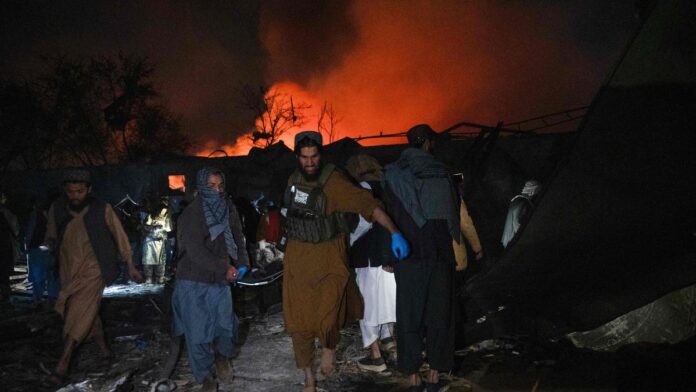

A devastating airstrike in Kabul has triggered a sharp diplomatic confrontation between Afghanistan and Pakistan, after Afghan officials claimed that a medical facility treating drug users was struck, leaving at least 400 people dead and over 250 injured.
According to Afghan authorities, the strike occurred late Monday night and caused widespread destruction to a rehabilitation hospital in the capital. Deputy government spokesperson Hamdullah Fitrat said emergency responders were still working to control fires and recover bodies from the debris as of Tuesday morning.
“The scale of destruction is immense,” Fitrat said in a statement posted on social media. “Large sections of the hospital have been completely destroyed, and rescue teams are continuing operations under extremely difficult conditions.”
Conflicting Narratives Emerge
While Afghan officials insist the airstrike directly hit a civilian healthcare facility, Pakistan has strongly denied the allegation.
In a statement released by Pakistan’s Ministry of Information, authorities said the military operation targeted what it described as “terrorist infrastructure” and military installations linked to militant groups. The statement emphasized that the strikes were carried out with precision to avoid civilian casualties.
Pakistan’s position was reinforced by officials close to Prime Minister Shehbaz Sharif, who described the Afghan claims as “false and misleading.” Islamabad maintains that the operation focused on neutralizing threats posed by militant networks allegedly operating from Afghan territory.
Hospital Allegedly Destroyed
Afghanistan’s Health Ministry spokesperson Sharafat Zaman told local media that the targeted facility, a rehabilitation center for drug users, had been almost entirely destroyed in the strike. According to Afghan authorities, many of the victims were patients undergoing treatment at the time of the attack.
Government spokesperson Zabiullah Mujahid condemned the incident, calling it a violation of Afghanistan’s sovereignty and international norms. He stated that the majority of casualties were civilians, further intensifying outrage within the country.
Footage aired on local television showed firefighters battling flames and smoke rising from the ruins of a heavily damaged structure. The images have fueled public anger and raised concerns about the humanitarian impact of escalating military operations.
Rising Border Tensions
The alleged airstrike comes amid rapidly worsening relations between the two neighboring countries. Cross-border clashes have intensified in recent weeks, marking one of the most severe escalations in years.
Afghan officials reported that earlier exchanges of fire along the border resulted in civilian casualties, including children. In Khost Province, mortar shells reportedly struck residential areas, destroying homes and injuring multiple people.
Pakistan, meanwhile, has accused Afghanistan of harboring militant groups responsible for attacks inside its territory. These include factions such as the Pakistani Taliban, which Islamabad considers a major security threat.
The situation has led Pakistani authorities to describe the ongoing conflict as an “open war,” reflecting the seriousness of the escalation.
International Concerns Mount
The violence has drawn international attention, with the United Nations Security Council urging Afghan authorities to intensify efforts to combat terrorism. In a recent resolution, the council condemned all forms of terrorist activity and extended the mandate of its political mission in Afghanistan.
Although the resolution did not directly mention Pakistan, it highlighted the growing instability in the region and the need for coordinated efforts to prevent further escalation.
Analysts warn that continued hostilities could destabilize an already fragile region, complicating humanitarian efforts and increasing the risk of broader conflict.
Escalation and Retaliation
The latest developments follow a series of retaliatory strikes and counterattacks between the two countries. Pakistan has conducted multiple air operations targeting sites it claims are used for planning attacks against its citizens.
In response, Afghan authorities have accused Pakistan of indiscriminate strikes and civilian casualties. Both sides have presented sharply different casualty figures, making independent verification difficult.
Pakistani President Asif Ali Zardari recently accused Afghanistan’s leadership of crossing a “red line” by allegedly deploying drones that injured civilians inside Pakistan. Kabul has rejected these claims.
Humanitarian Impact
Beyond the political and military implications, the humanitarian toll of the conflict continues to rise. Hospitals, homes, and civilian infrastructure have reportedly been damaged, leaving many without access to essential services.
Afghanistan’s Deputy Prime Minister Abdul Salam Hanafi described the situation as a “forced conflict,” expressing regret over civilian casualties and emphasizing the need to defend national sovereignty.
Relief agencies warn that continued violence could overwhelm emergency services and deepen the crisis for vulnerable populations already affected by years of instability.
Uncertain Path Ahead
The current escalation traces back to late February, when cross-border tensions reignited following earlier airstrikes and retaliatory actions. A ceasefire brokered in October had temporarily reduced hostilities, but recent events have effectively collapsed that fragile agreement.
With both sides firmly holding their positions and accusations continuing to escalate, prospects for immediate de-escalation appear uncertain.
As rescue teams continue their work in Kabul, the international community faces mounting pressure to intervene diplomatically and prevent further loss of life in a conflict that shows no clear signs of slowing.