





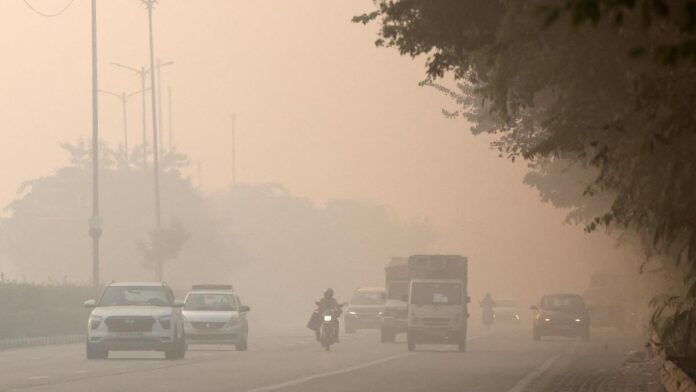

Delhi’s air quality plunged into the ‘severe’ category on Tuesday, prompting authorities to implement emergency pollution-control measures across the National Capital Region (NCR). The Commission for Air Quality Management (CAQM) has ordered an immediate ban on construction and demolition activities in the entire region, while schools up to Class 5 will shift to hybrid learning.
The Central Pollution Control Board (CPCB) defines ‘severe’ air quality as a condition that affects even healthy individuals and poses serious risks to those with existing respiratory or cardiac ailments. The worsening conditions led the CAQM to invoke Stage 3 of the Graded Response Action Plan (GRAP) a set of temporary but stringent restrictions designed to curb air pollution during critical episodes.
Under these measures, the use of BS-III petrol and BS-IV diesel light motor vehicles has been prohibited in Delhi, Gurugram, Faridabad, Ghaziabad, and Gautam Buddh Nagar. Ongoing restrictions under Stages I and II of GRAP including bans on waste burning, dust control protocols, and limitations on certain industrial activities will continue to remain in force.
The CAQM further directed the governments of Delhi, Haryana, Uttar Pradesh, and Rajasthan to implement Stage 3 restrictions “with immediate effect” across all NCR districts. “Keeping in view the prevailing trend of air quality, and in an effort to prevent further deterioration, the Sub-Committee has decided to invoke all actions under Stage III of the extant GRAP with immediate effect,” the Commission said in a statement.
According to the guidelines, schools up to Grade 5 in Delhi and adjoining NCR districts will be required to conduct classes in hybrid mode a combination of online and physical attendance wherever feasible. The directive aims to reduce children’s exposure to toxic air while ensuring continuity in education.
During winter months, Delhi’s air quality routinely dips due to low wind speeds, vehicle emissions, industrial activity, and stubble burning across northern India. The GRAP framework categorizes air quality into four escalating stages Stage I (Poor, AQI 201–300), Stage II (Very Poor, AQI 301–400), Stage III (Severe, AQI 401–450), and Stage IV (Severe Plus, AQI above 450).
With the AQI crossing the 420 mark on Tuesday, Delhi’s toxic haze once again underscored the capital’s struggle to breathe clean air during the onset of winter.