





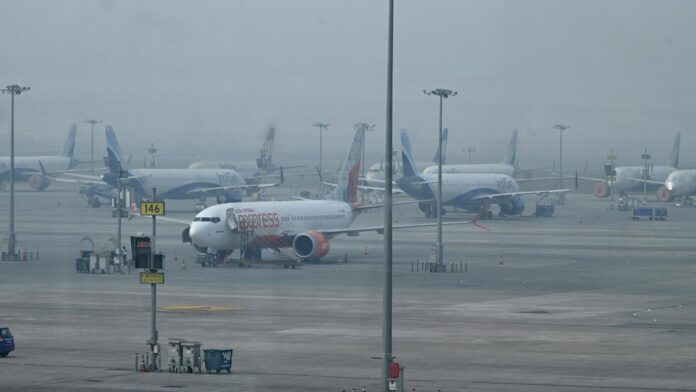

Delhi woke up to hazardous air conditions on Monday as the city’s Air Quality Index (AQI) crossed the 400 mark, slipping into the “severe” category. A thick blanket of fog and smog reduced visibility across the capital and large parts of northern India, disrupting flight operations and prompting advisories from the government, airports, and airlines.
The Ministry of Civil Aviation issued a travel advisory after multiple flights faced delays due to low visibility caused by dense fog. Officials warned that similar disruptions could continue as weather conditions remain unfavourable.
Government Issues Travel Advisory
In a statement shared on social media, the Ministry of Civil Aviation said foggy conditions across northern India were affecting flight operations at select airports. The ministry advised passengers to remain updated through official airline communication channels and to plan their journeys with extra buffer time.
“Due to fog conditions across parts of Northern India, flight operations at select airports may be impacted, leading to possible delays,” the ministry said. It also urged travellers to allow additional time for airport arrival and check-in procedures.
To assist passengers, the ministry shared customer support contact details for major airlines and encouraged flyers to verify flight status before leaving for the airport.
Airlines Closely Monitor Situation
Major airlines issued their own advisories as visibility remained poor across Delhi and nearby regions. IndiGo said dense fog covered several airports in northern India, which could impact both arrivals and departures through the day.
“If reduced visibility persists, flight departures and arrivals may be affected as the day progresses,” IndiGo said. The airline added that its teams were closely monitoring the situation and making operational adjustments to minimise passenger inconvenience.
IndiGo also advised travellers to check flight status before heading to the airport and to factor in additional travel time, as fog could slow road traffic as well.
Air India echoed similar concerns and said it had taken proactive steps to reduce disruptions. The airline assured passengers that timely updates would be shared through registered contact details and official digital platforms.
Delhi Airport Operating Under CAT III Conditions
Delhi’s Indira Gandhi International Airport confirmed that flight operations were taking place under CAT III conditions due to dense fog. CAT III allows aircraft equipped with advanced landing systems to operate during extremely low visibility, but delays and cancellations remain possible.
“Flight operations are currently being carried out under CAT III conditions due to dense fog,” the airport said in a statement. Ground teams remained deployed on-site to assist passengers and manage operations smoothly.
The airport advised travellers to contact their respective airlines for the latest updates and expressed regret for any inconvenience caused.
AQI Touches 402, Several Areas Worse
The deterioration in flight operations came as Delhi’s air quality worsened sharply. According to data from the Central Pollution Control Board (CPCB), the AQI touched 402 at 8 am on Monday, placing the city in the “severe” category.
For comparison, Delhi recorded an AQI of 390 on Sunday afternoon, which fell under the “very poor” category. Several parts of the city reported AQI levels well above 400.
Anand Vihar recorded an AQI of 455, making it one of the most polluted areas. Bawana followed closely with 411. Other hotspots included Wazirpur (443), Rohini (442), Punjabi Bagh (426), and Patparganj (431), all of which remained in the “severe” category.
Some areas showed marginally better air quality but still remained unhealthy. Dwarka Sector 8 recorded an AQI of 400, while IGI Airport Terminal 3 stood at 318. IIT Delhi registered 358, and Najafgarh recorded 353, all falling under the “very poor” category.
Dense Fog Reduces Visibility Across Capital
Apart from pollution, dense fog further worsened conditions across Delhi. Visibility dropped sharply in several areas, forcing motorists to drive with headlights switched on even during morning hours.
Thick fog settled in Anand Vihar, compounding the impact of severe pollution. Similar conditions were reported in Dhaula Kuan, Akshardham, Dwarka, Kartavya Path, and other parts of the city.
Residents reported discomfort due to cold temperatures, reduced visibility, and poor air quality. Health experts continue to warn that prolonged exposure to such conditions can aggravate respiratory and cardiovascular illnesses, particularly among children, the elderly, and people with existing health conditions.
Advisory for Passengers and Residents
Authorities urged residents and travellers to remain cautious over the coming days. Passengers were advised to monitor airline updates, avoid unnecessary travel, and allow extra time for commuting.
With weather conditions expected to remain challenging, officials stressed the importance of preparedness and patience. While hopes remain for clearer skies, Delhi continues to grapple with the combined effects of winter fog and severe air pollution, disrupting daily life and travel across the region.