





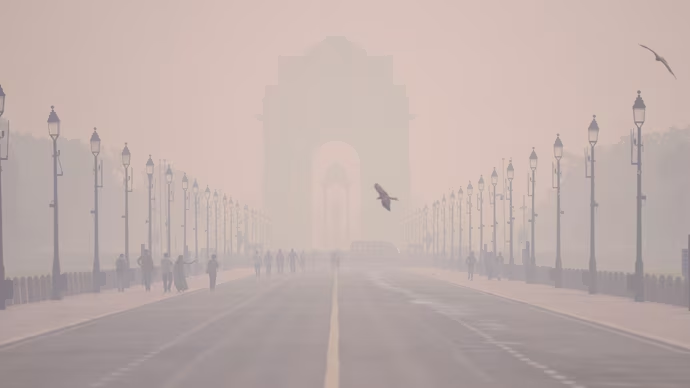

In a desperate attempt to combat the capital’s worsening air pollution, a cloud-seeding trial was carried out over parts of Delhi on Tuesday. The aircraft conducting the operation, based in Kanpur, Uttar Pradesh, has returned after completing the initial run, officials confirmed.
The trial aimed to trigger artificial rainfall over the city, which has been blanketed in a dense layer of toxic smog since Diwali. However, officials cautioned that rain is unlikely before 5 p.m., citing low moisture levels below 20 per cent in the clouds currently hovering over the city. Such conditions, experts said, make precipitation highly improbable.
If the first attempt fails, a second flight may be launched from Kanpur later in the day, depending on weather conditions.
Delhi’s First Cloud Seeding Project
The Delhi government, in collaboration with the Indian Institute of Technology (IIT), signed an MoU in September to conduct five cloud-seeding trials between October 1 and November 30, at a total cost of ₹3.21 crore. All operations are planned over north-west Delhi, which routinely records some of the city’s highest pollution levels.
Cloud seeding involves dispersing substances such as silver iodide nanoparticles, iodised salt, or dry ice into the atmosphere to encourage rainfall. The process is used globally to ease drought, reduce hail, or clear fog, and can be executed through aircraft, rockets, or ground-based generators.
Why Delhi Needs Artificial Rain
Delhi’s air quality has once again plummeted to hazardous levels, as pollution from farm fires, firecracker smoke, and winter weather stagnation combine to trap toxins over the city. Despite a 77.5 per cent fall in stubble-burning incidents compared to last year, the capital recorded its worst post-Diwali air quality in five years.
The city’s average PM2.5 concentration hit 488 µg/m³, nearly 100 times above the WHO’s safe limit, and over 200 per cent higher than pre-Diwali readings.
The situation worsened further despite the Supreme Court’s allowance for “controlled” use of green crackers this Diwali rules that were widely flouted. The morning after the festival, the city awoke under a thick, grey haze, underscoring the futility of the restrictions.
Capital Gasping for Air
As of 8 a.m. Tuesday, the Air Quality Index (AQI) remained in the severe category across most of Delhi Siri Fort (350), RK Puram (320), Bawana (336), Burari Crossing (326), Dwarka Sector 8 (316), Mundka (324), Narela (303), and Punjabi Bagh (323).
The persistent smog has become a grave public health concern. A report by the Energy Policy Institute at the University of Chicago warned that prolonged exposure to Delhi’s pollution could reduce residents’ life expectancy by nearly 12 years, compared to WHO standards.
Hope in the Clouds
Authorities are pinning their hopes on artificial rain to provide at least temporary relief from the suffocating pollution. If successful, the rainfall could help settle airborne pollutants and improve visibility across the city.
For now, however, all eyes remain on the sky and on whether science can deliver a few much-needed drops of relief for the capital’s weary citizens.