





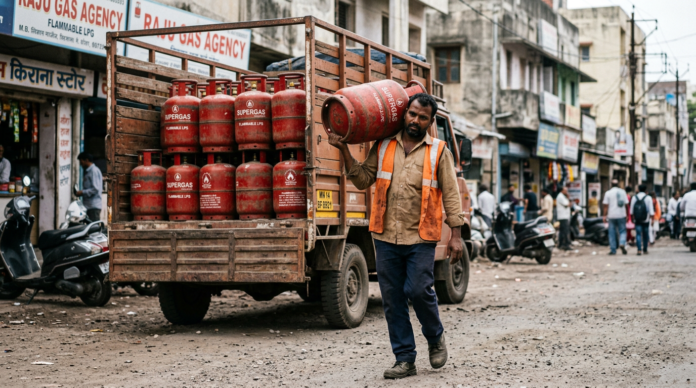

Household cooking gas prices across India have been increased once again, with the government approving a hike in the price of domestic LPG cylinders and commercial cooking gas. The revised rates, which came into effect on March 7, raise the price of a standard 14.2-kg household LPG cylinder by ₹60 nationwide, while commercial cylinders used by businesses have become costlier by ₹115.
The latest price revision comes at a time when global energy markets are experiencing heightened volatility due to geopolitical tensions in the Middle East, particularly the ongoing Iran-related crisis that has raised concerns about oil supply routes and global fuel prices.
Impact on Household Consumers
For millions of Indian households that rely on LPG for daily cooking, the price increase represents a noticeable jump in monthly household expenses.
In Delhi, the price of a 14.2-kg domestic LPG cylinder has increased from ₹853 to ₹913. Similar increases have been implemented across major cities.
In Mumbai, the price has risen from ₹852.50 to ₹912.50. Kolkata has seen the cylinder price climb from ₹879 to ₹939, while in Chennai the cost has increased from ₹868.50 to ₹928.50.
This marks the first revision in domestic LPG prices since April 2025, when rates had remained unchanged for nearly a year. During that period, international energy prices fluctuated but domestic cooking gas prices were largely kept stable.
With the new increase now in place, analysts say the adjustment reflects rising input costs and global energy pressures.
Businesses Face Higher Costs
The impact of the price hike is expected to be particularly significant for commercial establishments that depend heavily on LPG cylinders.
Hotels, restaurants, street food vendors, catering services and small food businesses typically use the larger 19-kg commercial LPG cylinders. These cylinders have now become ₹115 more expensive.
In Delhi, the price of a commercial LPG cylinder has increased from ₹1768.50 to ₹1883. Mumbai has seen prices move from ₹1720.50 to ₹1835.
In Kolkata, the cost has gone up from ₹1875.50 to ₹1990, while Chennai has witnessed an increase from ₹1929 to ₹2043.50.
Industry representatives warn that the higher fuel costs could eventually translate into slightly higher food prices, particularly for small eateries operating on thin profit margins.
Energy Supply Concerns Amid Global Tensions
The price revision coincides with global anxiety surrounding energy supplies due to tensions in the Middle East, particularly the risk of disruptions along the Strait of Hormuz one of the world’s most critical oil shipping routes.
Despite these concerns, the Indian government has sought to reassure consumers that there is no immediate threat to domestic energy availability.
Union Minister for Petroleum and Natural Gas Hardeep Singh Puri recently emphasized that India’s fuel supply position remains stable.
“Our priority is to ensure the availability of affordable and sustainable fuel for our citizens. There is no shortage of energy in India, and consumers should not worry about supply disruptions,” Puri said in a statement shared on social media.
Government Says Fuel Stocks Are Adequate
Officials have stressed that India currently maintains sufficient reserves of crude oil and petroleum products to meet domestic demand.
Government sources indicated that India’s diversified energy import strategy has significantly reduced the risk of supply shocks linked to any single region.
Even if shipping disruptions were to affect energy flows through the Strait of Hormuz, authorities believe alternative supply sources could offset potential shortfalls.
India has steadily expanded its crude oil import network over the past few years, sourcing energy from multiple countries in order to strengthen energy security.
Growing Role of Russian and US Supplies
One notable shift in India’s energy strategy has been the sharp increase in crude imports from Russia since 2022.
Earlier accounting for only a tiny share of India’s energy imports, Russian crude now forms a much larger portion of the country’s oil basket.
Government sources say that in February alone, India imported roughly 1.04 million barrels per day of crude oil from Russia, accounting for about 20 percent of total imports.
In addition to Russian crude, India has also begun importing larger volumes of liquefied petroleum gas from the United States.
LPG shipments from the US began arriving in India earlier this year after public sector oil companies signed a one-year agreement in November 2025 to import around 2.2 million tonnes per annum from the US Gulf Coast during the 2026 contract period.
Production Boost Ordered
To ensure adequate domestic supply, the government has also instructed Indian LPG refineries to increase production levels.
Officials say this measure will help maintain stable LPG availability across the country even as global energy markets remain uncertain.
State-run oil companies, including Indian Oil Corporation, have also moved to counter rumors circulating online about fuel shortages.
In a public statement, Indian Oil said reports suggesting petrol or diesel supply disruptions were incorrect.
“India has sufficient fuel stocks and our supply networks are functioning normally. Citizens should rely only on official information and avoid panic,” the company said.
Balancing Prices and Energy Security
Energy analysts say India faces the complex challenge of balancing domestic affordability with global price pressures.
While subsidies and pricing controls can shield consumers temporarily, rising international energy costs often eventually translate into domestic price adjustments.
The latest LPG price increase highlights how global geopolitical developments can ripple into household budgets thousands of kilometres away.
For now, the government insists that India’s energy security remains strong but the situation in global energy markets will likely continue to influence domestic fuel prices in the months ahead.