





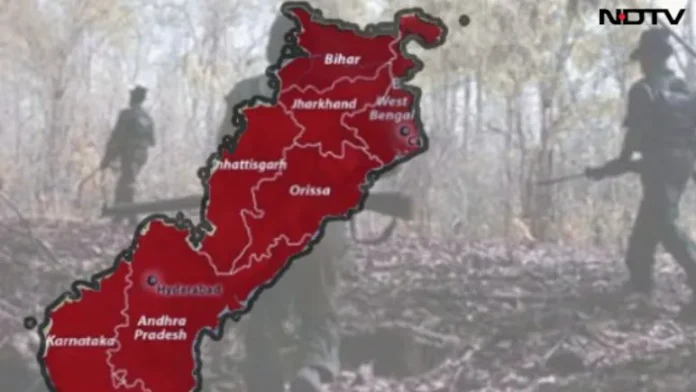

India’s decades-long battle against Left-Wing Extremism appears to be entering its final phase, with the government claiming that Maoism is now “on the verge of extinction.” The announcement marks a significant turning point in a conflict that once stretched across a vast belt of central and eastern India, widely known as the “Red Corridor.” From tribal forests to remote hill districts, the insurgency shaped security policy, development priorities and political discourse for more than sixty years.
The movement traces its roots to a peasant uprising in Naxalbari in West Bengal in 1967. Initially framed as a revolt against feudal land ownership, it quickly evolved into an armed ideological struggle inspired by Maoist doctrine. Over time, the insurgency expanded across multiple states including Andhra Pradesh, Telangana, Chhattisgarh, Jharkhand, Bihar, Odisha, Madhya Pradesh and parts of Karnataka and Kerala. At its peak, the movement influenced hundreds of districts and posed one of India’s most serious internal security challenges.
Why now?
The decline of Maoist influence has been gradual but consistent over the past decade. A combination of sustained security operations, leadership losses, infrastructure development and surrender policies has steadily weakened the insurgent network. Several key commanders have either been killed or surrendered, fragmenting organisational cohesion. Intelligence-led operations in dense forest zones once considered impenetrable strongholds have further restricted movement and logistics.
Simultaneously, governments at both state and central levels increased road connectivity, telecom access, welfare schemes and tribal outreach in previously isolated regions. These measures reduced the appeal of insurgency among local populations, which had historically provided support or shelter. Rehabilitation policies offering financial incentives and reintegration opportunities also encouraged many cadres to surrender. As a result, violence incidents, recruitment and geographical spread have all declined sharply.
The most significant shift occurred in Chhattisgarh’s Bastar region, long regarded as the heart of the insurgency. Security presence expanded deeper into forested pockets, while new camps and road networks improved access. Similar declines were reported in Andhra Pradesh and Telangana, once epicentres of Maoist operations. Karnataka has already been declared Naxal-free, and activity in Kerala remains minimal. Today, only scattered pockets in parts of Chhattisgarh and Jharkhand are believed to have residual presence.
What next?
While the government’s declaration signals progress, experts caution that the end of organised insurgency does not automatically resolve underlying socio-economic issues. Many affected districts still face challenges such as land disputes, tribal displacement, mining conflicts and limited access to education and healthcare. Without sustained development, the risk of localised unrest remains.
The next phase is expected to focus on consolidation strengthening governance in previously affected areas. This includes expanding roads, schools, mobile connectivity, banking access and employment opportunities. Authorities are also expected to increase policing through smaller local units rather than large-scale operations. Intelligence monitoring will remain crucial to prevent regrouping by splinter factions.
Another priority is rehabilitation. Hundreds of former cadres require reintegration into society through livelihood programs, skill development and social acceptance. Successful rehabilitation reduces the possibility of re-radicalisation and helps stabilise fragile regions.
Who cares?
The winding down of Maoist violence has implications far beyond security. Economically, many of the affected regions are rich in minerals such as iron ore, coal and bauxite. Improved stability could accelerate infrastructure projects, mining operations and industrial investment. This, in turn, may boost employment and regional growth.
For local communities, the impact is more immediate. Reduced violence means better mobility, access to markets, education and healthcare. Villages that once faced restrictions due to landmines, ambushes and armed presence can reconnect with administrative systems. Political participation is also expected to increase, with higher voter turnout and local governance becoming more effective.
Strategically, the decline of Maoism allows security forces to reallocate resources to emerging threats, including border security and urban policing. It also strengthens India’s internal stability narrative, which is critical for long-term economic planning and investor confidence.
However, the transition from conflict to peace must be handled carefully. History shows that insurgencies often fade unevenly, leaving behind isolated cells. Continued vigilance, development-led governance and inclusive policies will determine whether the Red Corridor truly becomes a chapter in history.
For now, the government’s claim signals a milestone the possible end of one of India’s longest-running internal conflicts. Whether this marks a permanent resolution or merely a pause depends on what follows: sustained development, responsive governance and long-term engagement with communities that once lived in the shadow of insurgency.