





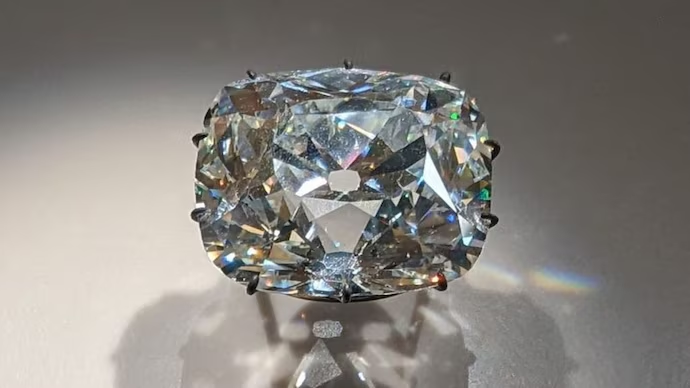

The Regent Diamond one of history’s most fabled gems has once again captured global attention following a recent theft alert in France. Today, it rests safely in the Louvre Museum, but its story stretches across centuries, empires, and betrayals from the depths of an Indian mine to the crowns of European monarchs.
The diamond’s tale begins in 17th-century southern India, within the Kollur mines along the Krishna River. According to legend, a slave discovered the gem during the 1687 siege of Golconda under Emperor Aurangzeb. Desperate to conceal his treasure, the slave hid it inside a wound on his leg. His hope for freedom was short-lived an English sea captain killed him and sold the diamond to Indian merchant Jamchand.
In 1701, Thomas Pitt, Governor of Fort St. George in Madras, acquired the diamond from Jamchand for 48,000 pagodas a vast sum at the time. Pitt secretly shipped the 426-carat stone to England, hidden in the heel of his son’s shoe. After two years of cutting by London craftsman Harris, it was transformed into a dazzling 141-carat cushion-shaped gem. Yet whispers of deceit surrounded its sale satirist Alexander Pope even immortalized Pitt’s alleged greed in verse, and historians later described the episode as a symbol of colonial exploitation.
Failing to sell it in England, Pitt eventually sold the gem in 1717 to Philippe II, Duke of Orléans and Regent of France, for £135,000 equivalent to about £26 million today. The diamond, renamed Le Régent, became part of the French Crown Jewels. It adorned the crowns of Louis XV, Louis XVI, and Charles X, and even embellished Marie Antoinette’s hat.
During the French Revolution, the Crown Jewels were looted, and the Regent disappeared, only to be rediscovered years later in a Paris attic. It was pledged by the revolutionary government to finance wars and later set in the sword hilt of Napoleon Bonaparte.
Following Napoleon’s downfall, his wife Marie Louise of Austria took the diamond to Vienna before it was returned to France. The gem continued to grace royal crowns including those of Louis XVIII and Napoleon III. Since 1887, it has been displayed at the Louvre Museum, mounted in a Greek-style diadem made for Empress Eugénie.
Gemologists regard the Regent as one of the purest diamonds ever cut its flawless clarity and storied past make it a masterpiece of both beauty and betrayal. Weighing 141 carats and valued at over $60 million, it stands as a silent witness to centuries of conquest, ambition, and humanity’s eternal fascination with what glitters.
From the dusty mines of India to the grandeur of French royalty, the Regent Diamond’s journey mirrors mankind’s timeless quest for power a saga where brilliance and bloodshed intertwine beneath the sparkle of a single stone.