





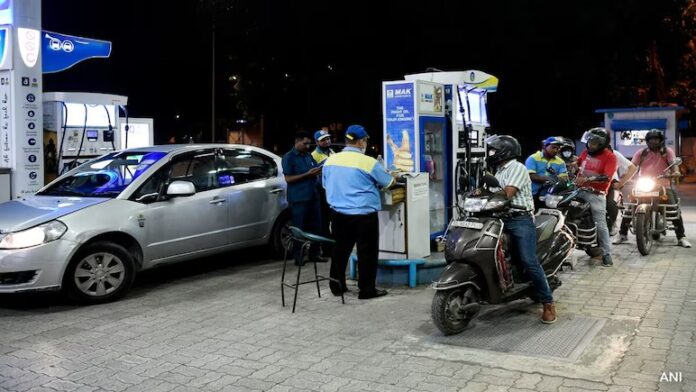

India’s sharp cut in excise duty on petrol and diesel comes at a time when global oil markets are under intense pressure, but for consumers expecting an immediate drop in prices, the reality may be far more complex. On Friday, the Centre reduced excise duty by ₹10 per litre on both fuels, bringing it down to ₹3 per litre for petrol and effectively zero for diesel. While the move appears to signal relief, early indications suggest that the benefit may not translate directly to lower prices at fuel stations.
The decision has been triggered by a sudden spike in global crude oil prices, driven by escalating geopolitical tensions. Brent crude, the global benchmark, has surged from around $70 per barrel to over $120 within weeks following the US-Israel conflict involving Iran and the disruption of oil flows through the Strait of Hormuz. This narrow maritime route is one of the world’s most critical energy corridors, handling nearly a quarter of global seaborne crude shipments. For India, the stakes are particularly high, as roughly 40 to 50 per cent of its crude oil imports pass through this route.
As supply fears intensified, fuel prices across the world surged, with several regions witnessing increases of up to 50 per cent. Against this backdrop, India’s decision to cut excise duty reflects an attempt to shield domestic consumers from a sharp and immediate spike. Petroleum Minister Hardeep Singh Puri underscored this approach, stating that the government chose to absorb part of the financial burden rather than pass it entirely on to citizens.
However, the economics of fuel pricing suggest that the impact of this tax cut may not be visible at the pump at least not immediately. Oil marketing companies (OMCs), which bear the cost of retail fuel sales, are currently facing significant under-recoveries. Industry estimates indicate losses of nearly ₹48.8 per litre due to elevated crude prices. In such a scenario, the reduction in excise duty is likely to be absorbed by these companies to offset losses rather than passed on to consumers as lower prices.
This effectively turns the tax cut into a stabilisation tool rather than a price reduction measure. Instead of making fuel cheaper, it prevents prices from rising even further. The distinction is crucial, especially at a time when inflationary pressures are closely linked to fuel costs. A sudden spike in petrol and diesel prices would have cascading effects across transportation, logistics, and essential goods, amplifying the cost of living.
The broader context also highlights India’s vulnerability to global energy disruptions. The Strait of Hormuz blockade has exposed the risks of heavy dependence on West Asian oil supplies. Beyond crude, India also imports significant quantities of liquefied natural gas and LPG from the region, making energy security a critical concern.
In response, the government has sought to reassure the public that there is no immediate risk of shortages. Officials have stated that India maintains sufficient reserves, with combined stockpiles covering over two months of demand. Efforts are also underway to diversify sourcing, with fast-tracked agreements aimed at securing alternative supplies of crude and LPG.
Despite these measures, the road ahead remains uncertain. If global crude prices continue to stay elevated or rise further, oil marketing companies may eventually be forced to revise retail prices upward. Alternatively, the government could face increasing pressure to extend fiscal support, which would come at the cost of reduced revenue. Either way, the current intervention appears to be a temporary buffer rather than a long-term solution.
For consumers, the immediate takeaway is subtle but significant. While fuel prices may not drop, they are also being prevented from rising sharply at least for now. For businesses, especially those dependent on transportation and fuel-intensive operations, this stabilisation provides short-term predictability in an otherwise volatile environment. For policymakers, the situation underscores the delicate balance between protecting consumers and maintaining fiscal discipline.
Ultimately, the excise duty cut reflects a strategic choice in a moment of global uncertainty. It signals an attempt to cushion the domestic economy from external shocks, even if that relief remains largely invisible at the fuel station. Whether this approach holds will depend on how long the global oil crisis persists and how effectively India can navigate an increasingly unpredictable energy landscape.