





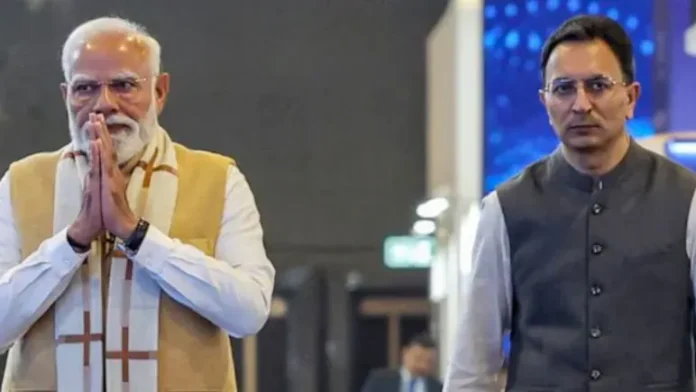

As New Delhi prepares to host the India AI Impact Summit 2026, the gathering is emerging as more than a technology conference. For Prime Minister Narendra Modi, it represents a strategic inflection point an opportunity to reassert India’s global ambitions after a politically and economically challenging year.
Six months ago, the government faced mounting external and domestic pressures. Tensions with Pakistan escalated into an armed confrontation, prompting sharp diplomatic exchanges. At the same time, U.S. President Donald Trump publicly criticized India’s trade policies and imposed steep tariffs on Indian goods. Questions also surfaced about India’s economic trajectory amid global headwinds.
Fast-forward to early 2026, and the landscape appears markedly different. Trade ties with Washington have stabilized, with tariffs on Indian exports reduced to 18%, placing India in a more competitive position relative to several Asian peers. A long-pending free trade agreement with the European Union was finally concluded in January, following nearly two decades of negotiations. Meanwhile, other global leaders including Canada’s Prime Minister Mark Carney are expected to visit India to revive or expand trade engagements.
Against this backdrop, the AI Impact Summit offers Modi a high-visibility platform to signal India’s return to confident global positioning.
A Stage for Strategic Signalling
The summit will bring together more than a dozen heads of state and some of the most influential figures in artificial intelligence, including OpenAI CEO Sam Altman, Alphabet’s Sundar Pichai, and Anthropic’s Dario Amodei. The scale of participation underscores India’s growing relevance in global AI conversations.
For Modi, the optics are significant. Nearly two years into his third term, he is seeking to consolidate his political authority and reinforce India’s image as a rising economic power. Analysts suggest that technology diplomacy particularly in AI allows him to project a forward-looking vision at a time when global innovation ecosystems are being reshaped.
“This summit provides a powerful stage for India to showcase itself as a modernizing force,” said Swaran Singh, professor of international relations at Jawaharlal Nehru University. “It reinforces India’s positioning as both a market and a thought leader.”
Domestic Momentum and Economic Reset
Domestically, the Prime Minister has regained political ground. Following a setback in the 2024 general elections, his party secured decisive victories in Bihar and Delhi state polls last year. Economically, the government has introduced labor reforms and revamped consumption tax frameworks to stimulate growth.
Official projections estimate economic expansion of up to 7.2% in the upcoming fiscal year, with senior policymakers privately expressing confidence that growth could exceed forecasts, especially after recent trade recalibrations.
India’s appeal to global technology firms has also strengthened. Amazon and Microsoft have committed over $50 billion in new investments, targeting AI infrastructure, cloud services and digital commerce. India’s vast digital user base combined with a relatively open regulatory framework makes it an attractive testing ground for AI-driven consumer applications.
Companies such as Google and OpenAI are offering AI tools at low or no cost to Indian users, viewing the country as a critical growth frontier, particularly as access to China remains constrained for Western tech giants.
The Global South Narrative
A central theme of the summit is expected to be AI governance tailored to the Global South. Indian officials have emphasized inclusive innovation, focusing on practical applications such as health diagnostics, crop advisory systems, digital education and governance platforms.
S. Krishnan, Secretary at the Ministry of Electronics and Information Technology, recently noted that Indian developers are building AI tools for real-world public service delivery solutions that resonate with emerging economies across Southeast Asia, Africa and the Middle East.
By framing the summit around themes of “People, Planet and Progress,” India aims to balance technological ambition with ethical responsibility. Observers say this narrative strengthens Modi’s aspiration to position India as a voice for developing nations navigating digital transformation.
Structural Risks and Economic Realities
Yet the AI push is not without risks. India’s vast IT services sector employing millions faces disruption as generative AI automates coding, analytics and back-office processes. Shares of major firms such as Infosys and Tata Consultancy Services have experienced volatility amid concerns about margin pressures and workforce adjustments.
Economists caution that India must accelerate job creation to absorb millions of young entrants into the labor market each year. While high growth rates are encouraging, employment elasticity remains a concern.
“AI can be a growth engine, but it could also intensify structural employment challenges,” said political analyst Nilanjan Mukhopadhyay. “The long-term test will be whether innovation translates into inclusive opportunity.”
A Moment of Recalibration
The AI Impact Summit arrives at a moment when global competition for technological leadership is intensifying. For India, it represents a strategic bet: that demographic advantage, engineering talent and digital scale can offset capital constraints and geopolitical uncertainty.
For Modi personally, the summit offers an opportunity to pivot the narrative from a year marked by diplomatic friction and economic skepticism to one defined by forward momentum and strategic partnerships.
Whether the gathering delivers substantive policy breakthroughs or remains largely symbolic will depend on follow-through. But as leaders convene in New Delhi, the message is clear: India intends to be a serious contender in shaping the next chapter of artificial intelligence.