





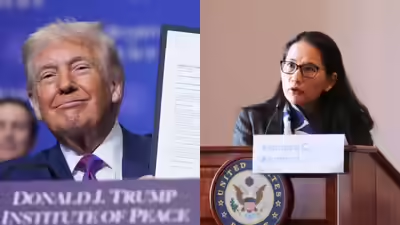

India on Thursday participated as an observer in the inaugural meeting of US President Donald Trump’s newly formed “Board of Peace” on Gaza, signalling diplomatic engagement while refraining from formally joining the initiative.
The meeting, held at the Donald J. Trump Institute of Peace in Washington DC, marked the first official session of the board, which has been proposed as a platform to coordinate post-war reconstruction efforts and facilitate long-term peace in Gaza. India was represented by Chargé d’affaires at the Indian Embassy, Namgya Khampa, according to reports from PTI.
The decision to attend as an observer rather than a member reflects a calibrated approach by New Delhi engaging with emerging diplomatic frameworks without committing to structures whose long-term mandate and global acceptance remain uncertain.
A New Diplomatic Platform
President Trump has pledged $10 billion in US funding for the Board of Peace, positioning it as a key mechanism for rebuilding Gaza following two years of conflict between Israel and Hamas that left large swathes of the territory devastated.
Under the structure outlined by US officials, Trump will retain veto power over board decisions and continue as its head even after leaving office. Countries seeking permanent membership as opposed to an initial two-year term are reportedly required to contribute $1 billion.
The board’s membership currently includes representatives from 27 countries, among them Argentina, Armenia, Azerbaijan, Hungary, Pakistan, Saudi Arabia and the United Arab Emirates. Notably, India was not present at the January 22 unveiling ceremony in Davos where Trump formally announced the initiative.
The executive board, finalised on January 17, comprises diplomats and financial leaders including US Secretary of State Marco Rubio, Jared Kushner and World Bank President Ajay Banga.
Funding and Conditions
Alongside the broader $10 billion pledge, the United States has also outlined a $1 billion initial reconstruction package focused on housing and infrastructure. However, funding is said to be contingent on specific security conditions, details of which have not been fully disclosed.
The proposal has generated debate in diplomatic circles. Supporters argue that a dedicated reconstruction body could streamline decision-making and accelerate aid delivery in a region where international efforts have often been fragmented. Critics, however, question whether the board may duplicate or even compete with existing multilateral institutions such as the United Nations.
Trump has previously suggested that the Board of Peace “might” replace the UN in certain peacekeeping and reconstruction roles, arguing that the UN has not fulfilled its potential in conflict resolution.
India’s Diplomatic Position
India’s participation as an observer underscores its broader foreign policy posture: maintaining strategic autonomy while engaging with diverse international initiatives.
New Delhi has historically supported a two-state solution to the Israel-Palestine conflict and has balanced relations with Israel, Palestine and key Gulf nations. By attending the meeting without joining the board, India appears to be keeping diplomatic channels open while avoiding alignment with any single restructuring model for post-conflict governance.
Diplomatic analysts note that India’s approach allows it to monitor developments closely without being tied to financial commitments or institutional obligations at this stage.
India’s presence at the meeting also signals recognition of the shifting geopolitical landscape. As major powers experiment with alternative diplomatic platforms outside traditional multilateral frameworks, countries like India must weigh engagement against the implications for global governance norms.
Global Reactions and Implications
The Board of Peace is being viewed in some quarters as a test case for new models of conflict resolution financing. With reconstruction costs in Gaza expected to run into tens of billions of dollars, questions remain about funding sustainability, transparency and oversight.
The involvement of financial institutions and private-sector actors on the executive board suggests a hybrid governance model blending state diplomacy with development finance mechanisms.
At the same time, the board’s governance structure particularly the US President’s veto authority may raise concerns among some nations about concentrated decision-making power.
For countries attending as observers, the initiative provides an opportunity to assess operational frameworks, funding modalities and geopolitical ramifications before considering deeper involvement.
A Delicate Balancing Act
India’s measured engagement reflects a consistent pattern in its foreign policy participating in emerging global forums while preserving policy flexibility.
As Gaza reconstruction discussions evolve, India is likely to continue advocating humanitarian support, infrastructure rebuilding and sustainable peace without deviating from its established diplomatic principles.
Whether the Board of Peace gains broader international legitimacy or faces resistance from multilateral institutions will shape its long-term impact.
For now, India’s attendance signals interest, not endorsement a stance that allows New Delhi to remain engaged in a complex and evolving geopolitical landscape without committing prematurely to a contested framework.