





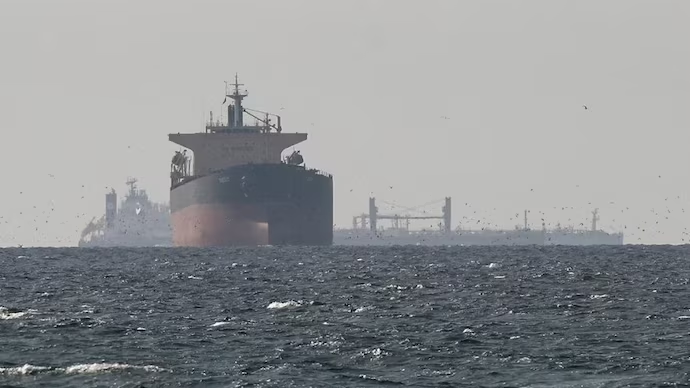

India has secured assurances for the safe passage of its oil tankers through the strategically vital Strait of Hormuz following high-level diplomatic talks between External Affairs Minister S. Jaishankar and Iran’s Foreign Minister Abbas Araghchi, according to government sources. The development comes at a critical moment as escalating tensions in West Asia threaten one of the world’s most important energy transit routes.
The diplomatic engagement reflects New Delhi’s urgent effort to protect its energy supply lines while the conflict involving Iran, Israel, and the United States continues to intensify. With shipping risks increasing in the Persian Gulf region, India moved swiftly to ensure that its crude oil and liquefied petroleum gas (LPG) imports can continue flowing without major disruption.
A Strategic Maritime Lifeline
The Strait of Hormuz, located between the Persian Gulf and the Gulf of Oman, is widely regarded as one of the most crucial maritime chokepoints in the global energy system. Nearly 20 percent of the world’s oil and natural gas shipments pass through this narrow waterway every day.
For India, which imports the majority of its energy requirements, uninterrupted access to this route is vital for maintaining domestic fuel supplies and economic stability.
Sources familiar with the discussions said Iran has agreed to allow Indian oil tankers to continue navigating through the strait, even as vessels linked to the United States, European countries, and Israel are reportedly facing restrictions in the region.
The arrangement followed direct conversations between Jaishankar and Araghchi, with both sides focusing on preventing disruptions to India’s energy shipments during the ongoing geopolitical crisis.
India’s Diplomatic Balancing Act
Beyond the talks with Tehran, India also engaged with other major international stakeholders to assess the evolving security situation in the region. Jaishankar reportedly held discussions with Russian Foreign Minister Sergey Lavrov and French Foreign Minister Jean-Noël Barrot to coordinate diplomatic efforts aimed at maintaining stability in critical maritime routes.
These consultations underscore India’s strategy of maintaining communication with multiple global powers while protecting its national interests during periods of geopolitical uncertainty.
India’s foreign policy approach has increasingly emphasised strategic autonomy engaging with diverse partners while avoiding alignment with any single bloc.
Regional Conflict Raises Shipping Risks
Tensions in the region escalated earlier this month after Iran’s Islamic Revolutionary Guard Corps (IRGC) warned that the Strait of Hormuz could effectively be closed to shipping amid the ongoing confrontation.
Iranian state media reported that vessels attempting to cross the waterway could face potential targeting, a statement that triggered alarm across global energy markets.
The crisis intensified further following reports that Iran’s Supreme Leader Ayatollah Ali Khamenei had been killed in a joint US-Israeli strike, dramatically escalating hostilities in the region.
In response, Iran has taken a series of security measures across the Persian Gulf, increasing concerns about disruptions to global oil supply chains.
Energy analysts warn that even temporary instability in the Strait of Hormuz can ripple through global markets, driving up fuel prices and affecting countries heavily dependent on imports.
Impact on India’s Energy Market
The uncertainty surrounding shipping routes has already begun affecting India’s energy supply chain. Disruptions linked to the conflict and the heightened security environment around the Strait of Hormuz have contributed to a shortage of commercial LPG in several parts of the country.
Restaurants and hotels in major cities including Bengaluru, Chennai, and Mumbai have reported difficulty obtaining LPG cylinders used for cooking, forcing some establishments to cut down operations.
Industry groups claim that deliveries of commercial LPG cylinders have been irregular in recent days, leaving many businesses concerned about possible shutdowns if the situation continues.
Reports suggest that nearly 20 percent of hotels and restaurants in Mumbai have temporarily halted operations due to fuel shortages, while hospitality associations in Chennai have urged the central government to intervene and stabilise supply.
Rising Energy Prices and Public Concerns
Fuel price increases have added to the pressure on consumers and businesses alike. Earlier this month, the price of a 14.2-kg domestic LPG cylinder was raised by ₹60, while the price of commercial LPG cylinders increased by around ₹115.
The supply disruption has also encouraged black-market activity in some regions, with reports suggesting that cylinders are being sold unofficially for as much as ₹2,000 to ₹2,500 in certain areas.
Such developments have heightened public concerns about the country’s fuel availability, particularly as global energy markets remain volatile.
Government Monitoring the Situation
Prime Minister Narendra Modi has directed Union ministers to closely monitor the situation and address concerns related to LPG availability. According to officials, the issue was discussed during a recent Cabinet meeting where ministers were asked to counter misinformation regarding potential supply shortages.
The government has emphasised that the current energy challenges stem largely from international developments rather than domestic policy decisions.
Officials maintain that India has adequate reserves and contingency plans to manage temporary disruptions caused by geopolitical instability.
A Test for Energy Security
The safe passage arrangement for Indian tankers through the Strait of Hormuz represents an important diplomatic success for New Delhi during a volatile period in global politics.
However, experts caution that the broader conflict in West Asia could continue to affect international energy markets and shipping routes in the coming weeks.
For India the world’s third-largest oil importer ensuring stable access to energy supplies will remain a critical priority as the geopolitical situation evolves.