





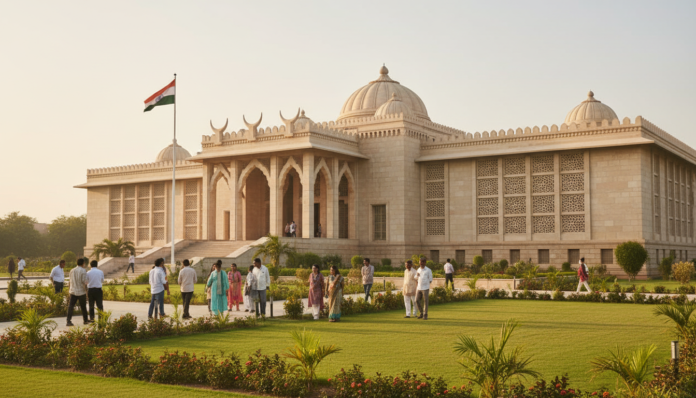

India is preparing to establish its first National Cow Culture Museum in Mathura, Uttar Pradesh, in a project that aims to combine tradition, agriculture, science, and rural economics under one institutional framework. The proposed museum will be developed within the campus of Pandit Deendayal Upadhyaya Veterinary Science University, with officials positioning it as both an educational hub and a cultural landmark for the Braj region.
Authorities say the initiative is designed to move beyond symbolic reverence and present a comprehensive understanding of cattle in Indian society spanning religious belief, agrarian livelihoods, dairy science, biodiversity conservation, and public health.
A Convergence of Faith and Function
Agra Divisional Commissioner Nagendra Pratap said the museum will highlight why cattle occupy a distinctive position in Indian civilisation. While the spiritual dimension of the cow in Sanatan tradition will be acknowledged, the focus will extend to practical contributions in farming systems, dairy production, and rural economies.
According to officials, the project seeks to explain the ecological and economic relevance of cattle through scientific documentation. Exhibits will examine topics such as indigenous breed preservation, sustainable dairy practices, bio-manure usage, and the role of cattle in regenerative agriculture.
“The aim is to help people understand cattle not only through faith but also through their measurable social and economic contributions,” an official associated with the planning process said.
Proposed Features of the Museum
Preliminary plans indicate that the museum will feature approximately 100 curated digital and physical exhibits. These displays will showcase major indigenous cattle breeds across India, including rare and endangered varieties. Officials believe that documenting breed diversity is essential at a time when crossbreeding and commercial pressures have altered traditional livestock patterns.
Interactive sections are expected to explore the science of milk production, dairy processing, and nutritional values of products such as curd, ghee, butter, and cheese. A segment will also examine references to cattle-based products in Ayurvedic literature and their historical use in rural households.
Modern presentation technologies including augmented displays, digital archives, and audiovisual storytelling are likely to be incorporated to make the museum accessible to students, researchers, and general visitors.
In addition, planners have proposed setting up a dairy parlour within the complex, where visitors will be able to purchase fresh dairy products. This component is intended to demonstrate the farm-to-consumer model and encourage awareness of quality-controlled dairy production.
Administrative Backing and Site Inspection
The initiative follows directives from Uttar Pradesh Chief Minister Yogi Adityanath, who has emphasised the integration of cultural heritage with developmental policy in the Braj region.
A team of senior officials recently inspected the identified site within the veterinary university campus. Those present included Braj Teerth Vikas Parishad Vice-President Shailajakant Mishra, District Magistrate C.P. Singh, Mathura-Vrindavan Development Authority Vice-President Lakshmi N., CEO Suraj Patel, environmental adviser Mukesh Sharma, and veterinary expert Amit Shukla.
Officials discussed spatial planning, exhibition themes, infrastructure design, and visitor management systems during the inspection.
Economic and Educational Objectives
Beyond its cultural narrative, the museum is being positioned as an educational institution. Authorities suggest it will serve students of veterinary science, agriculture, and rural development by offering structured modules on indigenous livestock management.
India remains one of the world’s largest producers of milk, and cattle play a central role in sustaining millions of smallholder farmers. By documenting best practices in breed conservation and dairy science, planners hope the museum will contribute to awareness of sustainable livestock economies.
Officials also argue that presenting cattle within an economic framework could strengthen understanding of rural supply chains — from fodder cultivation to dairy cooperatives.
Cultural Context in the Braj Region
Mathura, traditionally associated with Lord Krishna, already draws millions of pilgrims annually. Authorities believe the museum could complement existing religious tourism while expanding its scope toward agricultural education.
The project underscores the cow’s longstanding portrayal as a maternal figure in Indian tradition. However, officials insist the museum will avoid purely symbolic representation and instead adopt a research-oriented and documentation-driven approach.
The Braj region’s identity, they argue, is closely linked with pastoral traditions. By institutionalising that heritage, the state aims to create a centre that attracts scholars, tourists, and policymakers alike.
Looking Ahead
While timelines for completion have not yet been formally announced, authorities indicate that architectural design and exhibit planning are in advanced stages. Funding modalities and public-private collaboration models are also under consideration.
If implemented as envisioned, the National Cow Culture Museum would represent a first-of-its-kind initiative in India — attempting to institutionalise livestock heritage through a combination of cultural documentation and scientific exposition.
Whether it becomes primarily a tourism attraction or evolves into a research-driven institution will depend on execution, curatorial depth, and sustained academic engagement.