





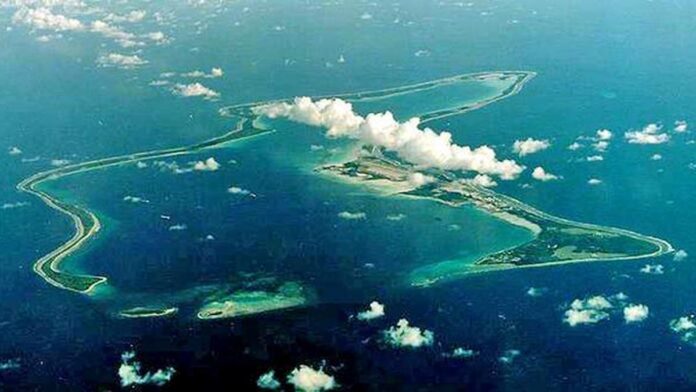

The ongoing conflict between Iran and the United States appears to be entering a more dangerous phase, with its geographic scope widening into the Indian Ocean. In a significant escalation, Iran reportedly launched ballistic missiles targeting a key joint US-UK military installation on Diego Garcia a move that could redefine the trajectory of the war.
According to a report by the Wall Street Journal, citing US officials, Iran fired two ballistic missiles aimed at the strategically vital base. While neither missile successfully struck its intended target, the attempt itself has raised serious concerns among defense analysts and policymakers.
Initial assessments indicate that one missile failed mid-flight, while the second was intercepted by a US naval defense system deployed in the region. However, it remains unclear whether the interceptor successfully neutralized the threat or merely diverted it. The Pentagon has not issued an official statement regarding the incident, leaving several operational details unconfirmed.
What makes this development particularly alarming is the sheer distance involved. Diego Garcia lies approximately 4,000 kilometers from Iranian territory a range that suggests a significant advancement in Tehran’s missile capabilities. If confirmed, this would mark a major shift in Iran’s strategic reach, potentially enabling it to target military assets far beyond its immediate neighborhood, including parts of Europe.
The strike attempt also signals a deliberate expansion of the war’s theatre. Until now, the conflict had largely been concentrated in the Middle East and surrounding regions. By extending operations into the Indian Ocean, Iran appears to be sending a broader geopolitical message not just to Washington, but to its Western allies as well.
Indian political leaders have also taken note of the escalation. Manish Tewari, a former Union Minister, described the move as a clear indication that Iran is widening the conflict. In a public statement, he suggested that targeting Diego Garcia represents both a strategic and symbolic shift, demonstrating Iran’s intent to challenge Western influence in multiple regions simultaneously.
This is not the first instance of military engagement in the Indian Ocean during the current conflict. Weeks earlier, a US submarine reportedly sank the Iranian naval vessel IRIS Dena south of Sri Lanka. The frigate, which had participated in the MILAN 2026 hosted by India, was returning home when it was struck by a torpedo. The attack resulted in significant casualties, with reports suggesting that more than 85 personnel lost their lives.
The Pentagon has previously stated that weakening Iran’s naval capabilities is a key objective of its military campaign, which began on February 28. The sinking of IRIS Dena was widely interpreted as part of this broader strategy to limit Tehran’s ability to project power across maritime routes.
Diego Garcia itself holds immense strategic importance. Located in the central Indian Ocean, the base has long served as a critical logistics and operations hub for US military campaigns. It played a key role in air operations during the wars in Afghanistan and Iraq and continues to function as a staging ground for regional deployments.
The base is jointly operated by the United States and the United Kingdom, making it a cornerstone of Western military presence in the Indo-Pacific region. Its location allows rapid deployment of forces across Asia, the Middle East, and parts of Africa, underscoring its strategic value.
The political context surrounding Diego Garcia further complicates the situation. The United Kingdom has agreed to transfer sovereignty of the Chagos Islands back to Mauritius, though it retains a long-term lease for the base. This arrangement has been a subject of international debate, particularly given the base’s military significance.
Meanwhile, Donald Trump has publicly opposed the handover, citing security concerns. The latest missile incident is likely to intensify those debates, as it highlights the base’s vulnerability and importance in an evolving conflict landscape.
Defense analysts warn that the attempted strike could mark a turning point. By targeting a facility so far from its borders, Iran is not only demonstrating enhanced military capabilities but also signaling a willingness to escalate the conflict beyond traditional boundaries.
For global observers, the implications are profound. An expanded theatre of war increases the risk of broader international involvement, disrupts critical shipping lanes, and heightens uncertainty in already volatile energy markets. The Indian Ocean, a vital artery for global trade, could become a new flashpoint if hostilities continue to intensify.
As of now, much remains uncertain. Without official confirmation from the Pentagon or further details from independent sources, the full scope of the incident is still unfolding. However, one conclusion is becoming increasingly clear: the conflict is no longer confined to its original battlegrounds.
With tensions rising and new fronts emerging, the coming weeks may prove decisive in determining whether this escalation leads to wider confrontation or prompts renewed diplomatic efforts to contain the crisis.