





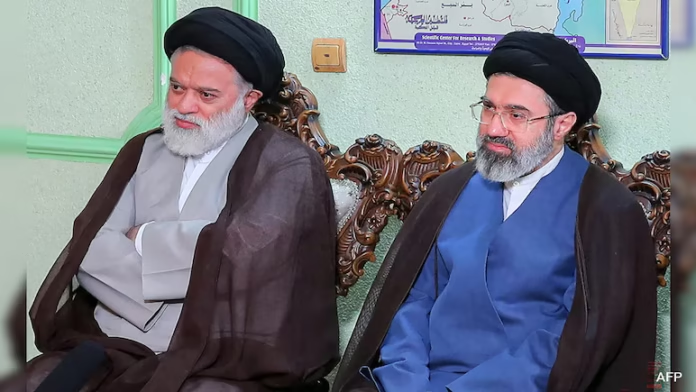

Iran’s political leadership has taken a dramatic and controversial step by elevating Mojtaba Khamenei, the son of slain Supreme Leader Ayatollah Ali Khamenei, as the new supreme leader of the Islamic Republic. The decision by Iran’s powerful Assembly of Experts signals a clear shift toward a more confrontational stance in Tehran at a time when tensions with the United States and Israel are already at their highest level in years.
Ali Khamenei, who had ruled Iran since 1989, was killed earlier this month in a joint US-Israeli military strike, triggering a leadership crisis within the Islamic Republic. Within days, senior clerical authorities moved quickly to ensure continuity by appointing Mojtaba Khamenei as his successor a choice widely seen as reinforcing the dominance of hardline factions within Iran’s political system.
Regional observers say the move sends a strong political message to Washington and its allies. Former US President Donald Trump, who has been closely associated with the current confrontation with Iran, had earlier suggested that Mojtaba would be an “unacceptable” successor.
Despite such pressure, Tehran’s clerical establishment chose to elevate him anyway, a move analysts say reflects Iran’s determination to resist external influence in its leadership decisions.
A Powerful Position in Iran’s Political System
Under Iran’s complex political structure, the supreme leader holds ultimate authority over the state, wielding influence over military strategy, foreign policy, intelligence agencies, and the country’s nuclear programme. The position also oversees Iran’s elected institutions, including the presidency and parliament.
By appointing Mojtaba Khamenei, the Assembly of Experts has effectively ensured continuity within the ruling establishment. Analysts say the transition also reflects the increasing influence of the Islamic Revolutionary Guard Corps (IRGC), which has become one of the most powerful institutions in Iran.
“Mojtaba’s elevation suggests that the system is closing ranks around its most hardline elements,” said Alex Vatanka, a senior fellow at the Middle East Institute.
According to experts, the appointment may also serve to rally nationalist sentiment inside Iran by framing the late Ali Khamenei’s death as a form of martyrdom.
A Leader With Deep Security Ties
Although Mojtaba Khamenei has never held an elected office, he has long been considered one of the most influential figures within Iran’s political and security networks.
Over the years, he developed close ties with senior clerics and commanders within the Revolutionary Guards, often acting as a gatekeeper to his father and playing an important role in shaping internal decision-making.
Analysts have frequently described him as a “shadow power broker” who helped coordinate relations between Iran’s clerical leadership and its security apparatus.
His influence also extended into Iran’s vast economic networks, many of which are controlled by institutions linked to the Revolutionary Guards and religious foundations.
In 2019, the United States Treasury Department imposed sanctions on Mojtaba, accusing him of representing his father’s authority in government affairs despite holding no official position.
Confrontation Instead of Compromise
Many analysts believe Mojtaba’s leadership is likely to push Iran further toward confrontation with Western powers.
His political views have historically aligned with the most conservative elements within Iran’s ruling establishment, particularly those opposed to negotiations with the United States.
Paul Salem, another senior fellow at the Middle East Institute, said the current geopolitical climate makes diplomatic compromise unlikely.
“Anyone emerging from this moment will be deeply shaped by the conflict,” Salem said. “The leadership choice reflects a hardline response to a hardline situation.”
Iranian insiders also suggest that Mojtaba may adopt a tougher domestic approach as he seeks to consolidate authority.
That could include expanded powers for the Revolutionary Guards, tighter social controls and stronger crackdowns on dissent, particularly in response to growing public dissatisfaction.
Domestic Pressures Mount
Even before the recent conflict escalated, Iran was facing significant internal challenges.
The country has been grappling with a weakened economy, high inflation, and a depreciating currency, all of which have contributed to rising poverty levels.
These pressures have fuelled widespread public frustration, leading to protests that some observers described as the most serious unrest since the 1979 Islamic Revolution.
Analysts say Mojtaba’s leadership will likely coincide with heightened security measures aimed at preventing further instability.
“The system will probably tighten its grip internally,” said a regional official familiar with developments in Tehran. “The leadership will prioritise survival above all else.”
A Region Watching Closely
Mojtaba Khamenei’s appointment also carries major implications for the wider Middle East.
Israel has previously warned that Iran’s leadership could remain a military target if the conflict continues to escalate.
Meanwhile, Washington has signalled that its broader strategy toward Iran’s political and military leadership remains under review.
For Gulf states and regional governments, the leadership transition raises concerns about the potential for a prolonged confrontation between Iran and its adversaries.
Some analysts compare the situation to other regimes that survived long periods of isolation and conflict but became increasingly authoritarian in the process.
If Iran’s leadership continues to prioritise confrontation over diplomacy, the region could face a prolonged period of instability.
For now, Mojtaba Khamenei’s rise marks a pivotal moment in Iran’s history one that could shape the country’s political trajectory and its relationship with the rest of the world for years to come.