





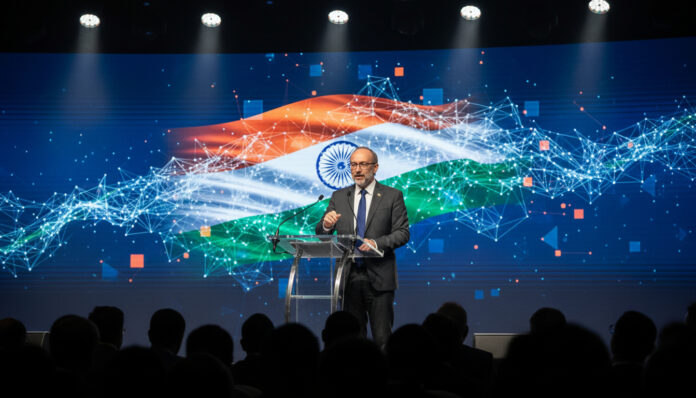

As India sharpens its ambition to become a global leader in artificial intelligence, Wikipedia co-founder Jimmy Wales has offered a perspective that is both enthusiastic and cautionary. Speaking on the sidelines of a major AI summit in New Delhi, Wales praised India’s technological momentum while underscoring the need for human oversight, responsible regulation and the protection of open knowledge ecosystems.
The summit, which drew more than 200,000 registrations and representatives from over 20 countries, reflected what Wales described as the “energy of India.” He acknowledged that he anticipated a large gathering but was surprised by the scale and international participation. For him, the event symbolised India’s growing voice in global technology policy and AI governance debates.
A Nation Powered by People, Not Just Platforms
Wales emphasised that India’s technological edge lies not solely in corporate investment or infrastructure, but in its demographic advantage. With one of the world’s youngest populations and a rapidly expanding digital base, India represents a unique intersection of scale and adoption.
Drawing on his experience building Wikipedia into a global knowledge platform, Wales highlighted India’s outsized contribution to the English-language Wikipedia, ranking third globally. He also noted the vibrancy of contributions across more than two dozen Indic languages, calling linguistic diversity one of India’s strongest assets in the AI era.
Artificial intelligence systems are increasingly being trained to operate across multiple languages, yet significant gaps remain. Wales suggested that India’s multilingual environment offers both a challenge and an opportunity. Improvements in AI translation and language modelling could unlock productivity gains and knowledge access for millions, particularly in rural and underserved communities.
The Human Check on Machine Intelligence
Despite his optimism, Wales was careful not to present AI as an unqualified good. He warned that generative systems, while capable of producing vast amounts of text and data, still require rigorous human validation.
“AI can produce a lot of content,” he said, “but determining whether it is accurate or misleading ultimately demands human judgement.”
This insistence on human oversight echoes Wikipedia’s long-standing editorial philosophy. Unlike algorithm-driven platforms, Wikipedia relies on volunteer editors who debate, verify and refine content through community-driven processes. Wales indicated that this human-centred model remains critical at a time when AI-generated misinformation is proliferating.
He also acknowledged the broader global debate around AI’s role in military systems and weaponisation, though he refrained from offering detailed commentary on defence applications. Instead, he focused on information ecosystems, arguing that unchecked automation in public discourse could amplify falsehoods at unprecedented speed.
Regulation Requires Partnership
With governments worldwide attempting to craft AI safety frameworks from the European Union’s AI Act to regulatory efforts in the United States and China Wales stressed that effective governance cannot be unilateral.
In his view, public-private collaboration is essential. Governments may establish guardrails, but innovation and implementation often reside within the private sector. Without cooperation, regulatory systems risk becoming either overly restrictive or ineffectual.
He advocated policies that not only mitigate risk but actively encourage beneficial applications. Healthcare and research into neglected diseases were cited as areas where AI could make meaningful contributions if guided responsibly.
Combating Misinformation in the AI Age
India’s digital expansion has brought tremendous connectivity but also rising concerns over misinformation. Wales addressed this challenge directly, warning that AI can amplify disinformation just as easily as it spreads knowledge.
He emphasised media literacy as a critical countermeasure. In an environment where content flows rapidly across social media platforms, citizens must develop the habit of verifying sources and valuing professional journalism.
Wikipedia’s editorial standards, built around neutrality, citation requirements and transparent revision histories, were presented as a model for maintaining credibility in a high-speed information age.
Open-Source Innovation and India’s Startup Edge
Looking ahead, Wales suggested that some of AI’s most transformative breakthroughs may come from open-source ecosystems rather than closed, proprietary platforms. He pointed to advancements that allow AI models to run on modest hardware, reducing the need for vast computational infrastructure.
This shift could democratise innovation, enabling startups and smaller enterprises to compete with major technology conglomerates. For India home to one of the world’s largest startup ecosystems such decentralised innovation could be a game changer.
“You don’t have to be the richest companies in the world,” Wales observed. “A smaller startup in India can build something remarkable.”
Wikipedia’s Future in an AI World
When asked about Wikipedia’s own trajectory, Wales reaffirmed that human contributors remain central to its mission. While AI tools are being cautiously explored for administrative or supportive tasks, the community remains wary of relying heavily on automated content generation due to issues such as hallucinations and factual inaccuracies.
The platform’s guiding principle, he reiterated, remains “knowledge for everyone” a vision grounded in collaborative human effort rather than algorithmic automation.
A Personal Note on India
Wales concluded on a personal note, describing India as one of his favourite destinations. He praised Indian volunteers who quietly collaborate with libraries and schools to expand knowledge access beyond metropolitan centres.
In many ways, he suggested, this grassroots spirit mirrors India’s broader AI aspirations: ambitious yet community-driven, technologically advanced yet grounded in human engagement.
As India positions itself at the forefront of AI policy and innovation, Wales’ message offered a nuanced reminder the country’s greatest advantage may not lie solely in algorithms or infrastructure, but in its people.