





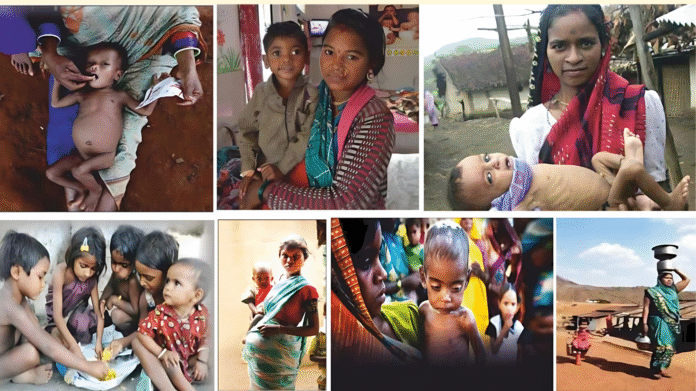

The Bombay High Court has once again placed Maharashtra’s longstanding malnutrition crisis in the spotlight, directing the state government to submit a detailed report on malnutrition among tribal children. The court’s order emphasizes the need to pinpoint affected villages, outline state actions taken so far, and propose a permanent mechanism to address the issue.
The directive comes in response to petitions that have been pending for over two decades, originally filed to address malnutrition in Melghat, a tribal region in Amravati district, and later expanded to include areas like Nandurbar. Despite periodic government interventions, data and ground realities suggest that progress remains painfully slow.
The Court’s Concerns: Two Decades of Delay
A bench of Chief Justice Alok Aradhe and Justice Sandeep Marne expressed frustration over the delay in achieving measurable results, remarking that the court cannot continue to monitor the issue indefinitely.
“How many children have died? We don’t have the latest data,” Chief Justice Aradhe asked pointedly during the hearing.
Advocate Uday Warunjikar, representing one of the petitioners, acknowledged that while some improvements have been made, many villages still struggle with chronic malnutrition. The court has now directed both the state and petitioners to collaborate on a joint report, identifying persistent hotspots and evaluating past interventions.
Why Malnutrition Persists in Tribal Maharashtra
Melghat—a region of 320 villages nestled in the Satpura ranges—remains a stark example of India’s nutritional paradox: rising GDP but stagnant health outcomes.
Studies, including an NCBI-backed survey, reveal alarming figures:
-
54% of children aged 1–5 years are severely to moderately underweight.
-
43% of adults aged 20+ years are also underweight.
-
The under-five mortality rate stands at 70 per 1,000 live births, among the highest in Maharashtra.
One major driver is faulty childcare practices, combined with diets that meet caloric needs but lack micronutrient diversity. Cereals and pulses dominate meals, while green leafy vegetables (GLVs)—key sources of vitamins and minerals—are scarce, especially outside the monsoon season.
“Kitchen gardens that provide vegetables flourish during monsoon (98%) but drop to just 4% in summer,” the study notes, underscoring a clear gap in year-round nutrition.
Additionally, benefits from government schemes like the Integrated Child Development Services (ICDS) and Public Distribution System (PDS) often get diluted when food meant for malnourished children is shared across entire households.
Government Efforts: Falling Short
Maharashtra’s government has implemented various schemes, including Anganwadi services, mid-day meals, and ICDS programs. However, these primarily target hunger rather than nutrition, focusing on calories over quality. Food distribution often suffers from poor quality, inadequate supply, and logistical gaps in reaching remote villages.
In a 2023 directive, the court had ordered authorities to pilot an action plan in 8–10 villages in Melghat and replicate it statewide if successful. While the state submitted data on malnutrition cases and deaths, the court now insists on updated figures and evidence of sustained impact.
Malnutrition’s Long Shadow
Health experts warn that malnutrition is more than a food problem—it’s a multi-sectoral issue tied to poverty, education, healthcare access, and cultural practices.
-
Malnutrition is the underlying cause of 3.5 million child deaths globally each year, with India contributing significantly.
-
It accounts for 35% of the disease burden in children under five, impacting not just survival but cognitive growth and future productivity.
-
Malnutrition in pregnant women perpetuates a cycle of low birth weight infants and poor health outcomes.
Without sustained, community-wide interventions, experts caution that food distribution or income boosts alone will have minimal long-term impact.
What’s Next?
The High Court’s latest order signals a shift toward accountability. It has tasked the government with mapping malnutrition hotspots, reporting on deaths and interventions, and presenting a clear, permanent strategy.
This could include year-round nutrition programs, kitchen garden promotion, culturally sensitive education campaigns, and better integration of existing schemes.
As global studies like the Copenhagen Consensus and Scaling Up Nutrition Movement highlight, investing in child nutrition is among the most cost-effective development strategies—with benefits rippling into health, education, and economic growth.
For now, the court has made one thing clear: Maharashtra’s fight against malnutrition can no longer wait.