





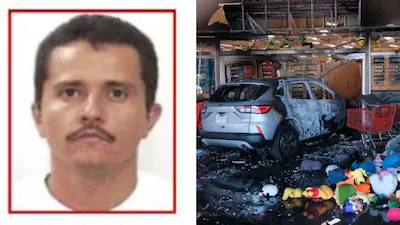

In one of the most consequential operations against organized crime in recent years, Mexican security forces have killed Nemesio Oseguera Cervantes, widely known as “El Mencho,” the leader of the powerful Jalisco New Generation Cartel (CJNG). The high-risk military raid, carried out in the western state of Jalisco, has triggered a wave of retaliatory violence that rippled across multiple regions, disrupting daily life and prompting international advisories.
Mexican defense officials confirmed that Oseguera, 59, sustained critical injuries during a confrontation with armed forces in the town of Tapalpa. He later died while being transported to Mexico City. The operation reportedly involved elite military units, air support from the Mexican Air Force, and intelligence cooperation that included inputs from U.S. agencies.
Authorities described the mission as a strategic strike aimed at dismantling one of the most aggressive criminal networks operating in Mexico. During the raid, at least six suspected cartel gunmen were killed, three soldiers were injured, and two individuals were arrested. Security forces also seized a cache of heavy weaponry, including rocket launchers and high-powered firearms.
A Swift Descent into Chaos
News of El Mencho’s death quickly spread, igniting violent reprisals by suspected CJNG members across Jalisco and neighboring states. Highways were blocked with burning vehicles, businesses shut down abruptly, and plumes of smoke rose over urban areas, including parts of Guadalajara. Gunmen were reportedly seen in several districts, prompting authorities to issue urgent stay-at-home warnings.
The unrest extended beyond Jalisco into Michoacán and the tourist hub of Puerto Vallarta, where reports indicated that thousands of visitors were confined to hotels amid road blockades and sporadic clashes. Public transportation services were suspended in some areas, and international carriers, including United Airlines, American Airlines, and Air Canada, canceled select flights to affected cities.
Mexico’s President Claudia Sheinbaum addressed the nation, urging calm and emphasizing that federal and state forces were working to restore order. She stressed that while disturbances were significant in certain areas, much of the country remained stable.
International Reactions and Travel Advisories
The volatility prompted diplomatic responses. The Indian Embassy in Mexico issued a public advisory urging Indian nationals to avoid unnecessary movement and remain sheltered until further notice. The advisory highlighted ongoing security operations, criminal activity, and road disruptions in Jalisco, Tamaulipas, parts of Michoacán, Guerrero, and Nuevo León.
Citizens were instructed to avoid areas near law enforcement activity, stay away from crowds, monitor verified local news updates, and strictly follow official guidance. In case of emergency, authorities advised dialing 911.
Similar travel advisories were reportedly under review by other nations with citizens in affected regions, particularly given Puerto Vallarta’s status as a major international tourist destination.
Who Was ‘El Mencho’?
Born in 1966, Nemesio Oseguera Cervantes rose from modest beginnings to become one of the most feared figures in global organized crime. After spending time in the United States during the 1980s, he was deported following a drug conviction. Over the following decades, he climbed the ranks of Mexico’s criminal underworld.
By the late 2000s, Oseguera had consolidated power within the Jalisco New Generation Cartel, transforming it into a transnational enterprise with vast influence. CJNG became known for its paramilitary-style tactics, rapid territorial expansion, and aggressive confrontations with rival cartels and state forces.
U.S. authorities had long identified him as a top target, offering a $15 million reward for information leading to his capture. He faced multiple indictments in U.S. federal courts on charges including drug trafficking, weapons offenses, and leading a continuing criminal enterprise responsible for trafficking cocaine, methamphetamine, heroin, and fentanyl.
CJNG’s rise marked a shift in Mexico’s organized crime landscape. Unlike older cartels that preferred strategic discretion, CJNG often displayed overt force, releasing propaganda videos featuring heavily armed fighters and military-grade equipment.
A Turning Point or Temporary Vacuum?
Security analysts caution that while Oseguera’s death represents a significant blow to CJNG’s leadership, it may not immediately dismantle the organization’s operational network. Cartels historically adapt quickly, with power vacuums sometimes triggering internal fragmentation or intensified turf wars.
Experts suggest that the coming weeks will be critical in determining whether this development weakens CJNG’s grip or leads to further instability. Authorities are expected to increase military and police deployments in western Mexico to prevent extended violence.
For now, the killing of “El Mencho” stands as one of the most dramatic chapters in Mexico’s prolonged struggle against organized crime. Whether it marks the beginning of sustained progress or another phase of cartel reconfiguration remains to be seen.