





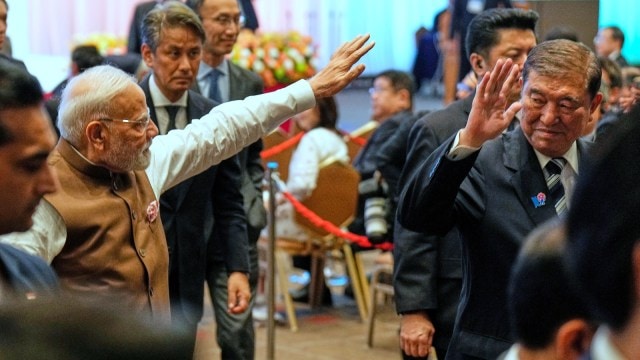

Prime Minister Narendra Modi on Friday joined Japanese Prime Minister Shigeru Ishiba in Tokyo for the India-Japan Economic Forum, underscoring the deepening economic partnership between the two nations. Speaking to industry leaders, Modi outlined a five-point roadmap aimed at taking bilateral cooperation to the next level.
“Japan has always been a trusted partner in India’s development journey. From metros to manufacturing, from semiconductors to startups, our partnership reflects confidence in every sector. Japanese companies have invested more than $40 billion in India,” he said, calling the relationship both “strategic and smart.”
Modi placed India’s economic story at the center of his remarks.
“Over the past eleven years, India has witnessed an unprecedented transformation. Today, India has political stability, economic stability, transparency in policies, and predictability. It is the fastest-growing major economy in the world and soon to become the third-largest,” he noted, crediting the approach of “Reform, Perform, and Transform.”
The Prime Minister then laid out five areas of focus:
-
Manufacturing and New Sectors: expanding cooperation from autos to batteries, robotics, semiconductors, shipbuilding, and nuclear energy, with a special role in the Global South.
-
Technology and Innovation: combining Japan’s strength in technology with India’s talent pool in fields such as AI, quantum computing, and space.
-
Green Energy Transition: collaborating on renewable power, nuclear energy, and green hydrogen as India works toward its 2030 and 2047 energy goals.
-
Next-Generation Infrastructure: highlighting India’s expansion of metro systems and progress on the Mumbai-Ahmedabad high-speed rail project with Japanese support.
-
Skill Development and People-to-People Ties: integrating India’s skilled youth into Japan’s workforce through training and language support.
The two leaders also announced an ambitious new investment target: 10 trillion yen over the next decade, doubling the original goal of 5 trillion yen by 2026—already met a year ahead of schedule. Ishiba stressed the importance of connecting small and medium enterprises and startups from both countries.
Modi concluded with a call to Japanese businesses: “Come, Make in India and Make for the World. Together, India and Japan will help shape the ASEAN century, a century of stability, growth, and shared prosperity.”
This renewed momentum comes at a time when India faces uncertainty over U.S. tariffs, raising concerns about their impact on the domestic MSME sector. For New Delhi, the partnership with Tokyo is not only economic but also strategic—anchoring India in a shifting Indo-Pacific order.