





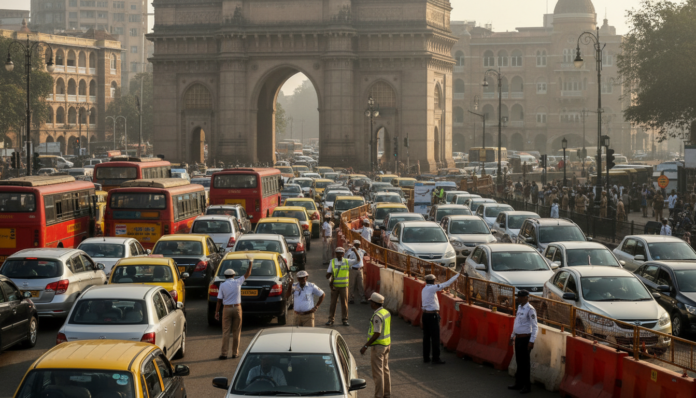

Mumbai is set to witness significant traffic disruptions on Tuesday as Prime Minister Narendra Modi and French President Emmanuel Macron visit the city for high-level engagements linked to the India–France Year of Innovation 2026. The Mumbai Traffic Police have announced extensive road closures, diversions and parking restrictions across South Mumbai and parts of the Western Express Highway, urging commuters to plan travel in advance.
The two leaders are scheduled to hold bilateral meetings at Lok Bhavan around 3:15 pm before jointly inaugurating the India–France Year of Innovation (IFYI) 2026 at the Gateway of India later in the evening. The event is expected to draw business leaders, start-ups, researchers and policymakers, prompting heightened security arrangements and coordinated traffic management.
Restrictions in South Mumbai
Traffic curbs in South Mumbai will remain in effect from 2 pm to 9 pm, covering key arterial roads around the Gateway of India and adjoining areas.
Chhatrapati Shivaji Maharaj Marg has been closed to regular vehicular traffic from Regal Junction, with movement permitted only for emergency vehicles. Similarly, the stretch from Shyama Prasad Mukherjee Chowk will remain shut in both directions except for ambulances and other emergency services.
Pramchandani Marg is also closed between North Court and Adam Street junction, again with exemptions only for emergency vehicles. The segment from Jokhim Alva Chowk to Adam Street junction will not allow regular vehicular movement during the restriction period.
To ease congestion, the traffic police have issued alternative routes for motorists travelling in and around South Mumbai. Vehicles from Regal can proceed via Shahid Bhagat Singh Marg, Mahakavi Bhushan Road and B K Boman Behram Road. Those travelling toward Radio Club from Alva Chowk are advised to use P Ramchandani Marg, Haji Niyaz Azmi Road and Bhid Bhanjan Mandir Road before connecting back through Shahid Bhagat Singh Road and Mahakavi Bhushan Marg.
Motorists may also divert via Jagannath Palav Chowk before taking the turnaround toward Shahid Bhagat Singh Marg and Mahakavi Bhushan Road, depending on their destination.
In a temporary modification, Rambhau Salgaonkar Road, typically a one-way stretch between Indu Clinic Junction and Volga Chowk, will operate as a two-way road between 1 pm and 4 pm to facilitate smoother dispersal.
Parking and Public Transport Impact
Multiple roads have been declared no-parking zones for the day. These include Nathalal Parekh Road, Jagannath Bhosle Road, Captain Prakash Pethe Road, Rambhau Salgaonkar Road, Shahid Bhagat Singh Road and B K Boman Behram Marg. Additionally, the stretch behind Hotel Taj from Raobahadur Desai Chowk to Hotel Diplomat has also been designated a no-parking area.
Taxi stands and BEST bus stands located at Adam Street and Indu Clinic Junction will remain closed during the restriction window. Taxi and BEST bus stands at Adam Street and P Ramchandani Marg will also not operate while the curbs are in place. Commuters relying on public transport in the Fort and Colaba areas have been advised to check updated routes and schedules issued by BEST.
Restrictions on Western Express Highway
Traffic measures extend beyond South Mumbai. In the Western suburbs, the movement of heavy vehicles has been completely prohibited on both northbound and southbound carriageways of the Western Express Highway between Vakola flyover and Dahisar toll naka from 8 am to 9 pm.
The ban is intended to ensure a smoother passage for official convoys and reduce congestion on one of Mumbai’s busiest corridors. However, ambulances, fire brigade vehicles, police vehicles and government vehicles deployed for VVIP security are exempt from these restrictions.
Commuters travelling between the city and suburbs during peak hours are likely to experience slowdowns, particularly near junctions connecting to the highway. Traffic police have advised motorists to allow additional travel time and, where possible, use alternative routes or public transport.
Security and Coordination
The visit by the French President is part of a broader diplomatic engagement aimed at strengthening bilateral cooperation in innovation, technology, defence and climate action. Given the high-profile nature of the event, multiple security agencies have coordinated with local police to implement layered security measures.
Officials said traffic management plans were designed after assessing anticipated crowd movement around the Gateway of India and key government venues. Barricades and diversion signage have been installed at strategic points, and traffic personnel will be deployed across affected zones to guide motorists.
Advisory to Citizens
Mumbai Traffic Police have urged residents to stay updated through official social media channels and helplines for real-time advisories. Citizens attending the Gateway of India event have been advised to use designated parking facilities and public transport options where feasible.
Office-goers and daily commuters in South Mumbai are encouraged to adjust work timings or opt for remote work arrangements, if possible, to avoid peak restriction hours.
While the curbs are temporary, they are expected to significantly affect evening travel across central business districts and major arterial roads. Authorities have assured that normal traffic flow will be restored once official movements conclude.
As Mumbai hosts a key diplomatic event symbolising India–France collaboration in innovation, the city’s transport network will operate under tight coordination a reminder of the logistical demands that accompany high-level international visits.