





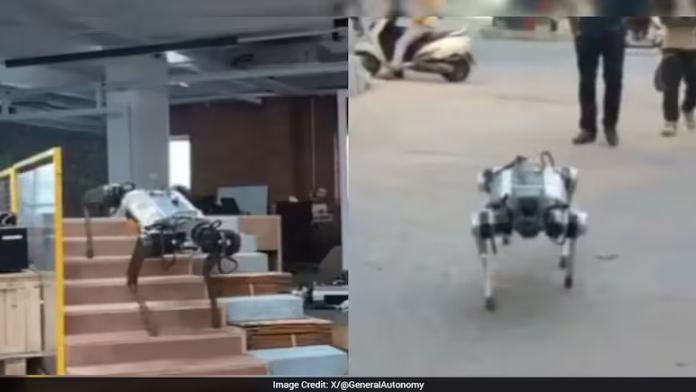

A Bengaluru-based robotics startup has thrust itself into the spotlight at the India AI Impact Expo 2026 by unveiling what it calls India’s most powerful indigenous quadruped robot. Named Param, the four-legged machine has quickly drawn attention online for both its rugged design and the company’s emphatic claim that it was “built from scratch” by Indian engineers.
Developed by deep-tech firm General Autonomy, Param was showcased last month before Prime Minister Narendra Modi during a National Startup Day event marking a decade of the Startup India initiative. The robot’s public demonstration at the AI Expo in New Delhi has now reignited discussion about India’s growing ambitions in robotics and advanced autonomous systems.
Built, Not Assembled
In a post shared on social media platform X, the company asserted that Param represents a departure from imported hardware being assembled domestically. “Not assembled, not bought built in India,” the startup declared, underscoring its emphasis on indigenous engineering.
According to the founders, development of the quadruped platform began roughly seven months ago, though they clarified that the timeline is difficult to isolate. The team reportedly leveraged experience and design learnings from earlier humanoid robotics projects, accelerating Param’s iteration cycle.
The company says it continues to refine the system every fortnight, indicating an agile development process typical of robotics startups seeking to rapidly test and upgrade hardware-software integration.
Designed for Real-World Terrain
Videos circulating from the expo and earlier demonstrations show Param navigating busy Bengaluru streets, detecting obstacles autonomously, and adjusting its gait dynamically. The robot is capable of climbing steps up to 30 centimetres, performing “crab walking” manoeuvres to squeeze through low-clearance areas, and recovering from falls without manual intervention.
Such mobility is central to quadruped robotics. Unlike wheeled or tracked machines, four-legged platforms can maintain balance across uneven surfaces, climb stairs, and traverse debris-laden environments.
Param’s capabilities reportedly include:
-
Autonomous navigation and obstacle avoidance
-
Payload support for sensors or logistics tasks
-
Adaptive gait modes for constrained spaces
-
Self-righting after instability or falls
While detailed technical specifications including payload limits, onboard processing power, or battery endurance have not been fully disclosed, company representatives describe the robot as rugged and field-ready.
A Growing Quadruped Ecosystem
Quadruped robots, often referred to as “robodogs,” are increasingly being deployed worldwide in sectors where human access is limited or hazardous. They are used for:
-
Industrial inspection in oil refineries and power plants
-
Search-and-rescue missions in disaster zones
-
Defence logistics and perimeter monitoring
-
Academic and applied robotics research
Global leaders in the segment include U.S.-based Boston Dynamics and Chinese manufacturer Unitree Robotics. The entry of Indian startups into this space signals a push to reduce reliance on imported systems and build domestic capability in robotics hardware.
Industry observers note that developing a quadruped robot from scratch involves complex coordination across mechanical design, embedded electronics, control systems, and AI-based perception an undertaking that demands both capital and specialised talent.
Political and Strategic Significance
Param’s demonstration before Prime Minister Modi adds symbolic weight to the project. The Startup India programme has increasingly emphasised deep-tech innovation spanning AI, semiconductors, space technology and robotics as critical pillars of India’s economic future.
During the earlier event, company representatives said the Prime Minister encouraged the team to continue developing the platform and jokingly advised them to “take care of Param in Delhi winters.”
Beyond symbolism, robotics has strategic implications. Autonomous systems are central to modern defence, disaster management and industrial automation. As India positions itself as a global technology manufacturing hub, indigenous robotics platforms could play a role in national security supply chains and export markets.
AI and Autonomy
Although Param is fundamentally a mechanical platform, its capabilities depend heavily on artificial intelligence. Autonomous navigation, object detection and balance control require machine vision, sensor fusion and real-time motion planning algorithms.
India’s AI ecosystem has grown rapidly over the past five years, supported by venture capital investments, cloud infrastructure expansion and government policy initiatives. Startups like General Autonomy appear to be capitalising on this environment by integrating AI with robotics hardware.
However, experts caution that commercial viability will hinge on reliability testing, safety certification, cost competitiveness and scalable manufacturing.
The Road Ahead
While early demonstrations are promising, sustained success will depend on whether Param transitions from a prototype into a production-ready system with defined use cases. Industrial contracts, defence partnerships or research collaborations could determine the trajectory.
India’s robotics ecosystem remains nascent compared to global leaders, but projects like Param suggest a maturing ambition one that blends mechanical engineering with AI innovation.
If the startup can maintain development momentum and secure institutional backing, Param may represent more than a viral social media moment. It could signal the beginning of a broader domestic robotics push aligned with India’s deep-tech aspirations.