





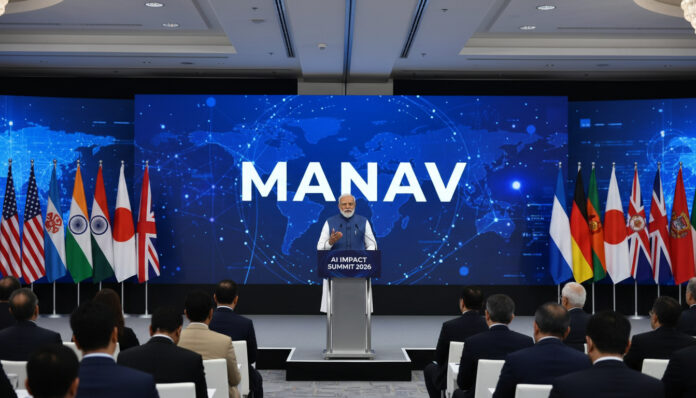

Prime Minister Narendra Modi on Thursday articulated India’s strategic approach to artificial intelligence, presenting a five-pillar framework called “MANAV” at the AI Impact Summit in New Delhi. Addressing a global audience of policymakers, technologists, academics and industry leaders, the Prime Minister positioned India not only as a fast-growing AI economy but as a country seeking to shape the moral and governance architecture of emerging technologies.
The summit, being held from February 16 to 20 at Bharat Mandapam, has brought together more than 500 global AI leaders, 150 academics and researchers, and hundreds of technology executives and philanthropists. The gathering is widely seen as India’s most ambitious attempt yet to influence global conversations around artificial intelligence policy, safety and innovation.
A Human-Centric Vision
In his keynote address, PM Modi introduced “MANAV” the Hindi word for “human” as an acronym representing five core principles that should guide AI development: Moral and Ethical Systems; Accountable Governance; National Sovereignty, especially over data; Accessible and Inclusive Technology; and Valid and Legitimate Systems.
Framing the initiative as distinctly human-centric, he argued that artificial intelligence must be developed with ethical guardrails and societal benefit at its core.
“Artificial Intelligence is not merely about making machines intelligent,” he said. “It is about enhancing human capability manyfold. The technology must empower people, not replace their values.”
He drew a historical parallel with the invention of wireless communication, noting that early pioneers could not have imagined how deeply connected the world would become. AI, he suggested, represents a transformation of similar magnitude but unfolding at unprecedented speed.
“What we are seeing today is only the beginning,” he said. “The pace at which this technology is evolving is unlike any previous industrial or technological shift.”
Speed, Scale and Responsibility
The Prime Minister underscored how the lifecycle of technological disruption has dramatically shortened. Innovations that once took decades to mature now spread globally in a matter of years. The evolution from machine learning to advanced generative systems, he observed, demonstrates how quickly capabilities are expanding.
Yet with that acceleration comes responsibility.
“We are entering an era where humans and intelligent systems will co-create, co-work and co-evolve,” he said, adding that governance frameworks must evolve just as rapidly to ensure trust and transparency.
By emphasising accountable governance and valid systems, the MANAV framework signals India’s intention to balance innovation with oversight an issue that has divided global policymakers. While the European Union has taken a regulation-first approach and the United States has largely favoured industry-led innovation, India appears to be advocating a middle path grounded in collaboration.
Data Sovereignty and Inclusion
One of the more pointed elements of the MANAV framework is national sovereignty, particularly regarding data ownership. As countries grapple with cross-border data flows, cybersecurity and digital colonialism concerns, India’s emphasis on sovereign data rights reflects its broader digital governance priorities.
At the same time, Modi stressed accessibility and inclusion arguing that AI must not widen global inequality. For a country with vast linguistic diversity and socioeconomic contrasts, inclusive AI development remains central to India’s domestic digital agenda.
The Prime Minister highlighted India’s growing digital infrastructure, including its expanding startup ecosystem and large base of software engineers, as foundational strengths in the AI era. He suggested that emerging economies have a unique opportunity to leapfrog traditional development barriers by integrating AI into healthcare, agriculture, education and public services.
Global Participation
The summit’s scale underscores India’s ambition to position itself as a convening power in the AI domain. United Nations Secretary-General António Guterres and International Monetary Fund Managing Director Kristalina Georgieva were among prominent global figures welcomed by PM Modi at the venue.
The five-day event features policy dialogues, technical workshops, industry showcases and multilateral discussions focused on responsible AI, global standards and innovation ecosystems. Organisers say participation includes chief technology officers, venture capital leaders and public-sector officials from across continents.
By hosting the summit, India is signaling that it wants a seat at the table where global AI norms are defined particularly as debates intensify over AI safety, misinformation, automation risks and intellectual property rights.
Strategic Positioning
The MANAV vision reflects a broader geopolitical strategy. As major powers compete for dominance in semiconductor supply chains, AI research and advanced computing infrastructure, India is aiming to combine scale with credibility.
Rather than framing AI purely as an economic opportunity, the Prime Minister’s speech positioned it as a civilisational shift requiring ethical stewardship. This narrative aligns with India’s longstanding diplomatic approach of advocating balanced multilateralism and representation for the Global South.
Whether MANAV evolves into a formal policy architecture or remains a guiding philosophy will depend on follow-through including regulatory frameworks, investment commitments and international collaboration.
For now, the summit marks a pivotal moment in India’s technological diplomacy. As AI systems increasingly shape economies, governance and public discourse, the debate is no longer about adoption alone but about direction. In articulating the MANAV framework, India has staked a claim in defining that direction.