





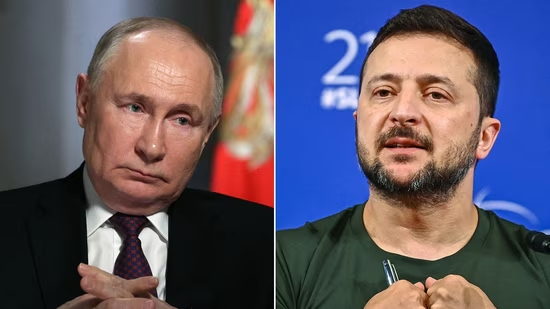

In a striking departure from his usual rhetoric, Russian President Vladimir Putin on Thursday extended an invitation to Ukraine for peace talks in Russia, pledging full security guarantees for Kyiv’s delegates. The announcement, made in Vladivostok at an economic forum, marks one of the few occasions in the three-year war that Moscow has openly signaled readiness to host negotiations.
What makes Putin’s statement more remarkable is his rare acknowledgment that Ukraine has the legal right to seek membership in the European Union. This is a subtle but significant shift. For years, Russia has drawn a red line at Ukraine’s westward tilt, portraying EU and NATO aspirations as existential threats. To hear Putin say otherwise suggests a recalibration, at least rhetorically.
Yet, this olive branch comes with thorns. Putin was unequivocal that any Western troops stationed in Ukraine—even under the guise of a postwar security guarantee—would be considered “legitimate targets” by Moscow’s military. This warning came just a day after French President Emmanuel Macron announced that 26 countries had pledged to provide Ukraine with long-term security commitments, including possible international forces across land, sea, and air.
Between Diplomacy and Deterrence
The juxtaposition is telling. On one hand, Putin is extending the prospect of peace talks; on the other, he is reasserting Russia’s hard military lines. It is diplomacy and deterrence, offered in the same breath.
The timing is equally crucial. With the war grinding into its fourth year, both Ukraine and its allies are looking for a way to lock in security guarantees that will last beyond the battlefield. Russia, meanwhile, is keen to shape that conversation on its own terms, especially as Western powers coordinate around a possible “postwar” order.
Whether Kyiv will take up Moscow’s invitation remains uncertain. Ukrainian President Volodymyr Zelensky has repeatedly said that any negotiations must respect Ukraine’s sovereignty and territorial integrity, principles that Russia has consistently violated since it annexed Crimea in 2014 and full-scale invasion in 2022.
For now, Putin’s remarks add a new layer of complexity to an already tangled conflict: a gesture toward peace cloaked in the language of continued confrontation.