





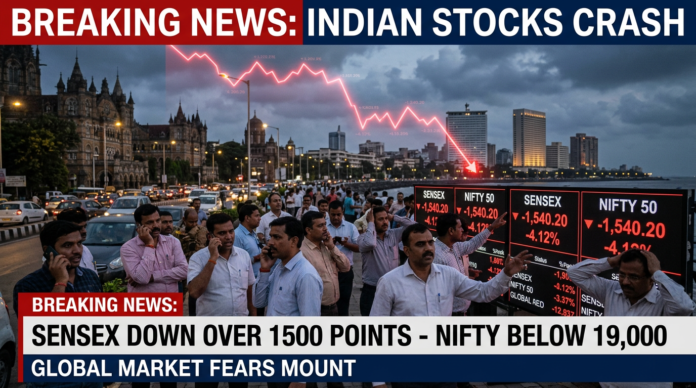

Indian financial markets witnessed sharp volatility on Monday as escalating geopolitical tensions in West Asia and surging crude oil prices triggered widespread selling across sectors. Investor sentiment weakened significantly amid growing concerns over potential disruptions in global energy supply, with benchmark indices falling sharply in early trade.
The S&P BSE Sensex plunged 1,650 points to 72,882.80, while the Nifty 50 dropped 532 points to 22,583.20 during morning trading. The decline reflected a broad-based sell-off, with losses seen across metal, banking, auto, and consumer sectors. Midcap and smallcap stocks also came under pressure, underscoring widespread risk aversion among investors.
Market participants attributed the sell-off primarily to rising uncertainty around the Strait of Hormuz, a vital maritime corridor through which a significant portion of global crude supply passes. Renewed warnings about potential disruptions in the region have heightened fears of a prolonged energy shock, particularly for oil-importing economies like India.
Crude oil prices surged above $110 per barrel, intensifying inflationary concerns. Higher energy costs tend to ripple across the economy, pushing up transportation expenses, manufacturing costs, and retail prices. For India, which relies heavily on imported crude, the impact is particularly pronounced. Analysts warn that sustained high oil prices could widen the current account deficit, weaken fiscal balances, and dampen economic growth.
The currency market reflected similar stress. The Indian rupee slipped to a record low against the US dollar, compounding the economic challenge. A weaker rupee increases the cost of imports, including crude oil, thereby adding further pressure on inflation. Currency volatility also affects foreign investor sentiment, often leading to capital outflows from emerging markets.
According to V.K. Vijayakumar, the ongoing conflict has triggered a global “risk-off” environment. Investors are moving away from equities toward safer assets, reflecting uncertainty about the duration and scale of geopolitical tensions. He noted that the absence of clarity regarding the conflict’s resolution is likely to keep markets volatile in the near term.
The sell-off was widespread across sectors. The Nifty Metal index declined nearly 4 percent, emerging as the worst-performing segment. Metal companies tend to be sensitive to global growth expectations, and fears of economic slowdown triggered heavy selling. Public sector banks also witnessed sharp declines, while financial stocks remained under pressure amid concerns over credit growth and liquidity.
Auto and real estate stocks recorded notable losses as well. These sectors are particularly vulnerable to rising interest rates and inflation, both of which could be influenced by sustained high oil prices. Consumer durables companies also slipped, reflecting expectations of weaker discretionary spending.
Midcap and smallcap indices fell close to 3 percent, indicating that the downturn was not limited to large-cap stocks. Such broad-based selling often signals a shift in investor sentiment rather than isolated profit booking. Traders reported increased hedging activity and cautious positioning as volatility rose.
Among individual stocks, Tata Steel emerged as one of the biggest losers, dropping more than 4 percent in early trade. Other major decliners included Adani Ports, Bajaj Finance, Titan Company, and Bharat Electronics. These losses reflected sector-specific concerns as well as broader market weakness.
In contrast, information technology stocks displayed relative resilience. Companies such as HCL Technologies and Tata Consultancy Services posted modest gains, benefiting from their export-oriented business models. IT firms often act as defensive plays during currency depreciation, as a weaker rupee boosts their dollar-denominated revenues.
Market volatility surged sharply, with the India VIX index rising over 14 percent. The spike indicates heightened uncertainty and expectations of large price swings in the near term. Elevated volatility typically discourages aggressive risk-taking and encourages investors to adopt defensive strategies.
Global markets have also been reacting nervously to developments in West Asia. Investors are closely monitoring the trajectory of the conflict and its impact on oil supply routes. Any escalation affecting shipping lanes could further push crude prices higher and intensify market stress.
For Indian investors, domestic fundamentals currently appear secondary to global developments. Institutional flows, currency movements, and oil prices are driving sentiment more than corporate earnings or macroeconomic data. Analysts suggest that until geopolitical clarity emerges, markets may continue to experience sharp swings.
Despite the current volatility, long-term investors are being advised to remain cautious but not panic. Market corrections during geopolitical events are not uncommon, though the duration depends on how quickly tensions ease. In the meantime, defensive sectors and export-oriented companies may continue to attract interest.
As the conflict enters another week and energy markets remain on edge, Dalal Street is likely to stay sensitive to global cues. With oil prices elevated and the rupee under pressure, investors are bracing for continued volatility in the days ahead.